
What BACnet Is
BACnet is an open building automation protocol standardized in ASHRAE 135. It models data as typed objects and properties rather than as raw register addresses, which makes it well suited to HVAC, lighting, metering, and supervisory building-management workflows.
Its practical advantage is discoverability. Services such as Who-Is, I-Am, ReadProperty, and COV give engineers a richer protocol surface than simpler polling-oriented protocols such as Modbus.
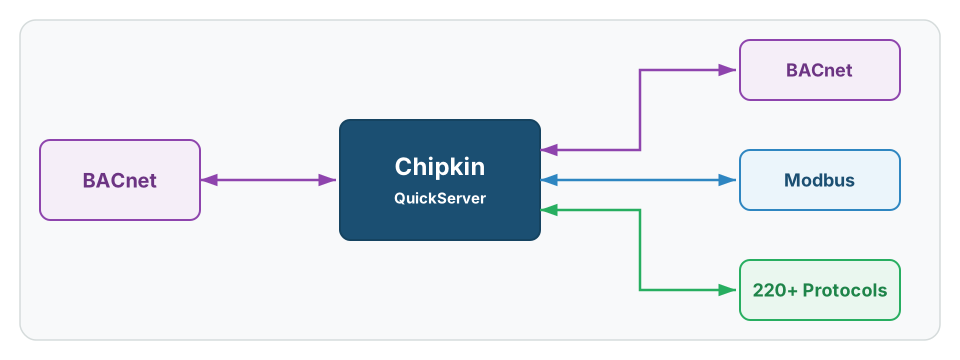
See QuickServer for BACnet protocol conversion options
For Chipkin-specific commissioning and field diagnostics, use the Troubleshooting Guide for BACnet MS/TP Networks and the BACnet Discovery & Network Architecture Reference.
History
BACnet was developed inside ASHRAE to solve a long-running building-automation interoperability problem: vendors could exchange physical wiring and serial links, but not a common data model. The standard reached ANSI/ASHRAE 135 in the mid-1990s, later aligned with ISO 16484-5, and formalized objects, properties, services, and conformance patterns so supervisory systems and field devices could integrate without every job becoming a proprietary one-off.
That history still matters onsite. BACnet projects are rarely blocked by the protocol existing at all. They are blocked by object modeling, network architecture, transport choice, or discovery assumptions.
Core Concepts
BACnet integrations are built around four ideas:
- Object type and instance: for example
analogInput:12orbinaryValue:30, with object identity tied to the BACnet device instance plan. - Property model: for example
presentValue,units, andstatusFlags, which explain what each object actually exposes. - Service model: discovery, read, write, alarm, trend, and subscription behavior, including Who-Is, I-Am, and COV.
- Network layer behavior: BACnet/IP, BACnet MS/TP, and routed-network design through tools such as BBMD and FDR.
If a BACnet job behaves strangely, the root cause is often not packet transport alone. It is usually an object-model mismatch, discovery-path mismatch, duplicate instance problem, or a supervisory-system expectation that does not match the exposed device behavior.
BACnet-Specific Information
BACnet is deeper than transport selection alone. Current revisions define more than 60 standard object types, several discovery and data-sharing service groups, and a conformance framework that matters when a project specification assumes certain behaviors.
Common Object Families
| Object Family | Examples | Why Support Teams Care |
|---|---|---|
| Analog objects | analogInput, analogOutput, analogValue | Common for temperatures, setpoints, pressures, and engineering values that need units and status handling |
| Binary and multi-state objects | binaryInput, binaryOutput, binaryValue, multiStateValue | Common for alarms, modes, command states, enable bits, and occupancy logic |
| Device and network objects | device, networkPort | Define device identity, addressing context, and transport-facing behavior |
| Schedules and calendars | schedule, calendar | Often drive supervisory schedules, exceptions, and occupancy strategies |
| Trending and alarms | trendLog, trendLogMultiple, notificationClass, eventEnrollment | Matter when a BMS expects event routing, history collection, or alarm acknowledgement workflows |
For deeper protocol-mechanics coverage, use BACnet Objects and BACnet Device Instance.
Core Service Groups
| Service Group | Examples | Why It Matters |
|---|---|---|
| Discovery | Who-Is, I-Am, Who-Has, I-Have | Establishes whether devices and objects can be found from the actual production path |
| Data access | ReadProperty, ReadPropertyMultiple, WriteProperty | Core read and write workflow for almost every BACnet integration |
| Change and event handling | SubscribeCOV, COV notifications, EventNotification, alarm acknowledgement | Determines whether the integration can be event-driven instead of strictly polled |
| Device management | DeviceCommunicationControl, ReinitializeDevice, time synchronization services | Useful for commissioning, restart behavior, and operational maintenance |
For deeper protocol-mechanics coverage, use BACnet Who-Is, BACnet I-Am, and BACnet COV.
Conformance and Testing
On serious BACnet jobs, “supports BACnet” is not enough. Support teams usually need the device PICS, the relevant BIBBs, and confirmation that the device behavior matches the services the BMS expects.
The BTL certification program exists to reduce that risk. BTL-recognized test labs validate products against BACnet conformance test packages, and the public BTL listing is a practical way to confirm whether a device was independently tested for interoperability assumptions that often show up in specifications.
Common Variants
| Variant | Where It Fits | Why It Matters |
|---|---|---|
| BACnet/IP | Ethernet and routed supervisory networks | Most common choice for workstations, front ends, and IP controllers |
| BACnet MS/TP | RS-485 controller trunks | Common field-level transport for unitary and plant controllers |
| BACnet/SC | Security-focused IP deployments | Relevant when IT policy requires TLS and brokered secure transport, even though this topic remains inline for now |
How To Get The Points List
BACnet is one of the more discoverable protocols in building automation, but a discovered object list is not automatically a finished engineering scope.
Preferred sources, in order:
- Live discovery with CAS BACnet Explorer or YABE
- Existing BMS export or commissioning database
- Vendor object list, PICS, or engineering submittal
- Packet capture and device browse when the site has a partially working system but poor paperwork
Use discovery to build the initial object list, then verify writable behavior, units, naming, and object purpose against the real supervisory intent.
[!TIP] BACnet gives you a discoverable object list. It does not guarantee that object naming, writable behavior, or semantic meaning are already clean enough for handoff.
Devices that Support BACnet
QuickServer is Chipkin’s primary gateway for exposing non-BACnet systems as BACnet-facing points and for moving BACnet data into other protocol ecosystems.
BACnet/IP: Automated Logic WebCTRL, Argus Control Systems, Neptronic SK-300 steam humidifier, Silent-Aire cooling units
BACnet MS/TP: Alerton ACM, Veris E50H5 electric meter, Trane RTAC chiller, Trane UC600, Daikin chiller
Common Integration Targets
- Modbus when a BACnet-facing BMS must exchange data with register-based field devices
- EtherNet/IP when PLC and industrial points need to surface in a building-management workflow
- LonWorks when retrofit projects need a common supervisory layer across mixed legacy building systems
Tools & Diagnostics
| Tool | Type | Description |
|---|---|---|
| CAS BACnet Explorer | Explorer | Browse devices, objects, properties, read/write behavior, and discovery responses |
| Wireshark | Packet analyzer | Inspect BACnet/IP traffic, broadcast paths, and packet-level failure patterns |
| YABE | Explorer | Lightweight open-source BACnet browser for validation and comparison |
| QuickServer | Gateway and diagnostics platform | Convert BACnet data to Modbus, MQTT, SNMP, and 220+ other protocols while exposing diagnostics that help isolate source-side versus target-side issues |
Frequently Asked Questions
What is the difference between BACnet/IP and BACnet MS/TP?
BACnet/IP runs on Ethernet and routed IP networks. BACnet MS/TP runs on RS-485 token-passing trunks and is common at the field-controller layer.
Why can one tool discover a BACnet device while a BMS cannot?
That usually points to discovery-path differences: the wrong network adapter, blocked UDP 47808 traffic, BBMD or FDR gaps, or a unicast-versus-broadcast discovery interoperability issue. Start with the BACnet Discovery & Network Architecture Reference.
When do I need BBMD?
You need BBMD when BACnet/IP discovery must cross subnet boundaries. Without it, Who-Is and I-Am stay local to one broadcast domain.
How do I avoid BACnet Device Instance conflicts?
Maintain a documented Device Instance plan by building, system, or deployment family. Duplicate instances create discovery and control anomalies that are difficult to diagnose later.
What does BTL certification mean for a BACnet project?
BTL certification means a product was independently tested against BACnet conformance requirements and interoperability expectations defined by the certification program. It does not replace project-specific validation, but it does reduce risk when a specification expects certain discovery, object, or service behavior.
Reference Documents
- BACnet International for current community resources, implementation guidance, and training links
- ASHRAE 135 BACnet Standard for the formal protocol definition
- ANSI/ASHRAE 135.1 Method of Test for Conformance to BACnet for formal conformance test requirements
- BTL Certification for certification workflow and independently tested product listings
- The BACnet Institute for self-paced BACnet training and implementation references
Related Pages
- BACnet/IP
- BACnet MS/TP
- BACnet Who-Is
- BACnet I-Am
- BACnet COV
- BACnet Device Instance
- BACnet Objects
- BACnet BBMD
- BACnet FDR
- BACnet Max Masters
- BACnet Token Passing
- BACnet Discovery & Network Architecture Reference
- BACnet Object Types & Properties Reference
- Troubleshooting Guide for BACnet MS/TP Networks
