
A manufacturing site needed Allen-Bradley PLC alarm data exposed to a Johnson Controls Metasys BACnet/IP building management system. Chipkin QuickServer turned Allen-Bradley DINT arrays and bit-level status points into a usable BACnet/IP handoff the site team could validate from both sides.
This was a plant-floor integration, not a lab exercise. The customer had to bridge Allen-Bradley production-side data into a BAS environment, keep the PLC and BACnet networks separate, and make sure each DINT-based alarm became a meaningful BACnet object instead of an opaque integer value.
At a Glance
- Industry: Manufacturing / industrial automation
- Customer: Manufacturing controls and building automation team
- Facility type: Production facility
- Client role: PLC and BAS integration stakeholders
- Project scale: Allen-Bradley alarm and status arrays exposed to a Metasys BACnet/IP BMS
- Protocols: From: EtherNet/IP -> To: BACnet/IP
- Chipkin product: Chipkin QuickServer Dual Ethernet FS-QS-2X10
- Project start: February 2023
- Internal reference: FSE15841
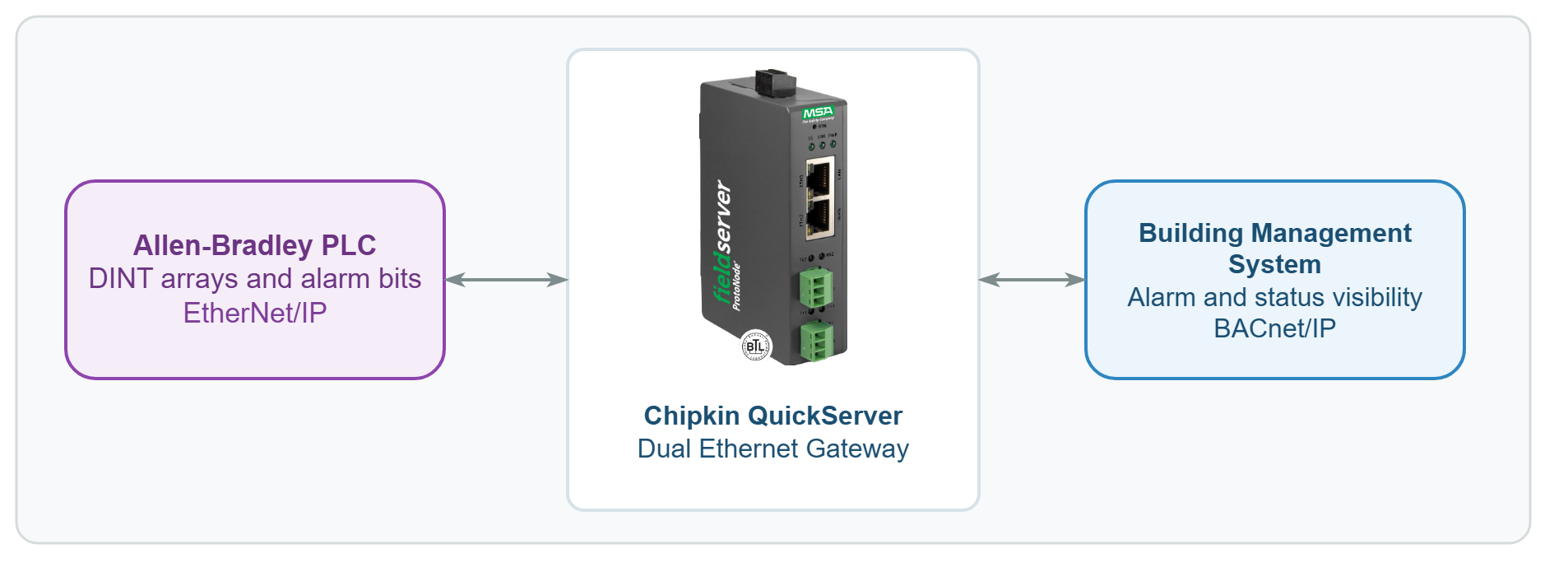
Allen-Bradley PLC -> EtherNet/IP -> Chipkin QuickServer -> BACnet/IP -> Metasys BMS
EtherNet/IP to BACnet/IP Challenge
The upstream/server side was an Allen-Bradley PLC programmed in Studio 5000. The downstream/client side needed those Allen-Bradley values on a BACnet/IP building management system. The project therefore depended on more than basic connectivity. It required a clean way to translate Allen-Bradley DINT arrays into BAS-friendly alarm and status objects.
The central challenge was data structure. The Allen-Bradley PLC stored multiple alarm states inside DINT arrays, including status groups that had to be represented as distinct BACnet objects. That is a common manufacturing protocol conversion problem: the PLC is optimized for control logic, while the BAS expects discoverable alarm points that can be trended and consumed cleanly.
There was also an architecture constraint. The Allen-Bradley PLC network and the Metasys BACnet/IP network lived on different IP segments, which made dual-port gatewaying part of the delivered design. The team had to preserve that network separation while still making the EtherNet/IP data available to the BACnet side.
Why Chipkin for EtherNet/IP to BACnet/IP Integration
This project fit Chipkin because it combined Allen-Bradley PLC-side data modeling with BAS-side presentation requirements. QuickServer provided the protocol gateway, but the real value came from translating Allen-Bradley DINT arrays into a BACnet/IP structure that the site team could use without reworking the plant controls strategy.
Chipkin support also worked in the collaborative middle ground that these projects often require. The BAS side, the Allen-Bradley PLC side, and the gateway side all had to line up. Chipkin helped keep the handoff moving while the customer’s PLC engineering team refined the source transfer structure and the BAS team validated the resulting BACnet/IP presentation.
The Solution: QuickServer EtherNet/IP to BACnet/IP Bridge
Chipkin configured Chipkin QuickServer to read Allen-Bradley PLC data over EtherNet/IP and then expose the relevant points to the downstream Metasys BACnet/IP BMS. The design used separate network paths for the Allen-Bradley PLC and BAS sides so the customer did not have to collapse existing network boundaries to make the protocol gateway work.
The implementation focused on translating Allen-Bradley DINT-based alarm arrays into BAS-friendly BACnet objects. That meant aligning the Allen-Bradley data layout, the QuickServer mapping, and the BACnet-side expectations until the alarm and status points presented cleanly on the destination system.
For another EtherNet/IP deployment, see the EtherNet/IP to BACnet/IP EMS Heartbeat Tuning case study.
PLC-to-BMS Integration Results
The project delivered a working EtherNet/IP to BACnet/IP handoff for a production facility.
Project proof points:
- Allen-Bradley DINT arrays were turned into usable BACnet/IP alarm and status objects.
- Dual-network connectivity preserved separate Allen-Bradley PLC and Metasys BMS network paths.
- Bit-level alarm data became usable from the BAS side instead of remaining trapped inside PLC arrays.
- The customer confirmed smooth BACnet/IP operation after final validation on both the PLC and BMS sides.
The final customer confirmation was clear:
“I was able to get everything talking on the Metasys side and I believe Bishop was able to get the PLC side working. The information seems to be coming through smoothly at this point.”
— Building automation engineer
Have a Similar EtherNet/IP-to-BACnet Project?
Need to expose Allen-Bradley PLC data to a BACnet/IP BAS without rewriting the plant controls architecture? Chipkin can help with QuickServer mapping, dual-network gatewaying, and protocol conversion for PLC-to-BMS integrations. Tell us about your project.
Frequently Asked Questions
Can QuickServer convert EtherNet/IP to BACnet/IP?
Yes. QuickServer can be used as an EtherNet/IP to BACnet/IP protocol gateway. In this deployment, Chipkin used that path to expose Allen-Bradley PLC alarms to a Metasys BACnet/IP system.
Can QuickServer expose Allen-Bradley DINT array alarms as BACnet objects?
Yes. This project specifically depended on turning Allen-Bradley DINT arrays and bit-level status values into BACnet/IP alarm objects that the BAS could consume more easily.
Can QuickServer keep the PLC network and BAS network separate?
Yes, when the project uses the right hardware. In this case, the Dual Ethernet QuickServer preserved separate Allen-Bradley PLC and BACnet/IP network paths while still serving the required data downstream.