
A remote HVAC facility needed live Modbus RTU chiller data exposed to a BACnet/IP building management system. Chipkin QuickServer helped the field team bridge the serial device to the BAS and validate control points during a focused remote support session at a hard-to-access site.
This was not a routine serial gateway install. The site was remote, technician access was limited, and the integration still had to work against a live BMS environment once the team was finally on location.
At a Glance
- Industry: HVAC / building automation
- Customer: HVAC service and building systems integration team
- Facility type: Remote border-crossing facility
- Client role: Field service and controls stakeholders
- Project scale: Remote-site chiller integration with live BAS validation
- Protocols: From: Modbus RTU -> To: BACnet/IP
- Chipkin product: Chipkin QuickServer / FieldServer gateway
- Project start: October 2025
- Internal reference: FSE22302
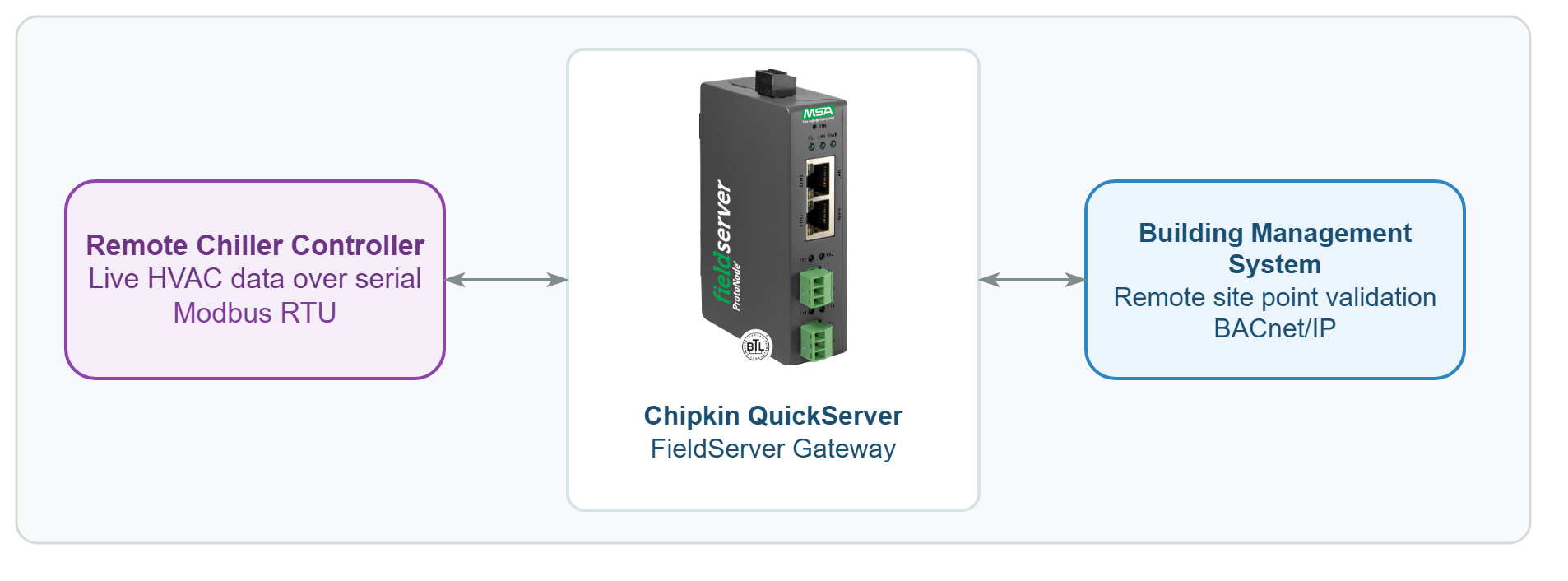
Remote chiller controller -> Modbus RTU -> Chipkin QuickServer -> BACnet/IP -> BMS
Modbus RTU to BACnet/IP Challenge
The upstream/server side was a remote Modbus RTU HVAC controller on RS-485. The downstream/client side needed those chiller values on a BACnet/IP building management system. That made the project more than a protocol bridge on paper. The integration had to survive remote-site logistics, limited technician availability, and the realities of commissioning at a facility that was difficult to reach quickly.
The technical challenge was field-sensitive: establish clean serial communication to the Modbus RTU device, expose the required points through the QuickServer protocol gateway, and then validate that the BACnet/IP BMS could read and write the served data as expected. At a remote site, small uncertainties around communication settings or device behavior can turn into major scheduling delays because every retest depends on who can physically get to the equipment.
The BMS side also required site-specific endpoint details and validation with the local integration team. That meant the project depended on successful coordination between the field technician, the BMS team, and the remote support workflow rather than just one configuration file delivered in isolation.
Why Chipkin for Modbus RTU to BACnet/IP Integration
This project fit Chipkin because the hard part was not whether Modbus RTU and BACnet/IP could be bridged. It was getting a real remote deployment through commissioning when the window for field validation was limited and every site visit mattered.
QuickServer provided the protocol gateway path, and Chipkin support added value by staying engaged through the remote commissioning phase, helping the customer validate the serial connection, and confirming that the BMS could interact with the served Modbus RTU points once the field team was finally online with the device.
The Solution: QuickServer Modbus RTU to BACnet/IP Bridge
Chipkin prepared the Chipkin QuickServer configuration around the customer’s Modbus RTU controller and BACnet/IP destination details, then supported the field team through remote validation once site access was available.
The decisive step came during the remote session, when the team confirmed communication with the Modbus RTU device and then validated point interaction from the BACnet/IP BMS side. That mattered because it converted the project from a remote commissioning uncertainty into a confirmed end-to-end workflow: the source device was talking, the protocol gateway was serving data, and the BMS team could interact with live points.
For another HVAC BACnet/IP deployment, see the McQuay MicroTech Open Protocol to BACnet/IP SCU Monitoring case study.
Remote Chiller Integration Results
The project delivered a working Modbus RTU to BACnet/IP handoff for a remote HVAC installation.
Project proof points:
- A remote-site Modbus RTU controller was brought into a BACnet/IP building management workflow.
- BMS-side point writes were validated during the remote support session.
- The customer avoided another unresolved field trip by establishing live communication during the active commissioning window.
- The gateway path was confirmed end to end at a facility with difficult site access.
The closeout outcome was practical:
“We connected to the chiller, confirmed a few writes from the BAS side, and we’re good to keep moving at site.”
— Field technician, remote HVAC integration team
Have a Similar Remote Modbus-to-BACnet Project?
Need to expose a remote Modbus RTU device to a BACnet/IP BMS without losing time to repeated site visits? Chipkin can help with QuickServer configuration and remote protocol conversion support that gives field teams a clearer validation path. Tell us about your project.
Frequently Asked Questions
Can QuickServer convert Modbus RTU to BACnet/IP?
Yes. QuickServer can be used as a Modbus RTU to BACnet/IP protocol gateway. In this project, Chipkin used that path to expose a remote chiller controller to the building management system.
Can Chipkin support remote commissioning for a Modbus-to-BACnet project?
Yes. This deployment is a good example of Chipkin staying engaged through a remote commissioning window where site access was limited and the field validation session mattered.
Can BACnet/IP point writes be validated during the same support session?
Yes, when the site team and BMS team are both available. In this project, the remote session confirmed communication with the Modbus RTU source and validated interaction from the BACnet/IP side.