
A biopharmaceutical process control project needed live OPC UA values exposed to a BACnet/IP building automation system across separate networks. Chipkin QuickServer delivered the OPC UA to BACnet/IP protocol conversion path and turned a secured, namespace-sensitive process integration into a field-validated BAS handoff.
The customer did not need a generic gateway connected to a friendly lab server. The OPC UA source used a secured endpoint, the BACnet/IP destination lived on a separate network, and the tag spreadsheet had to line up with the live OPC UA namespace closely enough for commissioning to succeed.
At a Glance
- Industry: Biopharmaceutical / process control
- Customer: Process control integration team
- Facility type: Biopharmaceutical production facility
- Client role: Building automation and process integration stakeholders
- Project scale: Secured process-control integration across separate OPC UA and BACnet/IP networks
- Protocols: From: OPC UA -> To: BACnet/IP
- Chipkin product: Chipkin QuickServer Dual Ethernet
- Project start: December 2022
- Internal reference: FSE15564
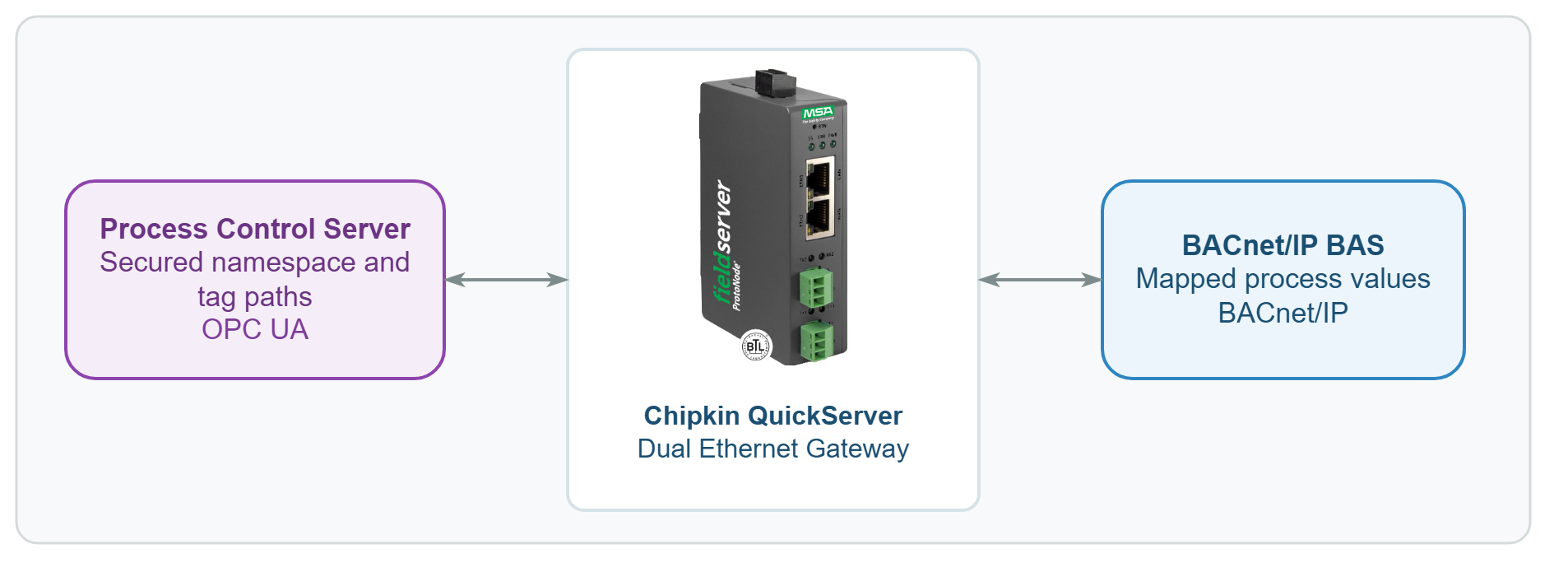
Secured OPC UA process server -> Chipkin QuickServer -> BACnet/IP BAS
OPC UA to BACnet/IP Challenge
The upstream/server side was a secured OPC UA process control server. The downstream/client side needed those values as BACnet/IP objects inside a building automation workflow. That made this more than a basic protocol bridge. The project needed a dual-network gateway, a correct OPC UA security setup, and BACnet/IP object exposure that matched the live process namespace exactly enough to avoid commissioning drift.
The most important technical challenge was tag-path alignment. The customer had a spreadsheet of OPC UA paths and a clear list of BACnet/IP destinations, but the tag list still had to be translated into working Node ID references against the live OPC UA namespace. In OPC UA work, a list that is close is not enough. The namespace has to match exactly or the BACnet/IP side can look connected while the live values stay empty.
The customer also needed the OPC UA source network and the BACnet/IP destination network kept separate. That made the Dual Ethernet QuickServer platform part of the solution itself, not just a packaging detail.
Why Chipkin for OPC UA to BACnet/IP Integration
This project needed a gateway partner that understood more than the protocol names. The customer needed secure OPC UA connectivity, BACnet/IP delivery, a dual-network layout, and a way to turn a spreadsheet of process tags into a working configuration without hand-building the entire job from scratch.
Chipkin fit because the gateway platform and the engineering workflow were both part of the answer. The Chipkin engineering team built a custom spreadsheet-to-configuration mapping approach, aligned the secure OPC UA connection details with the QuickServer setup, and helped the customer isolate the exact namespace differences that mattered during commissioning.
The Solution: QuickServer OPC UA to BACnet/IP Bridge
Chipkin configured Chipkin QuickServer as an OPC UA client on the source side and a BACnet/IP server on the destination side. The gateway used separate Ethernet ports for the two networks, which preserved the customer’s network boundary while still exposing the required process values to the BACnet/IP BAS.
To speed the deployment, Chipkin built the mapping workflow around the customer’s OPC UA tag spreadsheet instead of forcing one-point-at-a-time manual setup. That custom process converted the spreadsheet into a working configuration package, then made it easier to compare the intended OPC UA paths to the live server namespace during validation.
For another OPC UA deployment, see the OPC UA to Modbus RTU Data Center PDU Monitoring case study.
Process Control Integration Results
The project delivered a working OPC UA to BACnet/IP handoff for a secured, dual-network process control environment.
Project proof points:
- Dual-network separation was preserved while still exposing live process values to the BACnet/IP BAS.
- The custom spreadsheet-to-config workflow shortened the path from customer tag list to working deployment.
- Namespace alignment was resolved at the live OPC UA server level instead of left as a commissioning guess.
- The customer confirmed live values after the final OPC UA path correction.
The most useful public proof came from the final namespace correction:
“After changing the hyphens to underscores in all the OPC tag paths, the values are now properly showing in the data array.”
— Process contractor lead engineer
Have a Similar OPC-UA-to-BACnet Project?
Need to expose secure OPC UA data to a BACnet/IP BAS without reworking the upstream process controls? Chipkin can help with QuickServer configuration, namespace validation, and protocol conversion across separate Ethernet networks. Tell us about your project.
Frequently Asked Questions
Can QuickServer convert OPC UA to BACnet/IP?
Yes. QuickServer can be used as an OPC UA to BACnet/IP protocol gateway. In this project, Chipkin used that path to bring secured process-control values into a biopharmaceutical BACnet/IP environment.
Does QuickServer support secured OPC UA endpoints?
Yes. This case study centered on a secured OPC UA server, and the delivered QuickServer configuration was built around that security requirement rather than an open test endpoint.
Can QuickServer operate on two separate Ethernet networks simultaneously?
Yes, when the hardware and project architecture call for it. In this deployment, the Dual Ethernet QuickServer preserved separate OPC UA and BACnet/IP networks while still exposing the required process values downstream.