
A building-services innovation team needed to move BACnet/IP building data into AWS IoT over MQTT with TLS for a multi-building rollout. Chipkin QuickServer delivered the BACnet/IP to MQTT protocol conversion path, helped stabilize the secure cloud connection, and gave the customer a practical foundation for broader monitoring expansion.
This was not a one-building pilot framed as a lab exercise. The BACnet/IP building data had to leave the local building automation environment, enter a secure cloud workflow, and remain useful enough to support a broader rollout once the first deployment proved stable.
At a Glance
- Industry: Building services / utilities innovation
- Customer: Building-services innovation and implementation team
- Facility type: Multi-building commercial monitoring rollout
- Client role: Project and implementation engineers
- Project scale: Multi-building BACnet/IP cloud-monitoring rollout with later meter-integration expansion
- Protocols: Primary: BACnet/IP -> MQTT
- Later expansion: Modbus RTU -> BACnet/IP / Modbus TCP
- Chipkin product: Chipkin QuickServer CAS-QS-2020-3219
- Project start: January 2021
- Internal reference: FSE13251
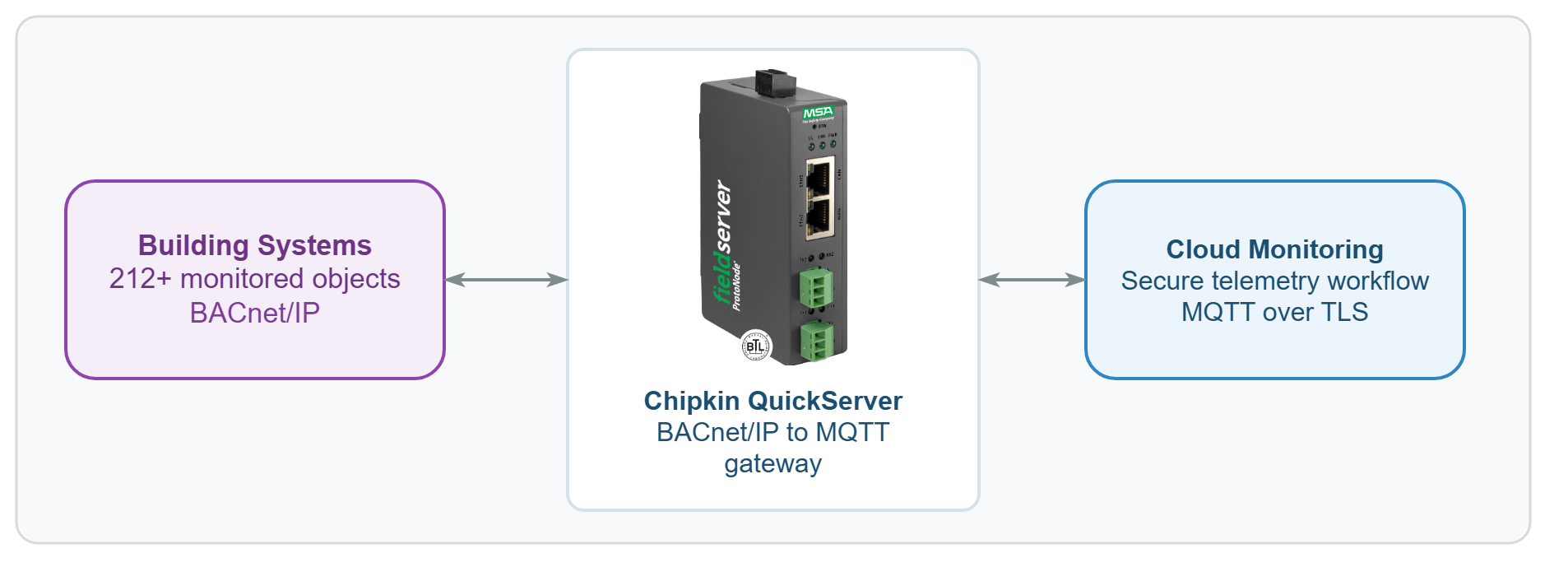
Building systems -> BACnet/IP -> Chipkin QuickServer -> MQTT with TLS -> AWS IoT cloud monitoring
BACnet/IP to MQTT Challenge
The customer needed a BACnet/IP monitoring environment to feed an MQTT cloud workflow instead of stopping at a local BAS. That meant the BACnet/IP building data had to move into AWS IoT with certificate-based security, dependable reconnect behavior, and a structure that could support more than one building over time.
The challenge was not just getting BACnet/IP objects out of the building. The customer needed a protocol gateway that could support cloud authentication, TLS handling, and topic behavior that made the BACnet/IP building data usable once it reached the cloud platform.
The project later widened to include meter-related work, but the primary commercial value stayed the same: prove that BACnet/IP building data could be published securely into a cloud monitoring workflow without rebuilding the source building automation environment.
Why Chipkin for BACnet/IP to MQTT Integration
This project needed more than a generic BACnet gateway. The team needed a QuickServer deployment that could handle BACnet/IP to MQTT protocol conversion, support AWS IoT connectivity requirements, and stay flexible enough for the broader rollout once the first buildings were online.
Chipkin support also mattered because this was not a static handoff. The team had to work through TLS certificate handling, MQTT reconnect behavior, and later expansion questions without splitting the deployment across multiple vendors or forcing the customer to troubleshoot the cloud edge alone.
The Solution: QuickServer BACnet/IP to MQTT Bridge
Chipkin configured QuickServer to read BACnet/IP building data and publish that BACnet/IP data into AWS IoT over MQTT using TLS-based authentication. That gave the customer one protocol gateway platform for the secure cloud handoff instead of a stack of separate integration tools.
Chipkin then helped the team stabilize the live deployment by working through certificate import, firmware behavior, and reconnect expectations that affect real building-to-cloud integrations. The later power-meter work was kept tightly scoped so it supported the same broader monitoring architecture without diluting the main BACnet/IP to MQTT story.
For another BACnet/IP deployment, see the OPC UA to BACnet/IP Process Control Tag Mapping case study.
Cloud Monitoring Results
The project delivered a working BACnet/IP to MQTT integration path for a multi-building monitoring strategy and established a foundation for later expansion.
Project proof points:
- AWS IoT cloud publishing was brought into the rollout through a secure MQTT workflow.
- BACnet/IP building data was moved into a cloud-monitoring architecture without replacing the source building systems.
- TLS-based connectivity was validated as part of the live deployment path.
- The rollout remained expandable once the first BACnet/IP to MQTT bridge was stable.
The customer closeout was direct:
“Its working well and its ok to close the ticket”
— Project engineer, multi-building monitoring rollout
Have a Similar BACnet/IP-to-MQTT Project?
Need to publish BACnet/IP building data into an MQTT cloud workflow with TLS while keeping the source BAS in place? Chipkin can help with QuickServer configuration, AWS IoT connectivity, and protocol conversion for building-to-cloud monitoring projects. Tell us about your project.
Frequently Asked Questions
Can QuickServer publish BACnet/IP data to MQTT?
Yes. QuickServer can read BACnet/IP data and publish it into an MQTT workflow. In this deployment, Chipkin used that path to move BACnet/IP building data into AWS IoT for a multi-building monitoring rollout.
Does QuickServer support MQTT with TLS?
Yes. This case study centered on an MQTT deployment that used TLS-based authentication for the cloud connection. Chipkin helped the customer work through certificate handling and live connection behavior during commissioning.
Can QuickServer handle both MQTT cloud publishing and local Modbus conversion?
It can support broader mixed-protocol projects when the delivered architecture calls for it. In this deployment, the BACnet/IP to MQTT cloud path stayed primary while later expansion work added meter-related integration around the same monitoring program.