
A water metering integrator needed three Kamstrup FlowIQ3100 meters exposed to BACnet/IP for a building monitoring workflow. Chipkin QuickServer helped turn an M-Bus address-discovery problem into a working BACnet handoff with fast configuration updates around the customer’s site visit.
This project mattered because the difficulty was not just reading meter values. The customer only knew the secondary addresses at first, while the live M-Bus configuration still depended on the primary addresses confirmed during on-site testing. Until those details were validated, the BACnet side could not be trusted.
At a Glance
- Industry: Water metering / building automation
- Location: Saudi Arabia
- Customer: Water metering and engineering integrator
- Facility type: Commercial water monitoring deployment
- Client role: Engineering and automation team
- Project scale: 3 FlowIQ3100 water meters with 3 configuration revisions
- Protocols: From: M-Bus -> To: BACnet/IP
- Chipkin product: Chipkin QuickServer FS-QS-1A50-1150
- Project start: January 2024
- Internal reference: FSE14962
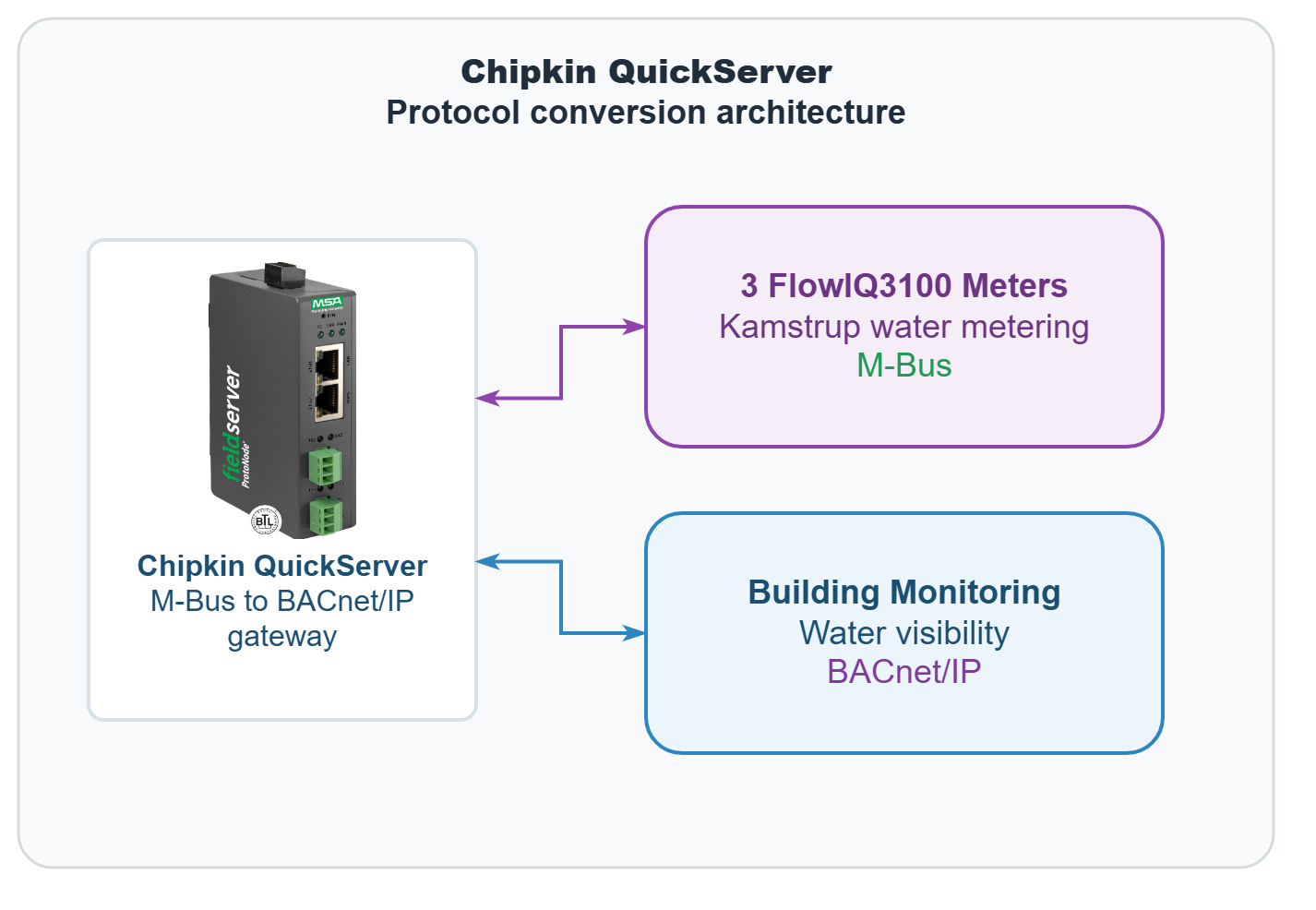
Architecture: Kamstrup FlowIQ3100 water meters -> M-Bus -> Chipkin QuickServer -> BACnet/IP -> building monitoring system
M-Bus to BACnet/IP Challenge
The upstream/server side was a set of three Kamstrup FlowIQ3100 water meters communicating over M-Bus. The downstream/client side needed those readings exposed to a BACnet/IP supervisory system with a point set the customer could actually use.
The hard part was address certainty. The customer initially supplied secondary meter addresses, but the live gateway configuration depended on the primary addresses that were only confirmed later during site testing. That is a common M-Bus trap: a project can look well documented on paper and still fail in the field because the address assumptions are wrong.
The customer also needed the BACnet presentation cleaned up after the first delivery. Object naming had to be corrected, the point list had to be reduced to the six values the project actually needed, and the revised file had to be ready quickly enough to support the scheduled on-site visit.
Why Chipkin
This was a strong fit for Chipkin because the job required protocol conversion plus practical M-Bus troubleshooting. Chipkin QuickServer provided the BACnet/IP handoff, and Chipkin support added value by iterating the meter mapping quickly as new field details came in.
That matters on M-Bus work because the difference between a good lab file and a working site file is often discovered only after the integrator confirms addressing and device behavior in person.
The Solution
Chipkin configured the QuickServer to poll the three FlowIQ3100 meters over M-Bus using the confirmed baud rate and device mode, then expose the selected values over BACnet/IP. The final working point set focused on the data the customer cared about most: volume, operating hours, reverse volume, and temperature-related values.
The configuration process moved through three practical revisions. The first file established the base gateway mapping, the second cleaned up the BACnet object naming and point scope, and the third aligned the project with the primary addresses confirmed during the customer’s on-site visit.
That revision pattern was the decisive move. Instead of treating the M-Bus address mismatch as a project reset, Chipkin used the confirmed site findings to finish a file the customer could adjust and deploy immediately.
For another monitoring project where source-device details had to be confirmed before the downstream BAS handoff was truly usable, see the Pneumercator ES825 to BACnet Fuel Monitoring case study.
Water Metering Results
The project delivered a working M-Bus to BACnet/IP path for a three-meter monitoring deployment.
Project proof points:
- 3 FlowIQ3100 meters were integrated through one QuickServer gateway.
- 3 configuration revisions moved the project from initial mapping to site-verified operation.
- Primary addresses 68, 69, and 70 were confirmed during on-site testing and reflected in the final file.
- The customer confirmed the gateway was operational after making minor project-specific adjustments.
The customer’s validation was direct:
“In morning I made some changes in the configuration file as per our need and it’s fine now. Thanks for your support.”
— Engineering manager, water metering integrator
Have a Similar M-Bus Meter Integration?
Need to expose M-Bus meter data to a BACnet/IP BAS without losing time to address and point-map rework? Chipkin can help with QuickServer configuration, M-Bus troubleshooting, and field-ready validation support. Tell us about your project.
Frequently Asked Questions
Can QuickServer convert M-Bus meter data to BACnet/IP?
Yes. This deployment used QuickServer to poll three FlowIQ3100 meters over M-Bus and expose the selected values to a BACnet/IP supervisory system.
Why do primary addresses matter on M-Bus projects?
Because a project can look documented on paper and still fail in the field if the live primary addresses are different from the early assumptions. This case moved forward only after the site visit confirmed addresses 68, 69, and 70.
Can Chipkin revise a gateway file around a scheduled site visit?
Yes. This project used several quick revisions so the customer could move from early mapping to a field-verified BACnet handoff without losing the commissioning window.