
A facilities integration team needed fuel tank monitoring, leak containment, and transfer-system data from a Pneumercator ES825 exposed to a BACnet/IP building automation network. Chipkin QuickServer bridged the specialized Modbus RTU devices into BACnet/IP and helped the field team verify live points during on-site testing.
This project stood out because it was not a single-device gateway exercise. The installation combined a Pneumercator ES825-200F fuel tank monitor, an FTI interface, and a leak containment system, with several point types that had to be interpreted correctly before they would be useful on the BACnet side.
At a Glance
- Industry: Fuel monitoring / building automation
- Customer: Facilities controls and monitoring integrator
- Facility type: Commercial fuel monitoring installation
- Client role: Project management and field commissioning team
- Project scale: Multiple fuel monitoring devices with contact-closure and status points exposed to BACnet/IP
- Protocols: From: Modbus RTU -> To: BACnet/IP
- Chipkin product: Chipkin QuickServer
- Project start: April 2023
- Internal reference: FSE16031
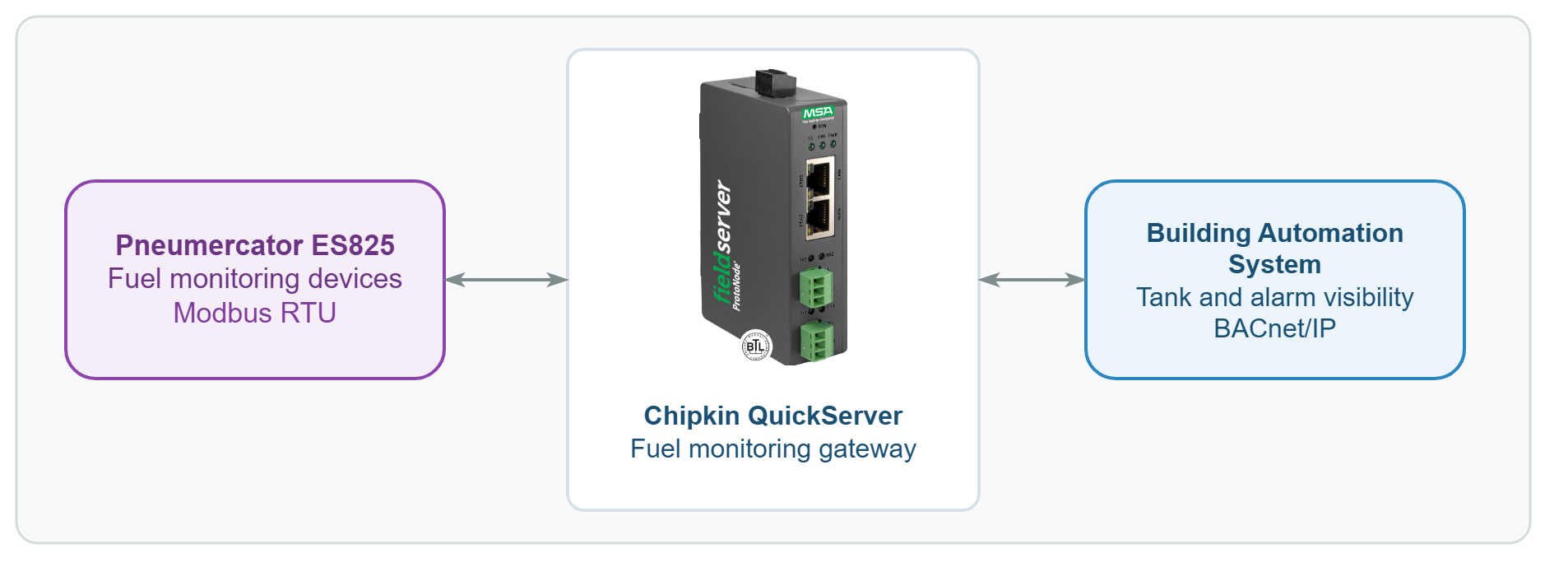
Pneumercator ES825 and fuel monitoring devices -> Modbus RTU -> Chipkin QuickServer -> BACnet/IP -> BMS
Pneumercator ES825 to BACnet/IP Challenge
The upstream/server side was a set of fuel monitoring devices communicating over Modbus RTU, centered on the Pneumercator ES825-200F. The downstream/client side was a BACnet/IP building automation environment that needed reliable access to Pneumercator ES825 tank status, leak containment information, and contact-closure states.
The complexity came from device behavior, not from the concept of protocol conversion itself. The Pneumercator ES825 contact-closure registers used bit-level status encoding, and the actual meaning of those bits depended on how the field device had been programmed. That meant the project needed more than a register list. It needed field validation to confirm that the served BACnet/IP values matched the real installed behavior.
For fuel-monitoring projects, that distinction matters. A Pneumercator ES825 point that is technically mapped but semantically wrong is not useful to the BAS team. The integration had to preserve meaning as well as connectivity.
Why Chipkin for Pneumercator ES825 to BACnet/IP Integration
This project fit Chipkin because the customer needed protocol conversion plus device-specific interpretation. QuickServer provided the BACnet/IP handoff, and Chipkin support added value by helping the customer verify the live Modbus RTU registers directly and align the gateway behavior with the installed Pneumercator ES825 equipment.
That kind of field-backed validation is especially important on specialized fuel monitoring devices where bit-level alarms, relay states, and status words do not always behave like generic Modbus examples.
The Solution: QuickServer Pneumercator ES825 to BACnet/IP Bridge
Chipkin configured Chipkin QuickServer to read the Pneumercator ES825-200F, the FTI system, and the leak containment system over Modbus RTU and serve the selected values into the BACnet/IP environment.
The decisive step was direct register verification during troubleshooting. By scanning the live Modbus device and reviewing the Pneumercator ES825 contact-closure registers, the team confirmed how the status layout behaved in the installed system. That let Chipkin finalize a configuration that matched the real device state instead of relying on assumptions alone.
For another fuel-monitoring integration using QuickServer, see the Franklin EVO 550 to BACnet/IP Fuel Monitoring case study.
Fuel Monitoring Results
The project delivered a working Modbus RTU to BACnet/IP integration for specialized fuel monitoring equipment.
Project proof points:
- The Pneumercator ES825-200F was successfully exposed to the BACnet/IP system through QuickServer.
- Contact-closure states and monitored values were validated against live Modbus register behavior.
- Multiple fuel-system devices were brought into one BACnet monitoring workflow.
- The field team confirmed the final working points after on-site spot checks.
The customer’s final validation was explicit:
“They tested the points that we were working on and then went back and spot tested ones that had been previously tested with positive results. Looks good.”
— Project manager, facilities integration team
Have a Similar Fuel Monitoring Integration?
Need to expose specialized Modbus RTU fuel monitoring devices such as a Pneumercator ES825 to a BACnet/IP BAS? Chipkin can help with QuickServer configuration, live register validation, and protocol conversion support for field-ready deployment. Tell us about your project.
Frequently Asked Questions
Can QuickServer convert Pneumercator ES825 to BACnet/IP?
Yes. QuickServer can be used as a Modbus RTU to BACnet/IP protocol gateway for a Pneumercator ES825 installation. This case study is an example of that fuel-monitoring workflow.
What Pneumercator ES825 signals can be exposed to BACnet/IP?
That depends on the installed configuration, but this project included tank status, leak containment, and contact-closure behavior from the Pneumercator ES825-200F and related devices.
Can Chipkin validate live Modbus registers during commissioning?
Yes. Direct Modbus RTU register verification was a major part of this deployment because the team needed to confirm the actual field meaning of the Pneumercator ES825 status bits before finalizing the BACnet/IP handoff.