
A building controls contractor needed floor-level leak and heartbeat status from a Modbus TCP master PLC exposed to a BACnet MS/TP BMS. Chipkin QuickServer turned an ambiguous register map and a late BACnet/IP versus MS/TP hardware conflict into a working Modbus TCP to BACnet MS/TP protocol gateway for a multi-building leak-detection monitoring system.
The project already had a clear operational goal: surface leak alarms and communication-loss conditions inside a BAS. The harder part was getting the protocol details into a form that could actually be commissioned, including bit extraction, address interpretation, and a hardware architecture that matched the purchased gateway.
At a Glance
- Industry: Building automation / leak-detection monitoring
- Customer: Building controls contractor
- Facility type: Multi-building leak-detection deployment
- Client role: Leak-detection and BMS integration team
- Project scale: Multi-building suite-level leak and heartbeat visibility through a master PLC
- Protocols: From: Modbus TCP -> To: BACnet MS/TP
- Chipkin product: Chipkin QuickServer FS-QS-2110-1138
- Project start: February 2023
- Internal reference: FSE15699
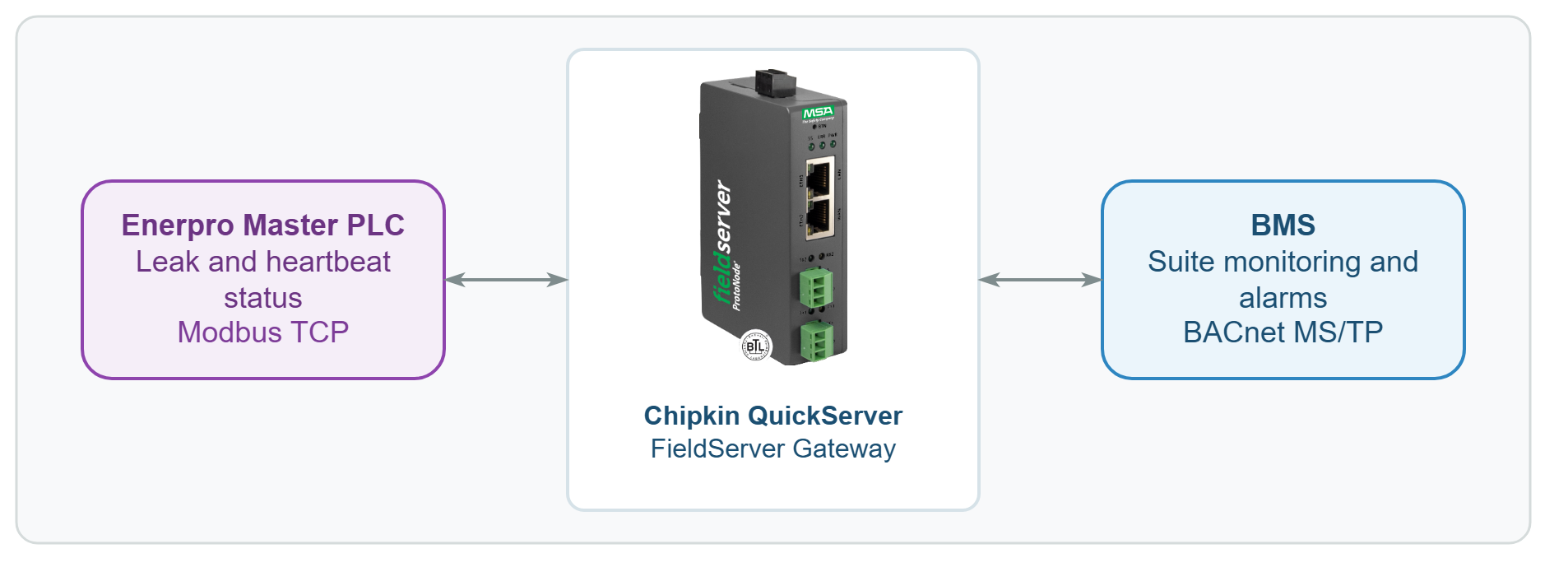
Enerpro master PLC -> Modbus TCP -> Chipkin QuickServer -> BACnet MS/TP -> BMS
Modbus TCP to BACnet MS/TP Challenge
The upstream/server side was a master PLC aggregating leak and heartbeat status over Modbus TCP. The downstream/client side needed those conditions as suite-level BACnet values inside a BACnet MS/TP BAS. That meant the project was not just a generic protocol bridge. It needed reliable bit extraction, usable naming, and point organization that would make sense to technicians in the field.
The first obstacle was the Modbus map itself. The supplied package referenced floor-level words and packed bit states, but it did not clearly state the Modbus addressing convention or function-code expectations. Until that was clarified, the QuickServer could not safely treat the data as the right type of Modbus registers for bit extraction.
The second obstacle was architecture. The customer initially expected a BACnet/IP handoff, but the selected QuickServer model had one Ethernet port and that port was already needed for the Modbus TCP master PLC. The project therefore had to move the BAS side to BACnet MS/TP so the protocol gateway design matched the actual hardware already on hand.
Why Chipkin for Modbus TCP to BACnet MS/TP Integration
This project fit Chipkin because the real risk was not raw compatibility. It was protocol interpretation. QuickServer could handle the conversion, but only if someone caught the addressing problem early, confirmed the correct data-flow direction, and aligned the hardware choice with the final BACnet transport.
Chipkin support added value by challenging the questionable Modbus assumptions before commissioning, working through the naming and alarm-model questions, and preventing the customer from fielding a configuration built on the wrong register interpretation.
The Solution: QuickServer Modbus TCP to BACnet MS/TP Bridge
Chipkin gathered a clearer intake, confirmed the application intent, and worked with the customer’s PLC side to verify how the leak and heartbeat states were actually exposed. The revised understanding was that the upstream system produced floor-level words for two conditions: leak alarms and no-heartbeat status. QuickServer then needed to read those words from the Modbus TCP master PLC, extract the relevant bits, and serve suite-level BACnet values to the BAS.
The decisive fix was clarifying the Modbus model before the point mapping was finalized. Once the addressing and function-code ambiguity were resolved, the bit-extraction workflow made sense again. The final design used the QuickServer Ethernet port for the Modbus TCP connection and moved the BMS handoff to BACnet MS/TP.
For another BACnet MS/TP deployment, see the Trane UC600 BACnet MS/TP to Modbus RTU case study.
Leak Detection Integration Results
The project delivered a usable Modbus TCP to BACnet MS/TP handoff for a multi-building leak-detection system.
Project proof points:
- Packed Modbus TCP words were translated into suite-level BACnet status values.
- The BACnet transport decision was corrected in time to fit the purchased QuickServer hardware.
- The naming and alarm model were organized so the BAS side could use the results more easily.
- The system came online successfully before the customer moved on to optional follow-up questions.
The customer closed the main integration loop with a concise confirmation:
“I think we are in good shape.”
— Project lead, building controls contractor
Have a Similar Modbus-to-BACnet Project?
Need to expose packed Modbus TCP alarm words to a BACnet MS/TP BMS without rewriting the upstream controls? Chipkin can help validate the addressing model, split out the point mapping, and deliver a QuickServer protocol gateway that is easier to commission in the field. Tell us about your project.
Frequently Asked Questions
Can QuickServer convert Modbus TCP to BACnet MS/TP?
Yes. QuickServer can be used as a Modbus TCP to BACnet MS/TP protocol gateway. In this deployment, Chipkin used that path to expose leak and heartbeat status from a master PLC to the BAS.
Can QuickServer split packed Modbus words into suite-level BACnet objects?
Yes, when the addressing model and bit layout are confirmed first. That bit-extraction workflow was a central part of this leak-detection project.
Can one QuickServer read Modbus TCP and serve BACnet MS/TP at the same time?
Yes. That was the final design in this case study once the customer aligned the architecture with the single-Ethernet-port QuickServer hardware already purchased.