
A commercial building controls team needed Veeder Root fuel monitoring data brought into a BACnet MS/TP building automation workflow without replacing the installed Metasys N2 path already in the field. Chipkin QuickServer delivered the Metasys N2 to BACnet MS/TP protocol conversion path, kept the project moving with same-day configuration delivery, and helped isolate a stale-data issue to the upstream integration gateway rather than the BACnet handoff.
This case is useful because it combines a fuel monitoring use case with a legacy building automation protocol bridge. The QuickServer integration itself was ready quickly, but the live site still needed a practical way to separate working BACnet delivery from an upstream device that was intermittently returning stale values.
At a Glance
- Industry: Building automation / fuel monitoring
- Location: Ottawa area, Ontario, Canada
- Customer: Commercial building controls team
- Facility type: Commercial office building with monitored fuel infrastructure
- Project scale: Veeder Root fuel monitoring exposed through a Metasys N2 path into one BACnet MS/TP building automation workflow
- Upstream/server device: Veeder Root fuel monitoring system through a Metasys Integration Gateway (MIG)
- Downstream/client system: Metasys building management system on BACnet MS/TP
- Protocols: From: Metasys N2 -> To: BACnet MS/TP
- Chipkin product: Chipkin QuickServer gateway, BACnet Device Instance 155008
- Project start: March 2023
- Internal reference: FSE15834
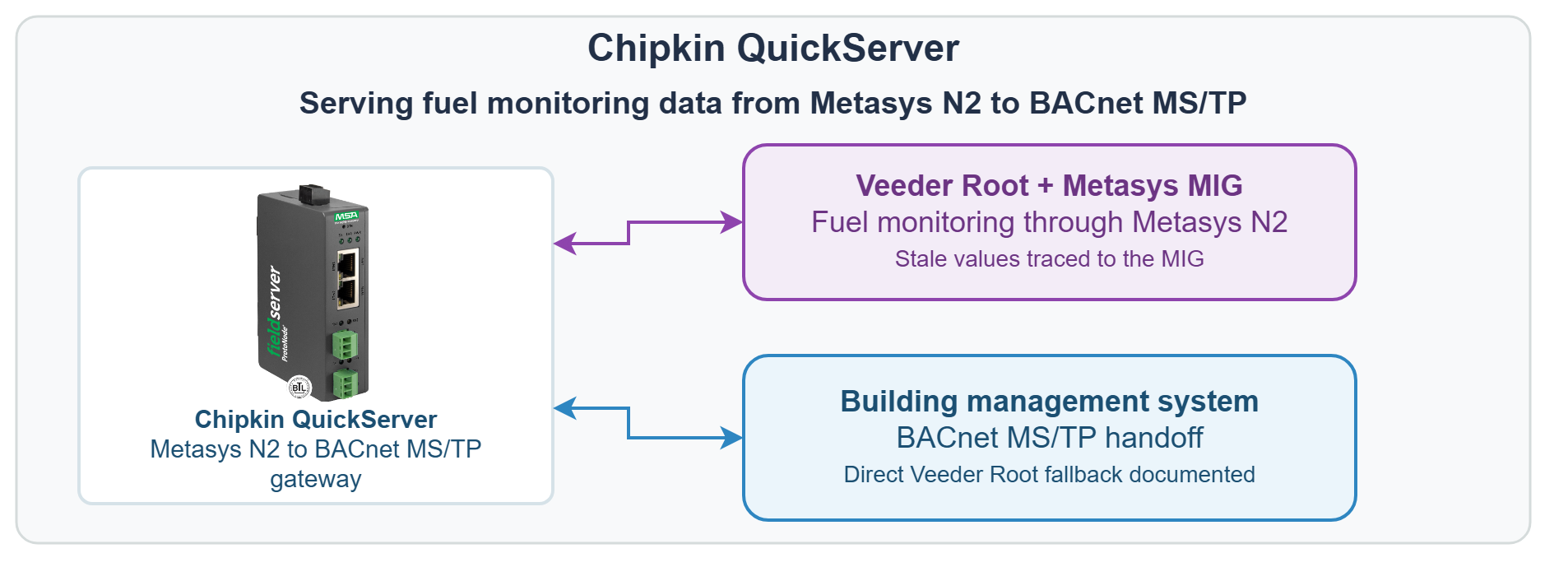
Veeder Root fuel monitor and Metasys N2 gateway -> Metasys N2 -> Chipkin QuickServer -> BACnet MS/TP -> building management system
Metasys N2 to BACnet MS/TP Challenge
The upstream/server side was a Veeder Root fuel monitoring system presented through a Metasys Integration Gateway on Metasys N2. The downstream/client side was a building management workflow that needed the same fuel data on BACnet MS/TP.
The challenge was not only getting a legacy protocol conversion path in place. The building team also had to prove that the BACnet MS/TP handoff was healthy while working around remote-access restrictions and an upstream integration gateway that intermittently returned stale values instead of current fuel data.
That matters in fuel monitoring projects because a site can lose time chasing the wrong side of the integration. If the BACnet side is working and the stale values live upstream, the real value is knowing exactly where to focus the next troubleshooting step.
Why Chipkin
This was a strong fit for Chipkin because the project needed more than a generic gateway. It needed a QuickServer deployment that could bridge Metasys N2 into BACnet MS/TP, get a usable file out quickly for a live field window, and then help the customer distinguish a healthy BACnet handoff from an unreliable upstream gateway behavior.
Chipkin support also added value by documenting an alternative architecture: if the site wanted to avoid the Metasys Integration Gateway entirely, the Veeder Root system could be brought directly into the QuickServer over RS232. That is practical design guidance, not just configuration delivery.
The Solution: QuickServer Metasys N2 to BACnet MS/TP Bridge
Chipkin configured the QuickServer to read the Metasys N2 path from the integration gateway and serve the required fuel monitoring points onto the downstream BACnet MS/TP network. The project moved quickly once the point list and device details were available, with the initial configuration delivered the next day for the field visit.
During live troubleshooting, the BACnet MS/TP side proved healthy while the upstream Metasys Integration Gateway continued returning stale values. Power-cycling that gateway restored current data, which confirmed the QuickServer was serving the right handoff and the stale-data behavior lived upstream.
Chipkin also documented a fallback architecture that bypassed the intermediary gateway and connected the Veeder Root system directly to the QuickServer. That gave the customer a cleaner path if long-term reliability on the existing Metasys N2 gateway ever became a concern.
For another fuel-monitoring integration that exposed tank data into a BAS, see the Veeder Root to BACnet/IP Hospital Fuel Tank Monitoring case study.
Fuel Monitoring Results
The project delivered a working Metasys N2 to BACnet MS/TP integration for a live fuel monitoring deployment.
Project proof points:
- Same-day configuration turnaround kept the project on schedule once the point list and field details were available.
- The BACnet MS/TP side worked immediately when the gateway was installed, narrowing the live issue to the upstream device path instead of the downstream BMS handoff.
- The stale-data behavior was isolated to the Metasys Integration Gateway and cleared with a power cycle.
- A direct Veeder Root to QuickServer fallback path was documented for future reliability planning.
Before: the site had an existing fuel monitoring path but no confirmed BACnet MS/TP handoff the building team could trust, and stale upstream values made the fault domain unclear. After: the building team had a working BACnet MS/TP fuel-monitoring handoff, a confirmed root cause for the stale-value behavior, and a documented alternate architecture if the intermediary gateway needed to be bypassed.
The customer’s confirmation was brief and clear:
“It seems like everything is communicating well now.”
— Controls systems designer, commercial building controls team
Have a Similar Metasys-N2-to-BACnet Project?
Need to expose a Metasys N2 fuel-monitoring path to BACnet MS/TP without wasting time troubleshooting the wrong side of the gateway? Chipkin can help with QuickServer configuration, diagnostic validation, and protocol conversion for legacy building automation integrations. Tell us about your project.
Frequently Asked Questions
Can QuickServer convert Metasys N2 to BACnet MS/TP?
Yes. In this deployment, Chipkin QuickServer read the existing Metasys N2 path and served the fuel monitoring points to the downstream BACnet MS/TP building automation system.
Can Chipkin help isolate whether stale values come from the gateway or the upstream device?
Yes. This project mattered because the BACnet MS/TP handoff was healthy while the upstream Metasys Integration Gateway was returning old values. That separation kept the troubleshooting effort focused on the real source of the issue.
Can a Veeder Root system be connected directly to QuickServer if the intermediary gateway is unreliable?
Yes. In this case, Chipkin documented a direct Veeder Root to QuickServer path as a fallback architecture so the site had another option if it wanted to bypass the intermediary gateway.