
An industrial automation team needed Veeder Root TLS-350 tank data exposed to BACnet MSTP for supervisory monitoring. Chipkin QuickServer helped turn a blocked serial startup into a working BACnet MSTP handoff after the project worked through TX/RX inactivity, panel selection, and a final revised configuration.
This project is a good example of why serial integrations often fail for reasons that are not obvious from the protocol labels alone. The gateway, panel selection, and communication settings all have to match the live installation before the BACnet side can show anything useful.
At a Glance
- Industry: Industrial automation / tank monitoring
- Customer: Industrial automation and facility integration team
- Facility type: Tank monitoring and BAS visibility project
- Client role: Project management and commissioning support
- Project scale: 1 Veeder Root TLS-350 integration with 3 configuration revisions
- Protocols: From: Veeder Root serial -> To: BACnet MSTP
- Chipkin product: Chipkin QuickServer FS-QS-2XX0-F series
- Project start: January 2026
- Internal reference: FSE22270
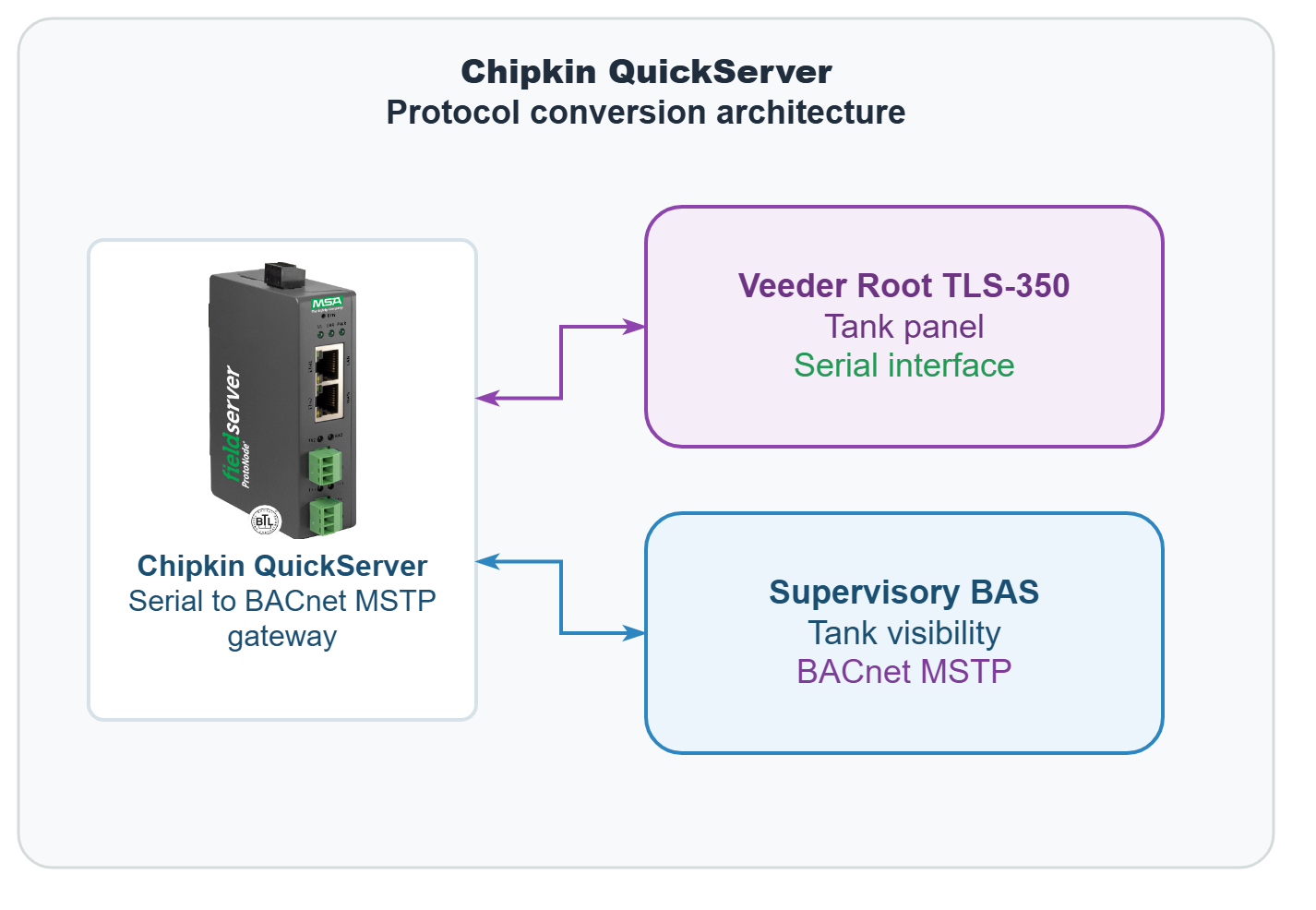
Architecture: Veeder Root TLS-350 tank panel -> serial interface -> Chipkin QuickServer -> BACnet MSTP -> supervisory BAS
Veeder Root TLS-350 to BACnet MSTP Challenge
The upstream/server side was a Veeder Root TLS-350 tank monitoring panel using serial communication. The downstream/client side needed that information presented over BACnet MSTP so the data could be consumed by a supervisory building automation workflow.
The initial symptoms looked like a dead serial path. The customer reported no TX/RX activity at the panel side, and later testing still showed unusable results until the right source-panel assumptions were revisited. In serial gateway work, that is a familiar failure mode: communication can appear broken even when the real issue is a mismatch in source selection or field setup details.
The job therefore required more than sending a first-pass file. It needed diagnostic follow-up, a corrected configuration, and confirmation that the live panel being tested was the one the gateway configuration actually matched.
Why Chipkin
This was a strong fit for Chipkin because the project required both serial troubleshooting discipline and a clean BACnet MSTP delivery path. Chipkin QuickServer provided the protocol bridge, while Chipkin support helped narrow the problem from a generic no-comms complaint into a field-corrected gateway setup.
That kind of support matters on tank-monitoring jobs because serial commissioning issues can waste a lot of time if the team does not separate wiring, settings, and source-panel assumptions early.
The Solution
Chipkin gathered the required TLS-350 details, confirmed the serial settings, and delivered a working QuickServer configuration for the BACnet MSTP destination side. After the first round of testing showed no usable communication, the project moved through additional checks around the serial mode, wiring, and the exact source panel being used.
The decisive move came when the customer switched to the correct Veeder Root panel and applied the revised file. That aligned the source assumptions with the gateway configuration and let the BACnet MSTP handoff start working as intended.
The result was a practical tank-monitoring integration rather than a stalled commissioning effort.
For another Veeder Root monitoring project that delivered downstream BACnet visibility without replacing the installed tank system, see the Veeder Root to BACnet/IP Hospital Fuel Tank Monitoring case study.
Tank Monitoring Results
The project delivered a working Veeder Root to BACnet MSTP integration path for live supervisory monitoring.
Project proof points:
- 3 configuration revisions were used to move the project from blocked startup to working communications.
- Serial settings and source-panel alignment were validated as part of the troubleshooting path.
- The BACnet MSTP handoff became readable after the revised file and corrected panel selection were applied.
- The customer confirmed live data access on the final test cycle.
The customer’s final confirmation was unambiguous:
“The latest file you sent works and I can read data now.”
— Senior project manager, industrial automation integrator
Have a Similar Veeder Root Integration?
Need to expose Veeder Root tank data to BACnet MSTP without losing time to serial troubleshooting and trial-and-error commissioning? Chipkin can help with QuickServer configuration, field diagnostics, and source-to-BACnet gateway delivery. Tell us about your project.
Frequently Asked Questions
Can QuickServer convert Veeder Root TLS-350 data to BACnet MSTP?
Yes. This case study used QuickServer to bring TLS-350 tank data into a BACnet MSTP supervisory workflow.
What if there is no TX or RX activity during startup?
That symptom does not always mean the serial link is fundamentally dead. This project shows why source-panel assumptions, serial settings, and the exact panel under test all need to be checked before treating the gateway file as the root problem.
Does the exact source panel matter on a Veeder Root integration?
Yes. The final breakthrough came when the customer switched to the correct source panel and applied the revised file that matched that real field setup.