
A building automation team needed BARD HVAC controller alarms surfaced inside a Schneider Electric BMS. Chipkin QuickServer helped convert SNMP data into BACnet/IP after the initial trap-based approach proved unreliable and the project shifted to consistent polling instead.
This story matters because it captures a common SNMP integration mistake. The protocol was not the problem. The problem was using the wrong interaction model for the operational goal and then needing a field-ready way to normalize the data into BACnet objects the BMS could trust.
At a Glance
- Industry: Building automation / HVAC monitoring
- Location: Alberta, Canada
- Customer: Facility automation and controls integrator
- Facility type: Remote HVAC alarm monitoring deployment
- Client role: Automation systems technician and project team
- Project scale: BARD HVAC alarm and status monitoring integrated into one BACnet/IP supervisory workflow
- Protocols: From: SNMP -> To: BACnet/IP
- Chipkin product: Chipkin QuickServer
- Project start: April 2025
- Internal reference: FSE21138
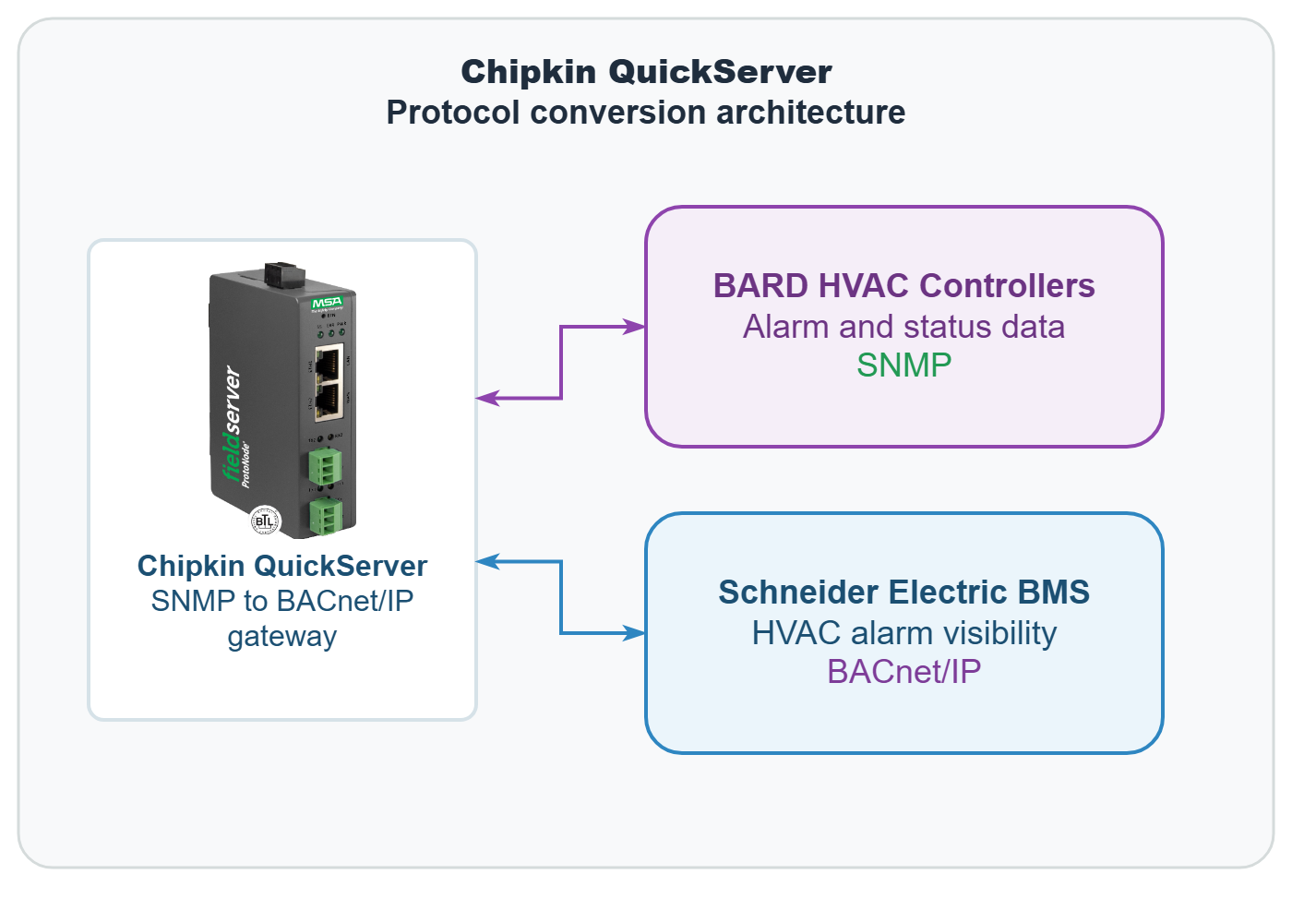
Architecture: BARD HVAC controllers -> SNMP -> Chipkin QuickServer -> BACnet/IP -> Schneider Electric BMS
SNMP to BACnet/IP Challenge
The upstream/server side was a set of BARD HVAC controllers exposing status and alarm data through SNMP. The downstream/client side was a Schneider Electric building management system that needed the same information represented as BACnet/IP objects for centralized alarm visibility.
The initial project path relied on SNMP traps. In practice, that made the alarm workflow harder to trust during commissioning. The customer needed a deterministic read path rather than intermittent event behavior that could be harder to validate cleanly in the BMS.
That turned the project into a protocol-strategy problem as much as a gateway problem. The team had to choose the right SNMP method first, then map the resulting data into BACnet in a way the supervisory system could use day to day.
Why Chipkin
This was a strong fit for Chipkin because the job depended on more than a basic SNMP driver. Chipkin QuickServer provided the protocol bridge, and Chipkin support helped the customer move from a trap-oriented assumption to a polling-based implementation that better matched the monitoring goal.
That kind of guidance is what turns a technically possible integration into one that operators can actually rely on.
The Solution
Chipkin configured the QuickServer to poll the BARD controllers over SNMP and serve the returned alarm and status values as BACnet/IP objects for the Schneider Electric system. The deployment used the controller and gateway IP settings from the site network and focused on alarm visibility rather than trap forwarding.
The decisive move was switching from SNMP traps to polling. That gave the customer a more repeatable validation path and a steadier data source for the BACnet side during commissioning.
With that shift in place, the project moved from unreliable event behavior to a practical building-monitoring workflow centered on readable alarm states and controller status points.
For another case where Chipkin helped turn field alarm data into a more usable BAS handoff, see the EtherNet/IP to BACnet/IP PLC Alarm Integration case study.
HVAC Alarm Monitoring Results
The project delivered a working SNMP to BACnet/IP integration path for HVAC alarm monitoring.
Project proof points:
- BARD HVAC controller status points were read successfully through SNMP polling.
- Alarm and operational data were exposed to the Schneider Electric BMS as BACnet objects.
- A trap-based approach was replaced with deterministic polling better suited to centralized monitoring.
- The customer confirmed the gateway was useful for controller alarm visibility after setup.
The customer’s confirmation was specific to the operational goal:
“I managed to setup the gateway to read the BARD unit status points… it is good for monitoring of the controllers’ alarm statuses.”
— Automation systems technician, facility controls integrator
Have a Similar SNMP-to-BACnet Project?
Need to expose SNMP device data to a BACnet/IP BMS without getting stuck on traps-versus-polling decisions? Chipkin can help with QuickServer configuration, point modeling, and commissioning support for practical alarm monitoring deployments. Tell us about your project.
Frequently Asked Questions
Can QuickServer convert SNMP data to BACnet/IP for HVAC monitoring?
Yes. In this deployment, QuickServer polled the BARD controllers over SNMP and exposed the resulting values to the Schneider Electric BMS over BACnet/IP.
Why would polling work better than traps for alarm visibility?
Because the customer needed a deterministic read path that was easier to validate cleanly during commissioning. This project improved once the workflow moved away from trap behavior and toward consistent polling.
Can Chipkin help model alarm points for a BACnet supervisory system?
Yes. The project depended on more than connectivity. Chipkin also helped shape the point presentation so the downstream BMS could use the alarm and status values in day-to-day monitoring.