
What EtherNet/IP Is
EtherNet/IP carries the Common Industrial Protocol (CIP) over standard Ethernet and IP networks. Its primary practical advantage is structured industrial interoperability: PLCs, drives, remote I/O, and adapter devices can expose objects, services, assemblies, and messaging models in a way that is more expressive than a flat register-only interface when the source variant is identified correctly.
At a deployment level, EtherNet/IP is common in PLC-centered manufacturing, packaging, material handling, machine control, and industrial skid environments. It is especially common in Rockwell and Allen-Bradley-centric North American installations, though the underlying Common Industrial Protocol (CIP) object model appears across a broader industrial device ecosystem.
In public QuickServer guidance, EtherNet/IP can be treated as field-proven, but the scoping still has to distinguish general CIP access, assembly-driven I/O, and narrower Allen-Bradley-specific paths such as DATA_TABLE_READ / WRITE or PCCC. Treating all of that as one generic capability is still the fastest way to over-scope a job.
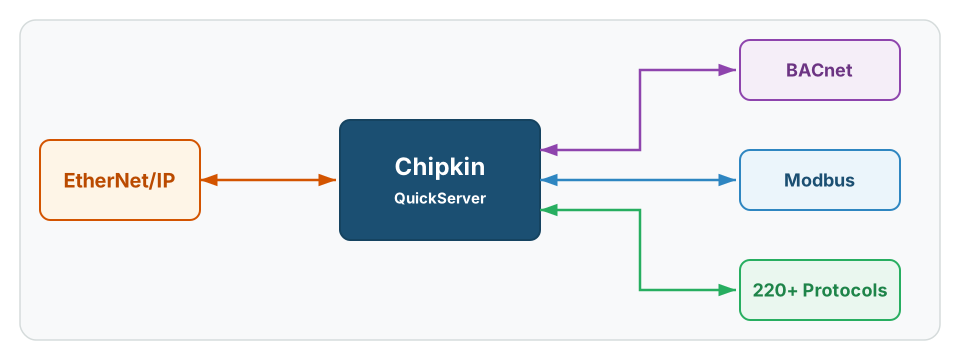
See QuickServer for EtherNet/IP protocol conversion options
For field guidance, use the EtherNet/IP Integration Guide: EDS Files, Read/Write Configuration & Common Pitfalls and the EtherNet/IP Troubleshooting Guide.
History
EtherNet/IP grew out of the CIP family as industrial networks moved from dedicated media toward standard Ethernet infrastructure. That shift preserved object-oriented industrial data modeling while making it easier to deploy PLC, drive, and adapter networks on mainstream switched Ethernet.
In practice, that history matters because many EtherNet/IP jobs are not generic Ethernet jobs. They are CIP jobs where the decisive question is which service pattern the source actually supports and whether the implementation behaves like general EtherNet/IP, an assembly object endpoint, or a narrower Allen-Bradley-specific path.
Core Concepts
EtherNet/IP integrations usually come down to a few technical facts and decisions:
- Common Industrial Protocol (CIP): Provides the object, class, instance, attribute, and service model underneath EtherNet/IP.
- Explicit messaging: Normally uses TCP port
44818for request-response reads, writes, and configuration traffic. - Implicit messaging: Commonly uses UDP port
2222for cyclic I/O exchange tied to assembly objects. - CIP path identity: Devices are often addressed by class, instance, and attribute path elements, not only by an IP address, which is why object identity matters as much as reachability.
- EDS and variant discipline: Engineering tools often depend on the correct Electronic Data Sheet (EDS) file and the right distinction between general CIP,
DATA_TABLE_READ / WRITE, and narrower Allen-Bradley-specific paths such as PCCC.
Most integration failures come from object and variant assumptions, not generic Ethernet problems.
EtherNet/IP-Specific Information
EtherNet/IP is deeper than port reachability and IP addressing. The engineering work sits in the CIP object model, assembly definitions, and service behavior.
CIP Objects and Service Behavior
| Area | Why It Matters | Common Failure Mode |
|---|---|---|
| CIP object and service support | Determines what can be read or written | Source is reachable, but required services are missing |
| Explicit versus implicit messaging | Changes the whole integration method | Team scopes a cyclic I/O project like a request-response job |
| Assembly definition and byte layout | Controls actual usable data | Tags exist in theory, but the assembly contract is wrong |
| Allen-Bradley-specific behavior | Narrows what is routine versus special | Intake assumes generic CIP where the device expects a narrower model |
The first real scoping decision is whether the device behaves like a general CIP endpoint, an explicit messaging target, an implicit messaging device, or a narrower vendor-specific service path. Many failures happen because a device was labeled EtherNet/IP while the actual usable behavior was much more constrained.
For many devices, object identity is defined through class, instance, and attribute addressing inside CIP service paths. That means a successful project depends on more than the right IP address. The integrator also has to know which object types exist, which instances are implemented, and which attributes or services are actually readable or writable.
For deeper references, use CIP in EtherNet/IP, EtherNet/IP Explicit Messaging, and EtherNet/IP Implicit Messaging.
Assembly Contracts and EDS Files
Many EtherNet/IP projects only become operational once the assembly object and EDS file details line up. Assembly instance numbers, byte counts, and direction assumptions define what the scanner thinks it is reading or writing, while the EDS file helps the engineering tools apply the right model to the installed device.
That is why a site can have healthy Ethernet reachability and still have unusable data. The protocol path is live, but the I/O contract is wrong.
For deeper references, use EtherNet/IP Assembly Objects and EtherNet/IP EDS Files.
Connected Sessions, Paths, and Identity
EtherNet/IP projects also fail when the team confirms only the network endpoint and not the CIP pathing assumptions behind the transaction. A successful session depends on more than an IP address. It depends on the right path segments, object identity, service support, and whether the source expects connected or unconnected behavior for the chosen interaction pattern.
That distinction matters during commissioning because a device can answer one narrow request pattern and still fail the real production workflow. A good intake package identifies which path is being used, whether the session is browse-like or cyclic, and which object or assembly identity the gateway is expected to expose.
That is also why EtherNet/IP Assembly Objects, EDS Files, and Data Table Read / Write should be treated as scoping references, not as optional follow-up reading.
Addressing and Object Identity
EtherNet/IP addressing has two layers. The first is normal Ethernet and IP reachability to the device. The second is CIP object addressing, where the useful data lives behind class, instance, attribute, service, and assembly definitions.
That distinction matters because a device can respond on the network and still fail the real job if the requested object path is wrong. In practice, the integrator often needs to confirm:
- the device IP endpoint and session reachability
- the object class or service family being targeted
- the instance number or assembly number being used
- the attribute or data member that holds the value of interest
- whether the path is read-only, write-capable, or cyclic I/O only
For deeper references, use CIP in EtherNet/IP, EtherNet/IP Assembly Objects, and EtherNet/IP Data Table Read and Write.
Narrower Allen-Bradley Service Paths
Not every EtherNet/IP intake should be treated like broad, vendor-neutral CIP access. Some jobs depend on narrower paths such as DATA_TABLE_READ / WRITE or legacy Allen-Bradley behavior better described by PCCC.
That distinction matters because reads can work in a limited way while the actual project objective still fails. If the scoping notes do not clearly distinguish read-only, read-write, cyclic I/O, and narrower controller-emulation expectations, the job will look simpler than it really is.
For deeper references, use EtherNet/IP Data Table Read and Write and PCCC.
Common Variants
| Variant | Where It Fits | Why It Matters |
|---|---|---|
| CIP in EtherNet/IP | Foundation object and service model | Explains why object and service detail matter more than basic IP reachability |
| Explicit Messaging | Configuration and ad hoc reads and writes | Usually uses TCP 44818 |
| Implicit Messaging | Cyclic I/O exchange | Common for continuous controller-to-device updates |
| Assembly Objects | I/O container model | Defines instance numbers, direction, and byte sizing for cyclic data |
| EDS Files | Engineering and scanner configuration artifact | Helps tools apply the right object and assembly model |
| Data Table Read / Write | Narrower Allen-Bradley-oriented access path | Important when the job is not really broad vendor-neutral CIP |
How To Get The Points List
For EtherNet/IP, the points list normally comes from the PLC or device engineering project plus object and assembly definitions, not from packet captures alone. The best handoff usually preserves tag intent, object or service behavior, assembly structure when applicable, and whether points are truly read-only or read-write.
Preferred sources:
- PLC tag export or controller project
- Device EDS file and vendor object documentation
- Assembly map with byte layout
- Existing SCADA or HMI point list tied to CIP objects
If the job depends on a narrower path such as DATA_TABLE_READ / WRITE, classify that explicitly before mapping starts.
Devices that Support EtherNet/IP
QuickServer is Chipkin’s primary gateway for exposing EtherNet/IP source data into BACnet, Modbus, MQTT, and related supervisory targets.
Representative device families include Allen-Bradley ControlLogix and CompactLogix controllers, PowerFlex drives, POINT I/O and FLEX I/O adapters, and other CIP-speaking industrial devices where the object and assembly model is known. In practice, the stronger public fit is still Allen-Bradley-centric work where the actual service path, assembly map, or narrower controller behavior has already been identified.
Common Integration Targets
- BACnet for building-management visibility of PLC data
- Modbus for register-based gateway handoff
- MQTT for telemetry publishing and broker workflows
Tools & Diagnostics
| Tool | Type | Description |
|---|---|---|
| QuickServer | Gateway and diagnostics platform | Useful when EtherNet/IP source data must be exposed as BACnet, Modbus, MQTT, or other supervisory formats while preserving the right CIP or assembly model |
| FieldServer Toolbox | Gateway diagnostics | Useful for validating downstream point presentation once the correct CIP path, assembly contract, or read-write model is proven |
| RSLinx Classic | Browser | Useful for Allen-Bradley network and device diagnostics |
| EIPScan | Scanner | Useful for explicit and implicit messaging tests |
| Wireshark | Packet analyzer | Useful for CIP and EtherNet/IP frame inspection |
Frequently Asked Questions
What is the difference between explicit and implicit messaging?
Explicit messaging is request and response traffic for configuration and reads and writes. Implicit messaging is cyclic I/O exchange for continuous controller data updates.
Why do reads work while writes fail?
That often means the point was treated as readable but not writable, or the actual service model is narrower than the intake suggested.
What is the first scoping question on an EtherNet/IP project?
Whether the source behaves like standard CIP, an assembly-driven I/O device, or a narrower Allen-Bradley-specific service pattern. That answer drives almost everything else.
Is EtherNet/IP always equivalent to generic CIP support?
No. CIP is the object and service model, but real device behavior still depends on vendor implementation details, supported services, and the exact data path required.
Reference Documents
- ODVA EtherNet/IP overview - Official overview of EtherNet/IP as an ODVA-managed industrial Ethernet technology.
- ODVA specifications - Official standards and specification access point for ODVA technologies including EtherNet/IP and CIP.
- EtherNet/IP on Wikipedia - Useful orientation source for overview and terminology context.