
A commercial facilities team needed leak-monitoring data from a Franklin Fuel Systems EVO 550 tank gauge exposed to a BACnet/IP building management system. Chipkin QuickServer turned the Franklin EVO 550 Modbus RTU interface into a working BACnet/IP protocol gateway the field team could confirm on site.
This was a focused fuel-monitoring integration with a clear objective: surface Franklin EVO 550 leak and status information inside the building automation environment instead of keeping it isolated at the tank gauge.
At a Glance
- Industry: Commercial fuel monitoring / building automation
- Customer: Commercial facilities and startup team
- Facility type: Fuel management installation
- Client role: Startup, testing, and controls stakeholders
- Project scale: Franklin EVO 550 leak and status points exposed to the BAS
- Protocols: From: Modbus RTU -> To: BACnet/IP
- Chipkin product: Chipkin QuickServer FS-QS-2010
- Project start: January 2023
- Internal reference: FSE15714
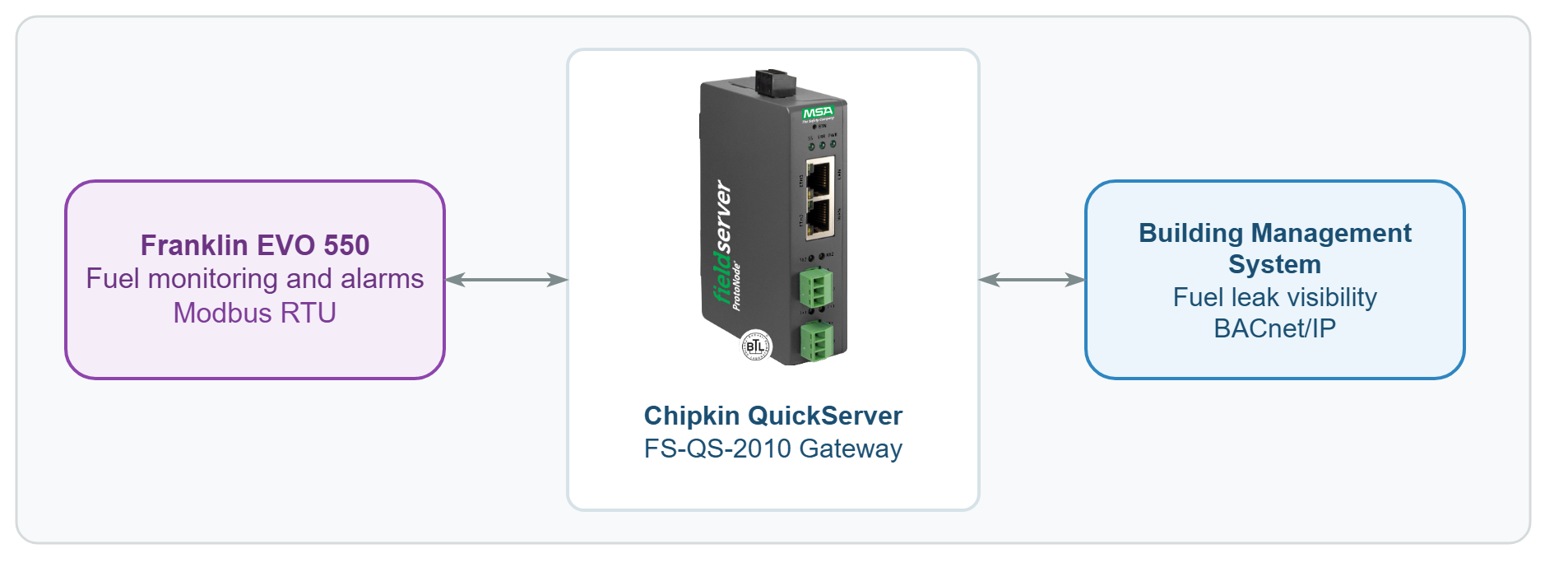
Franklin EVO 550 tank gauge -> Modbus RTU -> Chipkin QuickServer -> BACnet/IP -> BMS
Franklin EVO 550 to BACnet/IP Challenge
The upstream/server side was a Franklin Fuel Systems EVO 550 automatic tank gauge using a Modbus RTU interface. The downstream/client side needed those Franklin EVO 550 values on a BACnet/IP building management system. That made the project a real fuel-monitoring protocol conversion job rather than a generic gateway demo.
The work centered on two field realities. First, the team had to identify the exact Franklin EVO 550 points that mattered so the protocol gateway would expose useful leak-monitoring and status information instead of a broad, unfiltered register list. Second, the installed serial interface had to be aligned to the actual Franklin EVO 550 communication path used on site.
Because the Franklin EVO 550 documentation and access details were specialized, the integration also required close coordination with the customer’s startup and test team instead of assuming the BAS team alone would have every device-specific answer ready at the start.
Why Chipkin for Franklin EVO 550 to BACnet/IP Integration
This project fit Chipkin because the customer needed more than a gateway box. They needed a team that could help interpret Franklin EVO 550 tank-gauge documentation, narrow the point list to the leak and status data that mattered, and then get the Modbus RTU to BACnet/IP handoff working at the installation level.
QuickServer provided the protocol conversion path, and Chipkin support added value by helping the customer move from raw Franklin EVO 550 documentation toward a field-ready deployment that exposed the right points to the BACnet/IP BAS.
The Solution: QuickServer Franklin EVO 550 to BACnet/IP Bridge
Chipkin configured Chipkin QuickServer to read the Franklin EVO 550 over Modbus RTU and serve the selected data over BACnet/IP. The implementation focused on the customer’s chosen fuel-monitoring and alarm points rather than trying to mirror the entire Franklin EVO 550 point space without context.
Chipkin also helped align the deployment to the correct serial interface behavior on the field device, which is often the step that determines whether a Franklin EVO 550 integration becomes a routine startup or a prolonged site exercise. Once the gateway settings and selected points matched the installation, the field team was able to validate the BACnet/IP side successfully.
For another fuel-monitoring integration using QuickServer, see the Veeder Root to BACnet/IP Hospital Fuel Tank Monitoring case study.
Fuel Monitoring Results
The project delivered a working Modbus RTU to BACnet/IP handoff for Franklin EVO 550 fuel monitoring.
Project proof points:
- The Franklin EVO 550 interface was successfully exposed to the BAS through QuickServer.
- Leak and status monitoring points were selected from the Franklin EVO 550 documentation and mapped for BACnet consumption.
- The serial deployment path was validated at the installed device instead of remaining an unproven lab assumption.
- The field team confirmed the working system after on-site verification.
The customer’s final confirmation was direct:
“It’s all good. It’s working. Thank you.”
— Field technician, commercial facilities team
Have a Similar Fuel-Gauge-to-BACnet Project?
Need to expose tank-gauge or leak-monitoring data from a Franklin EVO 550 over Modbus RTU to a BACnet/IP BMS? Chipkin can help with QuickServer mapping, device-specific point selection, and protocol conversion for field-ready deployment. Tell us about your project.
Frequently Asked Questions
Can QuickServer convert Modbus RTU to BACnet/IP?
Yes. QuickServer can be used as a Modbus RTU to BACnet/IP protocol gateway. In this project, Chipkin used that path to expose Franklin EVO 550 fuel-monitoring data to a BAS.
What Franklin Fuel Systems models does QuickServer support?
This case study covers the Franklin EVO 550 tank gauge specifically. Contact Chipkin to confirm support for your exact Franklin Fuel Systems model and project architecture.
Can Chipkin help narrow the Franklin EVO 550 point list before commissioning?
Yes. A major part of this deployment was selecting the Franklin EVO 550 leak and status points that actually mattered for the BAS instead of exposing an oversized register list without context.