
A building automation integrator needed two QuickServers to bring McQuay MicroTech SCU data onto a Siemens BACnet/IP network. Chipkin helped move the McQuay MicroTech installation past zero-value diagnostics and support the Level 1 device architecture that ultimately made the project work.
This was a practical HVAC integration, not a lab-only demonstration. The customer had to bring multiple McQuay MicroTech self-contained units into a BACnet/IP environment, prove the data path in the field, and recover quickly when the first site tests showed online devices but useless zero-value arrays.
At a Glance
- Industry: HVAC / building automation
- Customer: Building automation integrator
- Facility type: Multi-unit air-conditioning monitoring project
- Client role: Controls integrator exposing McQuay MicroTech SCU data to a Siemens BACnet/IP network
- Project scale: Multi-unit McQuay MicroTech SCU monitoring across two QuickServers
- Protocols: From: McQuay MicroTech Open Protocol -> To: BACnet/IP
- Chipkin product: Chipkin QuickServer / FieldServer
- Project start: January 2024
- Internal reference: FSE18435
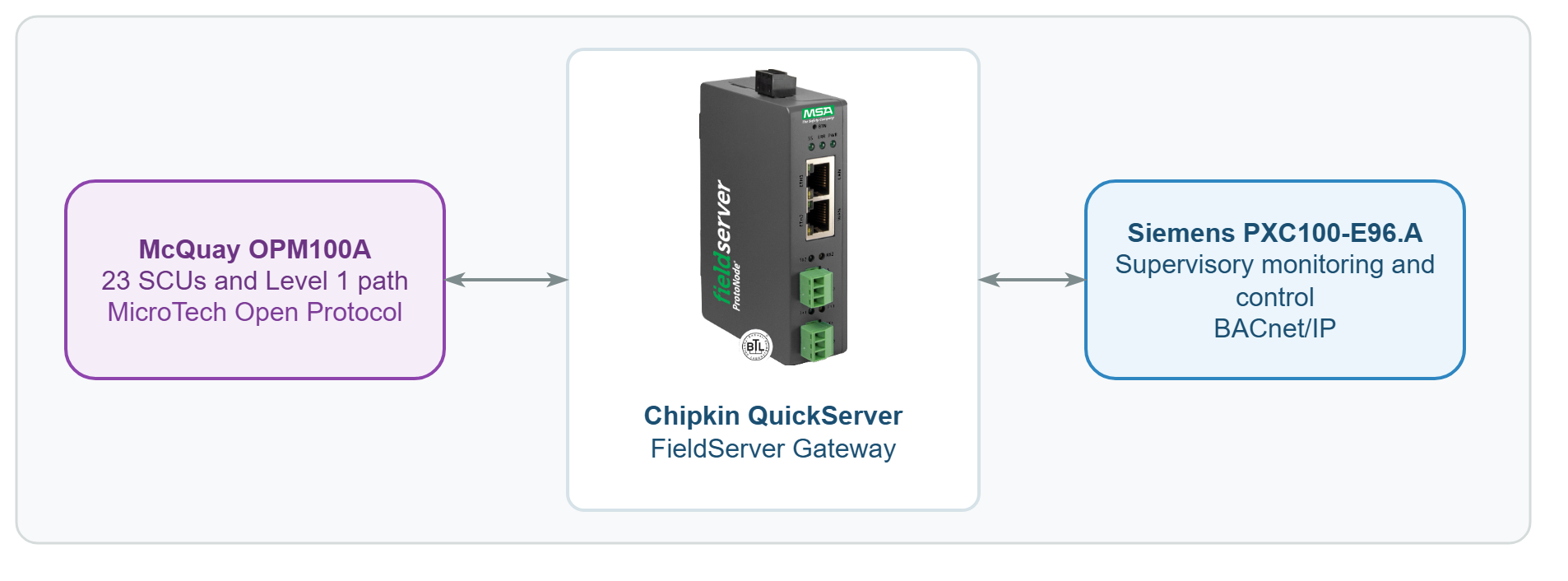
McQuay OPM100A and SCUs -> McQuay MicroTech Open Protocol -> Chipkin QuickServer -> BACnet/IP -> Siemens BMS
McQuay MicroTech Open Protocol to BACnet/IP Challenge
The upstream/server side used McQuay MicroTech Open Protocol over serial communication. The downstream/client side needed those McQuay MicroTech SCU points on a BACnet/IP network. The goal was not merely to prove one device. It was to establish a repeatable protocol gateway pattern the integrator could use across the full McQuay MicroTech SCU installation.
The immediate field problem was severe but familiar: the McQuay MicroTech devices appeared online, yet the actual data arrays stayed at zero or produced values that made no operational sense. That kind of failure is hard because it looks close to success. The wiring might be up, the device might answer, and the gateway might still expose the wrong thing to the downstream BACnet/IP side.
Even then, the project was not fully done. Once the McQuay MicroTech SCU data arrays began to populate, the customer still had to resolve a deeper architecture issue: communication had to take place with a Level 1 McQuay MicroTech device. Without that topology rule, a field team could still have a healthy-looking gateway that never reached the SCUs correctly.
Why Chipkin for McQuay MicroTech to BACnet/IP Integration
This project fit Chipkin because the hard part sat at the boundary between protocol behavior and field commissioning. QuickServer provided the protocol conversion platform, but the useful support came from reviewing diagnostics quickly, aligning the gateway behavior to the installed McQuay MicroTech hierarchy, and staying engaged while the customer validated the final SCU behavior.
The value here was not just that a gateway existed. It was that Chipkin helped move the job from all of the McQuay MicroTech data arrays showing zeros to a configuration that the customer could finish and confirm. That is the difference between a product shipment and a working HVAC integration.
The Solution: QuickServer McQuay MicroTech to BACnet/IP Bridge
Chipkin collected the McQuay MicroTech documents, photos, communication parameters, device counts, and BACnet settings needed to assemble the working integration. During field installation, the customer sent diagnostics showing that the McQuay MicroTech units were online but the values were not useful. Chipkin reviewed those diagnostics, checked the password and node information, and helped move the project from zero-value troubleshooting into a mapping and topology problem that could actually be solved.
The final closure came when the customer confirmed the correct Level 1 device requirement from the McQuay MicroTech documentation and their field work. Once that was understood, the customer finalized the configuration and reported that the gateway was properly configured and communicating with the SCUs.
For another HVAC BACnet/IP deployment, see the Modbus RTU to BACnet/IP Remote Chiller Integration case study.
SCU Monitoring Results
The project delivered a working McQuay MicroTech Open Protocol to BACnet/IP handoff for a multi-unit HVAC monitoring job.
Project proof points:
- A repeatable McQuay MicroTech SCU integration pattern was established across the installed units.
- The data path was validated in the field and moved the system from zero-value troubleshooting to live data-array population.
- The Level 1 device requirement was confirmed and documented in the final field workflow.
- The customer later provided a public testimonial after successful commissioning.
The customer’s testimonial was unusually strong and specific:
“We want to thank Chipkin for providing a product that was the perfect solution for our needs. Our customer now has a means of monitoring and controlling their units on our BACnet network, and they have been pleased with the performance of the system. We expect to be using this product again for subsequent projects.”
— Building automation integrator
Have a Similar McQuay or BACnet/IP Project?
Need to bring McQuay MicroTech SCU data onto a BACnet/IP network without replacing the existing unit controls? Chipkin can help with QuickServer configuration and protocol conversion support that gets the data path working before commissioning time runs out. Tell us about your project.
Frequently Asked Questions
Can QuickServer convert McQuay MicroTech Open Protocol to BACnet/IP?
Yes. QuickServer can be used as a McQuay MicroTech Open Protocol to BACnet/IP protocol gateway. This project is an example of that workflow for McQuay MicroTech SCU monitoring.
What McQuay MicroTech equipment can QuickServer support?
This case study includes McQuay MicroTech SCUs and an OPM100A-based architecture. Contact Chipkin to confirm support for your exact McQuay MicroTech model and site topology.
Why would McQuay MicroTech units show online but still return zero values?
That can happen when the device hierarchy or polling target is wrong even though the serial link looks alive. In this deployment, confirming the Level 1 McQuay MicroTech device requirement was the step that unlocked the final commissioning path.