
A dairy automation team needed WeatherAPI XML data exposed over Modbus TCP for PLC-driven barn control. Chipkin QuickServer turned the cloud weather feed into a repeatable XML to Modbus TCP gateway and helped the customer finalize a template that could be reused across multiple barns.
This project mattered because the customer was not looking for a one-off weather dashboard. The same integration pattern needed to be deployable across multiple barn systems, with site-specific coordinates and API credentials, while still handing the downstream PLC a clean Modbus TCP view of the live weather data.
At a Glance
- Industry: Agriculture / dairy automation
- Customer: Dairy operations automation team
- Facility type: Dairy barn automation deployment
- Client role: Automation and controls engineering team
- Project scale: Repeatable multi-barn weather integration template
- Protocols: From: XML / WeatherAPI -> To: Modbus TCP
- Chipkin product: Chipkin QuickServer FS-QS-2010
- Project start: June 2022
- Internal reference: FSE14977
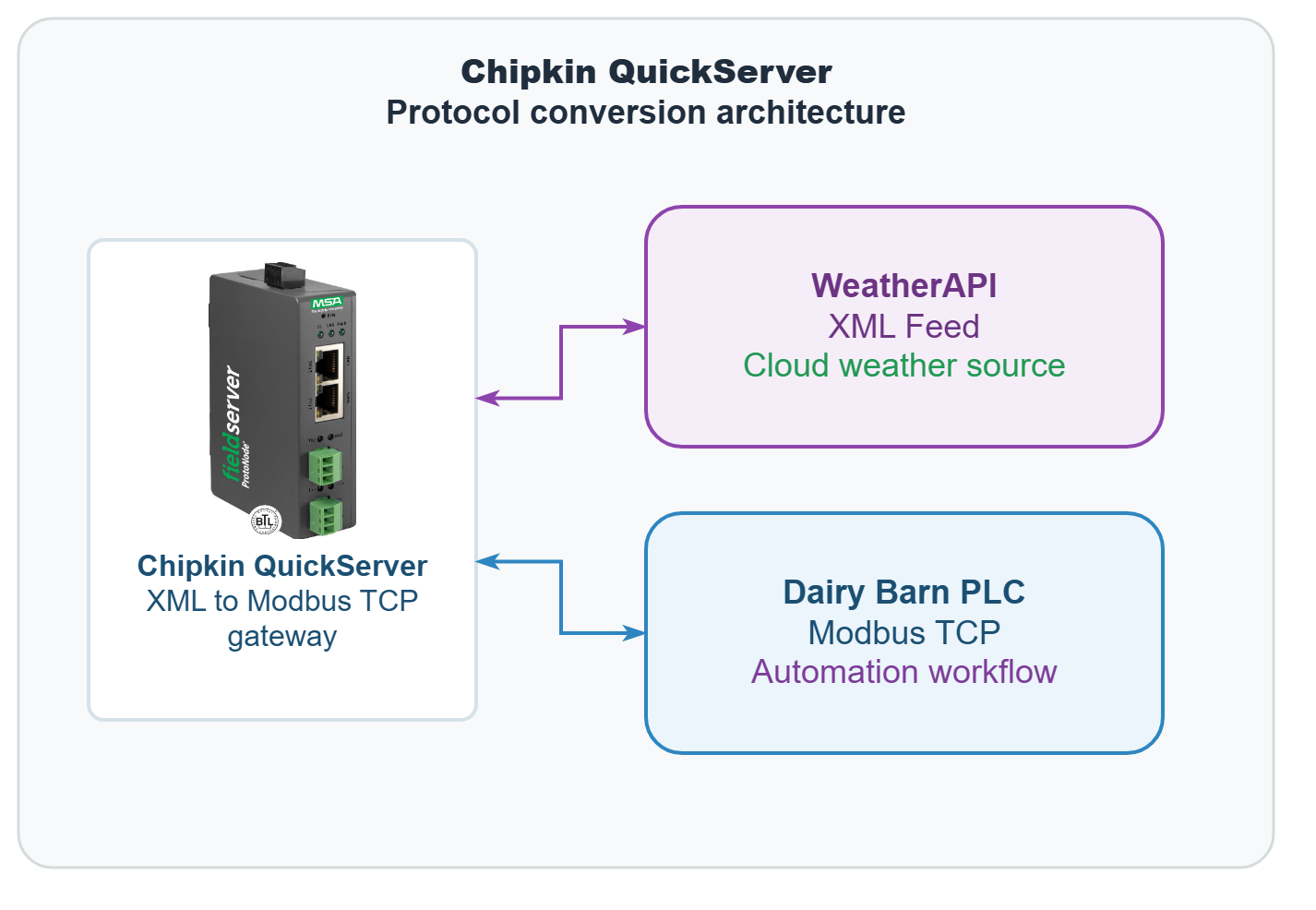
Architecture: WeatherAPI XML feed -> Chipkin QuickServer -> Modbus TCP PLC -> dairy barn automation workflow
XML to Modbus TCP Challenge
The upstream/server side was a WeatherAPI XML feed delivering real-time weather data. The downstream/client side was a PLC that needed the same information presented over Modbus TCP for barn automation logic.
The challenge was not basic internet connectivity. The customer needed one XML to Modbus TCP protocol gateway pattern that could be reused across multiple barns, with each system able to swap in its own coordinates and API key without redesigning the whole project.
That made the public value here very specific: turn a cloud weather service into a repeatable industrial handoff that fit a PLC-driven agriculture workflow instead of leaving the weather data isolated in a web API.
Why Chipkin for XML to Modbus TCP Integration
This was a strong fit for Chipkin because the job combined XML parsing, PLC-friendly Modbus delivery, and a rollout pattern the customer could repeat. Chipkin QuickServer provided the XML to Modbus TCP gateway path, while Chipkin support helped shape the project into something reusable instead of a one-barn custom file.
Chipkin also added value early by recommending XML over JSON for easier XPath-friendly parsing. That decision simplified the weather-feed side of the job and made it easier to structure a repeatable template for future barn deployments.
The Solution: QuickServer XML to Modbus TCP Bridge
Chipkin configured the QuickServer to read the WeatherAPI XML feed and expose the resulting weather values over Modbus TCP for the customer’s PLC workflow. The delivered approach was designed around a reusable template so each barn deployment could keep the same gateway pattern while changing only the customer-managed API key and site-specific location inputs.
The project then moved through a live refinement cycle rather than a restart. After a support session, Chipkin issued a revised configuration the same day, which kept the customer moving without turning a straightforward XML to Modbus TCP integration into a drawn-out commissioning exercise.
That combination made the outcome stronger than a simple protocol conversion. The customer got a working Modbus TCP handoff and a practical template for repeating the same architecture at other dairy sites.
For another project where Chipkin turned XML data into a downstream automation handoff, see the Control4 XML to BACnet/IP Home Automation Gateway case study.
Dairy Barn Automation Results
The project delivered a working WeatherAPI XML to Modbus TCP integration path for real-time dairy barn automation.
Before the project, the weather data lived in a cloud API outside the barn control workflow. After the QuickServer deployment, the customer had a repeatable Modbus TCP handoff the PLC team could use as part of the live automation system.
Project proof points:
- WeatherAPI XML data was exposed to the PLC as a usable Modbus TCP handoff.
- The same XML to Modbus TCP pattern was structured for repeat use across multiple barns.
- A same-day revision after the live support session kept the project moving during commissioning.
- The customer confirmed the original configuration was working and closed the project with a positive outcome.
The closeout note captured the result clearly:
“The field server pushing the original config file from Steven is working great. Just wanted to thank you for your help and support with it during the config process.”
— Automation engineer, dairy operations team
Have a Similar XML-to-Modbus Project?
Need to expose XML or web API data to a Modbus TCP PLC without rebuilding the downstream controls workflow? Chipkin can help with QuickServer configuration, repeatable gateway templates, and protocol conversion for practical industrial automation projects. Tell us about your project.
Frequently Asked Questions
Can QuickServer convert WeatherAPI XML data to Modbus TCP?
Yes. This project used QuickServer to read a WeatherAPI XML feed and present the resulting values to a downstream PLC over Modbus TCP.
Can the same XML-to-Modbus template be reused across multiple sites?
Yes. A core requirement in this deployment was making the XML to Modbus TCP approach repeatable across multiple barn systems rather than building each site from scratch.
Can the same QuickServer template support different API keys and locations?
Yes. A major part of the delivered value was making the QuickServer template reusable so each site could keep the same XML to Modbus TCP approach while updating its own API key and location inputs.