
What DF1 Is
DF1 is an Allen-Bradley serial protocol used on legacy programmable logic controller (PLC) and controller interfaces. Its practical value is direct serial access to older controller data when a project must bridge brownfield Allen-Bradley equipment into supervisory systems.
DF1 shows up mainly in legacy industrial automation, retrofit PLC integrations, and controller migrations where serial source data must be exposed onward as BACnet, Modbus, or another supervisory protocol. Current public guidance should treat DF1 as inquiry-stage scoping rather than a field-proven QuickServer delivery pattern.
For field-level diagnostic workflow, use the DF1 / Allen-Bradley Troubleshooting Guide.
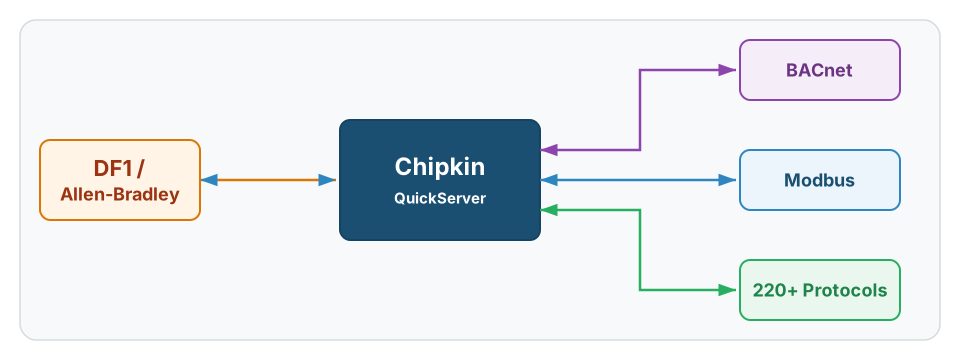
See QuickServer for legacy controller protocol conversion options
History
DF1 belongs to the earlier Allen-Bradley serial tooling era, where point-to-point controller communication, serial uploads, and legacy PLC interoperability were routine engineering tasks. That history matters because many present-day DF1 jobs are really retrofit or migration jobs, not greenfield protocol selections.
The protocol still matters in brownfield work, but the scoping risk is high. Teams often say “Allen-Bradley serial” when the real requirement is a different Allen-Bradley behavior family, such as PCCC inside another transport or a project that should really be treated as EtherNet/IP instead.
Core Concepts
DF1 scoping usually depends on:
- Controller family: PLC-5, SLC 5, MicroLogix, and compatible devices cannot be treated as interchangeable just because they are all Allen-Bradley branded or Allen-Bradley adjacent.
- Duplex mode: full-duplex and half-duplex behavior change timing, acknowledgements, and expected serial conversation patterns.
- Serial settings and node identity: baud rate, parity, framing, and node addressing still have to match before any command-level debugging matters.
- Command-family behavior: the most expensive mistakes usually come from choosing the wrong emulation or request model for the source device.
- Protocol-path validation: some jobs labelled DF1 really belong under PCCC or EtherNet/IP, so the first task is proving the real source behavior.
The highest-risk mistake is assuming every Allen-Bradley device responds to the same command style. A serial link can look electrically healthy while the real failure is a duplex-mode or command-family mismatch.
DF1-Specific Information
Serial Link Model And Duplex Behavior
DF1 is fundamentally a serial controller conversation. That means source-side success depends on correctly identifying the physical serial path, the framing parameters, and whether the device expects full-duplex or half-duplex behavior. In retrofit environments, half-duplex paths can involve radios, modems, or multi-drop timing assumptions that are easy to overlook if the team only verifies baud and parity.
This is why DF1 troubleshooting should start with the serial path model before anyone rewrites point maps. If the gateway and controller disagree on how the link is supposed to behave, every higher-level request will fail in ways that look random.
Allen-Bradley Command-Family Context
The next issue is command-family behavior. Legacy Allen-Bradley environments often blur together in project conversations, but controller family expectations still matter. A project may mention Allen-Bradley addressing, files, and serial communication while the actual device behavior lines up with one controller family and not another.
That is the core public caution for DF1: a healthy serial link does not prove that the request model is correct. The team still needs proof of the exact controller family, the expected emulation style, and whether the job is truly serial DF1 rather than another Allen-Bradley path using familiar terminology.
For related Allen-Bradley command-model context, see PCCC.
Inquiry-Stage Scoping Discipline
Current public evidence supports DF1 as scoping guidance, not as a routine field-proven QuickServer serial workflow. That means startup questions have to stay explicit: which controller family is installed, what duplex mode is documented, what serial settings are proven, and what point scope is actually required.
If those answers are incomplete, the right move is to narrow the first-point validation goal instead of treating the project like a standard production conversion. The first successful read matters more than a broad point-count promise at this stage.
Common Variants
| Variant | Where It Fits | Why It Matters |
|---|---|---|
| DF1 full duplex | Point-to-point serial links | Most straightforward direct controller-to-gateway path |
| DF1 half duplex | Radio or multi-drop paths | Timing and acknowledgement handling matter more |
| PLC-5-style behavior | Legacy controller emulation | Not interchangeable with every target device |
| SLC 5 and MicroLogix-style behavior | Legacy family behavior | Wrong emulation choice breaks reads and writes quickly |
How To Get The Points List
DF1 point lists usually come from the controller project and device documentation rather than from live discovery alone.
Preferred sources:
- PLC memory map or controller project export
- Allen-Bradley address list from the controls team
- Existing HMI, SCADA, or gateway mapping
- Vendor documentation for third-party Allen-Bradley emulation
In practice, the protocol can confirm communication, but it will not explain the engineering meaning of every PLC file and address. That interpretation still has to come from controller ownership or project documentation.
Devices that Support DF1
Representative source contexts that commonly trigger DF1 scoping include:
| Source Context | Why It Matters |
|---|---|
| PLC-5 and similar legacy controller environments | Often where serial retrofit work starts |
| SLC 5 and MicroLogix family projects | Common source of command-family mismatch risk |
| Allen-Bradley-adjacent third-party emulations | Requires proof of which behavior model is actually implemented |
Common Integration Targets
- BACnet for supervisory visibility of legacy PLC data
- Modbus for SCADA and register-oriented systems
- EtherNet/IP when serial and CIP-family systems coexist onsite
Tools & Diagnostics
| Tool | Type | Description |
|---|---|---|
| QuickServer | Gateway | Use when converting proven legacy controller data into BACnet, Modbus, or related supervisory targets |
| FieldServer Toolbox | Gateway diagnostics | Useful for confirming RX and TX activity and separating source serial problems from downstream mapping issues |
| Serial capture tools | Source validation | Useful for framing, response checks, and verifying whether the controller is talking at all |
| Controller manuals | Source documentation | Needed to confirm duplex mode, addressing assumptions, and command expectations |
Frequently Asked Questions
What is the most common DF1 scoping mistake?
Not identifying the exact Allen-Bradley behavior the source expects. The wrong emulation assumption can break the project even when the serial link is fine.
Is DF1 the same as EtherNet/IP?
No. DF1 is a legacy serial path, while EtherNet/IP is an Ethernet-based CIP-family protocol.
Why is duplex mode such a hard gate?
Because full-duplex and half-duplex paths behave differently on the wire. If the gateway is configured for the wrong style, the exchange fails before point mapping becomes relevant.
Why do some DF1 projects get reclassified as PCCC or EtherNet/IP work?
Because the original intake may describe Allen-Bradley behavior loosely. Once the team confirms the actual transport and command path, the project may belong under a different Allen-Bradley protocol family.
Reference Documents
- Rockwell Automation DF1 Protocol Reference Manual - Official Rockwell reference for DF1 communication behavior and protocol details.