
A power equipment supplier needed Servelec RIT-series battery charger data exposed to a DNP3 serial master for an electrical substation deployment. Chipkin QuickServer delivered the Modbus RTU to DNP3 Serial protocol conversion path and gave the customer’s engineering team a documented first DNP3 implementation they could ship with confidence.
This project stood out because the customer was adding DNP3 Serial to a battery charger product line that normally shipped with Modbus RTU and other familiar interfaces. The delivered result had to work in the field and make sense as a reusable pattern for future substation work.
At a Glance
- Industry: Power distribution / electrical substations
- Customer: Power equipment supplier and technical service team
- Facility type: Electrical substation monitoring deployment
- Client role: Engineering and technical service team shipping integrated charger systems
- Project scale: First-time DNP3 Serial battery charger integration for a shipped equipment line
- Protocols: From: Modbus RTU -> To: DNP3 Serial
- Chipkin product: Chipkin QuickServer FS-QS-2X10
- Project start: December 2021
- Internal reference: FSE14351
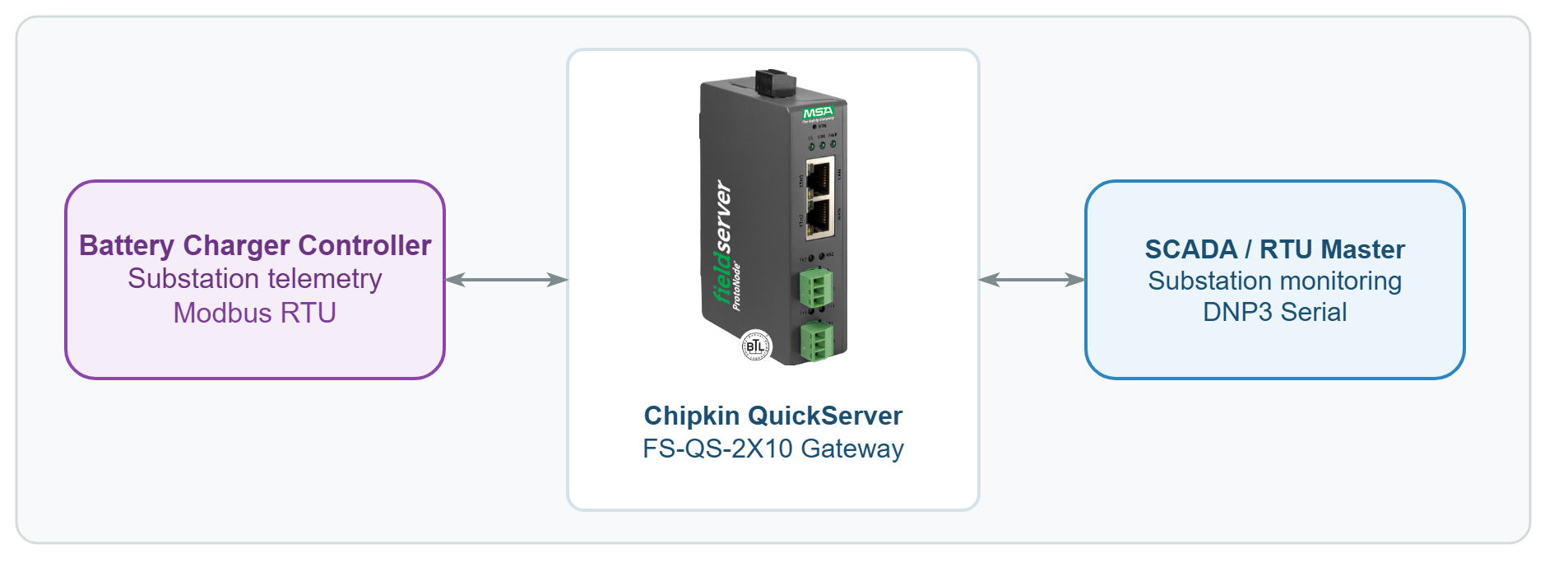
Servelec RIT-series battery charger -> Modbus RTU -> Chipkin QuickServer -> DNP3 Serial -> SCADA / RTU master
Modbus RTU to DNP3 Serial Challenge
The upstream/server side was a Servelec RIT-series battery charger exposing data over Modbus RTU. The downstream/client side was a DNP3 Serial master in a substation monitoring environment. That made the job a true serial-to-serial protocol conversion project rather than a simple local handoff.
This was also the customer’s first DNP3 Serial implementation in that product context. The team needed a Modbus RTU to DNP3 Serial gateway path they could understand, validate, and later document for other projects instead of a one-off charger integration that only worked once.
The battery charger behavior also mattered. The Servelec battery charger data could not be treated like a generic bulk-read device, so the project had to be organized around a mapping strategy the customer could trust as they expanded the point scope later.
Why Chipkin for Modbus RTU to DNP3 Serial Integration
This project was a strong fit for Chipkin because it combined a first-time DNP3 Serial rollout, a battery charger product line, and a need for reusable documentation. The customer needed more than a protocol box. They needed a partner that could turn Servelec battery charger data into a working DNP3 Serial presentation and explain the mapping clearly enough for internal follow-on use.
Chipkin’s support model matched that need. The QuickServer platform handled the Modbus RTU to DNP3 Serial protocol gateway role, while Chipkin also delivered the mapping document and serial layout guidance that made the result practical for a supplier shipping substation equipment.
The Solution: QuickServer Modbus RTU to DNP3 Serial Bridge
Chipkin configured Chipkin QuickServer to read the Servelec RIT-series battery charger over Modbus RTU and serve the required telemetry to the downstream DNP3 Serial master. That gave the customer a working protocol gateway path for the battery charger without redesigning the upstream equipment.
Chipkin also delivered a Modbus-to-DNP3 mapping document so the customer’s engineering team could see how the battery charger points were being translated and reuse that understanding in future documentation. The final architecture kept the charger side and the DNP3 side organized around the real serial layout instead of forcing the customer to infer it after the fact.
For another DNP3 deployment, see the DNP3 Ethernet to OPC UA Novatech Orion case study.
Battery Charger Integration Results
The project delivered a working Modbus RTU to DNP3 Serial handoff for substation monitoring.
Project proof points:
- A first-time DNP3 Serial implementation was completed for the customer’s battery charger line.
- The final serial layout supported both the Modbus RTU battery charger side and the DNP3 Serial master side.
- A Modbus-to-DNP3 mapping document gave the customer a reusable technical reference.
- The same integration path was expanded later as the customer gained confidence in the deployment.
The customer’s technical service team confirmed the milestone directly:
“I tried the new configuration and it worked correctly. Thanks for your help.”
— Technical service engineer, power equipment supplier
Have a Similar Modbus-to-DNP3 Project?
Need to expose Modbus RTU battery charger data to a DNP3 Serial master without redesigning the upstream equipment? Chipkin can help with QuickServer configuration, mapping documentation, and serial protocol conversion for power and utility environments. Tell us about your project.
Frequently Asked Questions
Can QuickServer convert Modbus RTU to DNP3 Serial?
Yes. QuickServer can be used as a Modbus RTU to DNP3 Serial protocol gateway. In this deployment, Chipkin used that path to expose Servelec battery charger data to a DNP3 Serial master in a substation environment.
Does QuickServer support serial-to-serial protocol conversion?
Yes. This case study is an example of a serial-to-serial integration where the upstream battery charger used Modbus RTU and the downstream monitoring side used DNP3 Serial.
Can Chipkin provide a Modbus-to-DNP3 mapping document?
Yes, when the project scope calls for it. In this deployment, Chipkin delivered a mapping document so the customer’s engineering team could document and expand the battery charger integration more easily.