
A power-systems integrator needed QuickServer gateways to expose NovaTech Orion RTU telemetry to OPC UA clients. Chipkin turned a blocked DNP3 Ethernet pilot into a working OPC UA handoff by defining the right client-server direction, standardizing the application path, and validating the result with UaExpert.
The customer had already proven that live NovaTech Orion telemetry could move from the Orion-side equipment into the QuickServer data arrays. The harder part was making the application engine present that NovaTech Orion data as an OPC UA server the downstream tools could actually browse.
At a Glance
- Industry: Power systems / SCADA integration
- Location: Philippines
- Customer: Energy systems integrator and distributor
- Client role: Local engineering partner for a NovaTech Orion deployment
- Facility type: Utility SCADA pilot / lab validation environment
- Project scale: Multi-gateway utility SCADA pilot across single-port and dual-port QuickServers
- Upstream/server device: NovaTech Orion RTU / Orion I/O / Bitronics Meter
- Downstream/client system: Reliance HMI and UaExpert
- Protocols: From: DNP3 Ethernet -> To: OPC UA
- Chipkin product: Chipkin QuickServer CAS-QS-3510-3212
- Project start: June 2023
- Internal reference: FSE16275
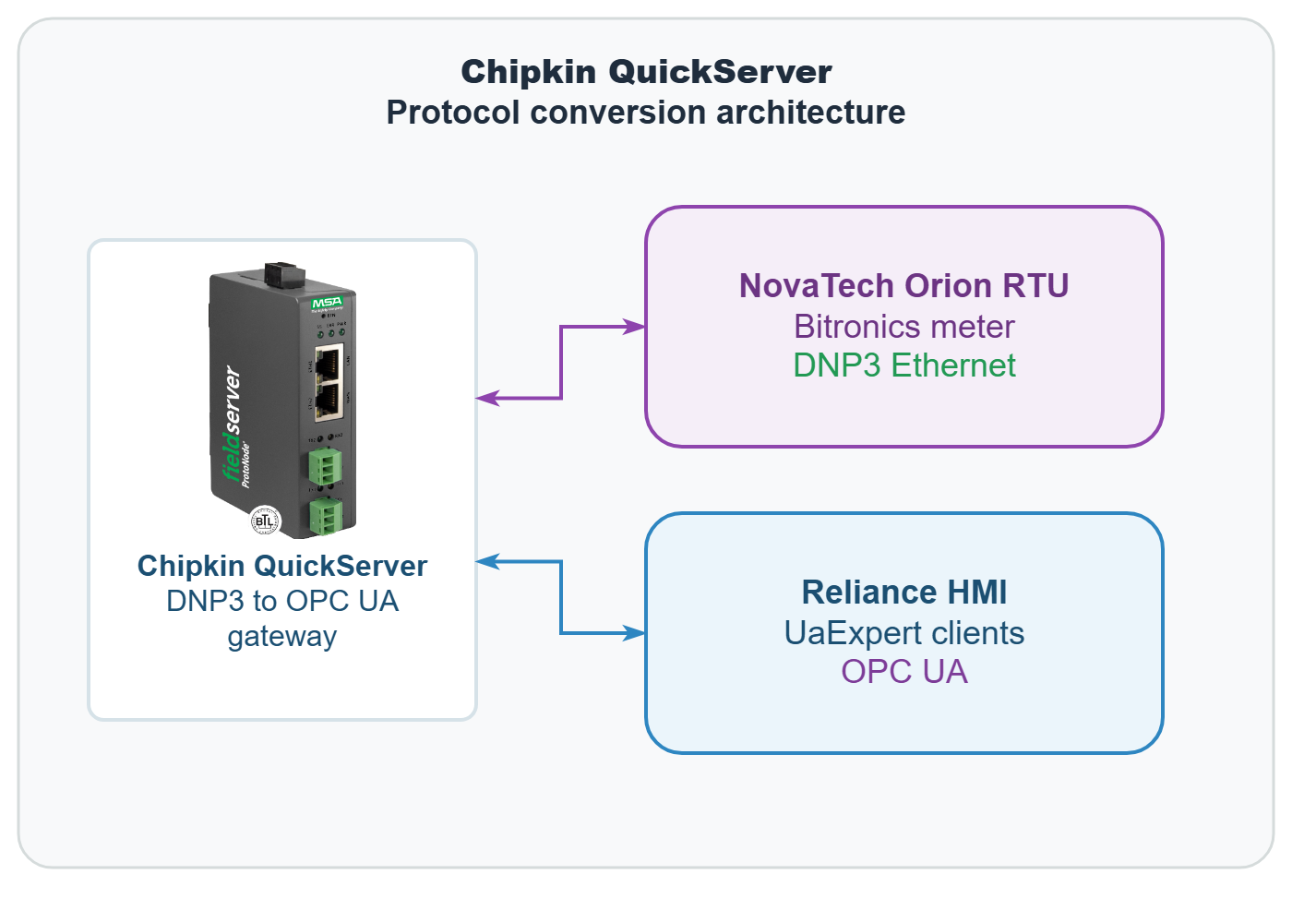
NovaTech Orion RTU / Bitronics meter -> DNP3 Ethernet -> Chipkin QuickServer -> OPC UA -> Reliance HMI / UaExpert
DNP3 Ethernet to OPC UA Challenge
The project was not blocked by basic protocol compatibility. It was blocked by direction, firmware state, and proof. The customer needed the QuickServer protocol engine to behave as a DNP3 Ethernet client against NovaTech Orion telemetry, then expose that NovaTech Orion data through an OPC UA server that Reliance and UaExpert could browse.
A second obstacle was commissioning clarity. During field testing, the customer confirmed that NovaTech Orion DNP3 communication and point mapping were working, but the OPC UA server side was not opening as expected. In practice, that left the customer with live NovaTech Orion data in the QuickServer arrays but no dependable way to prove the OPC UA server side end to end until the application path and test method were standardized.
The same integration path also had to work across more than one QuickServer hardware variant, which raised the commercial stakes of the pilot. The customer needed a repeatable DNP3-to-OPC UA protocol gateway pattern, not a one-off bench result.
Why Chipkin for DNP3 Ethernet to OPC UA Integration
This project fit Chipkin because the problem crossed protocol direction, application readiness, and field validation. QuickServer provided the gateway platform, but the real value came from locking down the NovaTech Orion DNP3 client to OPC UA server direction and delivering a tested sample that the customer could compare against its own bench setup.
UaExpert-based validation mattered more here than a generic gateway pitch. The customer’s engineers needed a proven browse and read path they could trust before broadening the rollout.
The Solution: QuickServer DNP3 Ethernet to OPC UA Bridge
Chipkin positioned Chipkin QuickServer as a DNP3 client on the protocol engine, polling the NovaTech Orion equipment and writing those values into shared data arrays. The application engine then exposed the same NovaTech Orion data as an OPC UA server for downstream client tools.
The decisive move was standardizing the validated application path. Chipkin confirmed the required setup for the pilot, delivered a tested DNP3 Ethernet to OPC UA server configuration, and provided a validation flow the customer could repeat against UaExpert before broader rollout.
For another OPC UA deployment, see the OPC UA to BACnet/IP Process Control Tag Mapping case study.
DNP3 to OPC UA Integration Results
The project delivered a working DNP3 Ethernet to OPC UA handoff for the NovaTech Orion pilot.
Project proof points:
- Live NovaTech Orion telemetry reached the QuickServer arrays before the team validated the OPC UA browse path.
- A tested application path and sample configuration standardized the DNP3 client to OPC UA server workflow.
- UaExpert communication was customer-confirmed after the corrected setup was applied.
- The pilot established a reusable rollout pattern for the customer’s broader NovaTech Orion program.
The customer’s engineers confirmed the validated result directly:
“Our team was able to make the UAexpert communicate with the Chipkin Fieldserver - it was able to give the data from its Data Arrays to UAExpert.”
— SCADA integrator, energy systems integrator, Philippines
Have a Similar DNP3-to-OPC-UA Project?
Need to expose DNP3 telemetry to an OPC UA client without replacing the upstream RTU? Chipkin can help scope the firmware requirements, define the right client-server direction, and validate the protocol conversion handoff before field commissioning. Tell us about your project.
Frequently Asked Questions
Can QuickServer expose NovaTech Orion data to OPC UA?
Yes. QuickServer can be used as a DNP3 Ethernet to OPC UA protocol gateway. In this deployment, Chipkin used that path to expose NovaTech Orion telemetry to UaExpert and Reliance-side workflows.
Does QuickServer support DNP3 Ethernet to OPC UA server workflows?
Yes. This case study is specifically about a DNP3 client to OPC UA server deployment where QuickServer polled NovaTech Orion equipment and published the resulting values to OPC UA clients.
Can Chipkin validate the OPC UA server with UaExpert before rollout?
Yes. UaExpert validation was a major part of this project because the customer needed a repeatable proof path before widening the NovaTech Orion rollout.