What Veeder Root Is
Veeder Root is a tank-monitoring protocol family most often encountered on TLS-series automatic tank gauge consoles that need to expose inventory, probe, leak, and alarm data to broader supervisory systems. Its practical value is that the console already concentrates the fuel-system state, so a downstream gateway can often expose a complete operational picture without polling each field device individually.
The support story is still TLS-family-specific. The right way to scope the job is from the installed console model, live source interface, and current site configuration, not from brand recognition alone.
For detailed field troubleshooting, use the Veeder Root Troubleshooting Guide and the Veeder Root Tank Monitor Integration Guide.
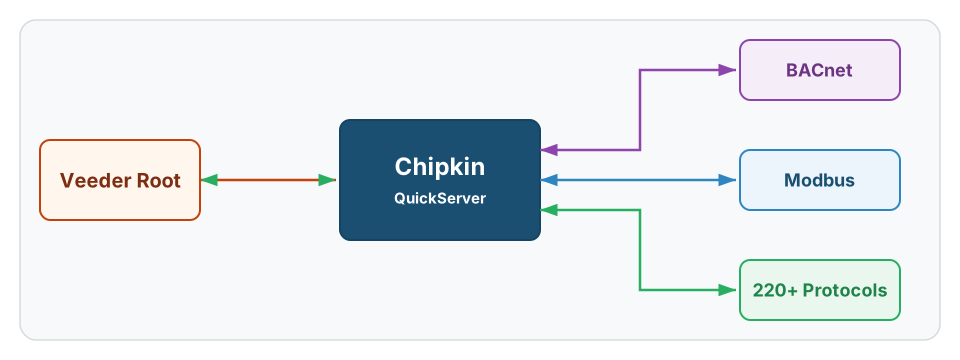
See QuickServer for Veeder Root protocol conversion options
History
Veeder Root became important in tank-monitoring and fuel-infrastructure work because TLS-family consoles gave sites a dependable source for inventory, alarms, and probe data. In modern retrofit projects, the goal is often not to replace that source system outright, but to expose it cleanly to supervisory and reporting layers.
That history matters because Veeder Root jobs usually succeed when the exact console family and existing site configuration are preserved. They fail when the project starts from a generic brand label instead of the installed TLS context.
Core Concepts
Veeder Root projects usually depend on:
- Exact TLS-family console model: TLS-350 versus TLS-450 and adjacent families change what should be assumed about the source system.
- Source interface validation: Serial path, pinout, and live console communication still need to be proven before downstream mapping work starts.
- Inventory quality: Tank, probe, sensor, and alarm definitions determine whether the console data is actually useful outside the native platform.
- Destination intent: Reporting, alarm visibility, trending, and supervisory handoff need to be identified early so the exposed point set stays disciplined.
Veeder Root-Specific Information
Public guidance for Veeder Root can be confident, but it still needs to stay TLS-family-specific and careful around adjacent compatibility claims.
Native TLS Data Model
Veeder Root projects are strongest when the console is treated as the authoritative operational source for tank inventory, alarms, and probe-state information. That is different from more ambiguous fuel-system integrations where the upstream device list is fragmented across several controllers or vendor-specific interfaces.
This is why console-side preservation matters. If the site already has a proven TLS configuration with useful labels, product definitions, and alarm handling, the integration goal is usually to preserve and normalize that model rather than rebuild it from scratch.
That is also why the exact console family matters so much. A Veeder Root TLS-350 job, a Veeder Root TLS-450 job, and a project that still depends on the Veeder Root Serial Interface do not all have the same startup assumptions.
Console and Intake Risk
| Area | Why It Matters | Common Failure Mode |
|---|---|---|
| TLS-family identification | Determines what is actually onsite | Project is scoped from brand recognition instead of the installed console |
| Serial interface validation | Controls whether the source path is real | Tank data assumptions are built before the physical link is proven |
| Tank and probe inventory | Defines usable point scope | A console is reachable, but the inventory model is incomplete |
| Adjacent compatibility claims | Prevents overstatement | Partial-compatibility cases are treated like native Veeder Root support |
Why Adjacent Compatibility Needs Caution
Fuel-system projects sometimes get described loosely because several vendors occupy similar tank-monitoring territory. Public guidance should stay disciplined here. Native TLS-family console work is one thing. Narrow compatibility cases that only resemble Veeder Root behavior at the serial or reporting layer are something else and should be called out as such.
Common Variants
| Variant | Where It Fits | Why It Matters |
|---|---|---|
| Veeder Root TLS-350 | Common installed console family | Important for model-specific intake and migration work |
| Veeder Root TLS-450 | Newer console family in some sites | Must be identified explicitly before scoping |
| Veeder Root Serial Interface | Physical source validation path | Still a hard gate for dependable integration |
How To Get The Points List
For Veeder Root, the points list should come from the actual console configuration plus the tank, probe, and alarm inventory, not from a generic expectation that every TLS console exposes the same scope.
Preferred sources:
- Console model and current site configuration
- Tank and probe schedule
- Existing alarm inventory and reporting expectations
- Console serial settings and live link confirmation
- Proven export or incumbent integration records if they exist
Devices that Support Veeder Root
QuickServer is Chipkin’s primary gateway for exposing native TLS-family console data to BACnet, Modbus, MQTT, and related supervisory targets.
Representative source systems include Veeder Root TLS-350 and TLS-450 console families. Adjacent compatibility cases should be treated as narrow and site-specific, not as broad equivalents.
Common Integration Targets
- BACnet for BMS-side tank visibility
- Modbus for SCADA and register-based monitoring
- MQTT for telemetry publishing, alarming, and analytics workflows
Tools & Diagnostics
| Tool | Type | Description |
|---|---|---|
| QuickServer | Protocol gateway | Normalizes native TLS-family console data into BACnet, Modbus, MQTT, and many other downstream protocols |
| FieldServer Toolbox | Gateway diagnostics | Useful for validating downstream point exposure after the source interface is proven |
| Console configuration records | Scope control | Useful for preserving installed tank and probe definitions |
| Serial interface validation tools | Source validation | Useful for proving the live communications path |
| Console-side service tools | Maintenance | Useful for confirming the installed console model and active configuration |
Frequently Asked Questions
What is the first question on a Veeder Root project?
Which TLS-family console is actually installed. That is the starting point for credible scoping.
Why does Veeder Root work still need serial validation?
Because the logical console model is not useful until the physical source path is proven. Pinout and interface assumptions still matter.
Why is the TLS model number such a hard startup gate?
Because the installed console family determines what should be expected from the source interface, the exposed inventory, and the amount of confidence you can place in legacy site documentation.
Are all fuel-console compatibility cases equivalent to native Veeder Root support?
No. Public guidance should keep native TLS-family support separate from narrower adjacent compatibility cases.
What usually makes a Veeder Root project go smoothly?
An identified TLS console family, a proven live source link, and preserved tank or probe inventory from the existing site configuration.
Reference Documents
- Veeder Root - Official vendor site for TLS-family console and tank-monitoring product context.