What PCCC Is
PCCC, often expanded as Programmable Controller Communication Commands, is an Allen-Bradley legacy command family associated with older controller data models and certain narrower modern encapsulation paths. Its primary practical value is continuity with installed Allen-Bradley logic, file-based addressing, and legacy host expectations that still appear in brownfield control systems.
PCCC matters most in older Rockwell and Allen-Bradley ecosystems where the site still thinks in data tables, typed files, and controller memory references rather than in a newer object-oriented protocol model. In current Chipkin evidence, it should not be treated as a broad standalone protocol strength. It is still a higher-risk, discovery-heavy path where fallback planning matters.
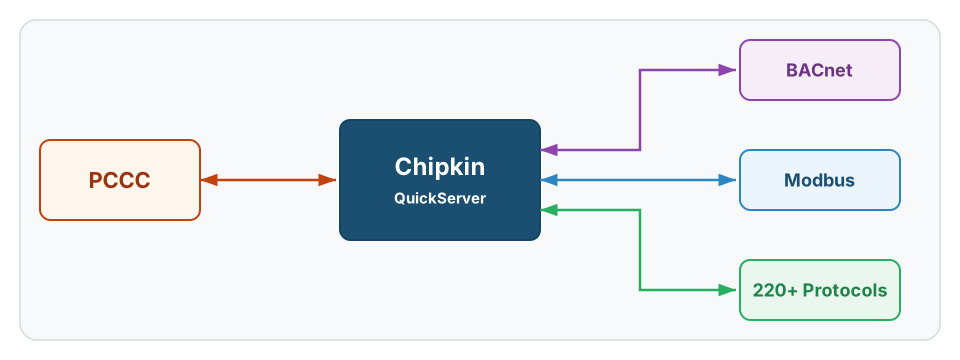
See QuickServer for PCCC-adjacent protocol conversion options
History
PCCC belongs to the Allen-Bradley legacy controller world and remained relevant because many plants built reporting, supervisory, and HMI expectations around classic file-based PLC data models. Even when newer transport layers appeared, older command behavior and memory conventions often survived inside gateways, drivers, and compatibility layers.
That history matters because many current PCCC conversations are not really about greenfield protocol choice. They are about how to preserve visibility into older controller logic or file-based data structures during modernization.
Core Concepts
PCCC projects usually depend on these concepts:
- Legacy Allen-Bradley command family: PCCC is tied to older Rockwell and Allen-Bradley controller behaviors, not to a broad modern multi-vendor ecosystem.
- File-based addressing model: data is usually referenced through typed files and offsets rather than through richer object-oriented models.
- Encapsulation context: the live job often involves PCCC over another transport or compatibility layer rather than a pure standalone network conversation.
- Modernization risk: many jobs exist because a site still depends on legacy logic visibility during a migration or integration project.
- Fallback planning: because implementations can be brittle, the project often needs a clear alternative path such as Modbus when appropriate.
PCCC-Specific Information
PCCC should usually be understood as a legacy controller command model and compatibility concern rather than as a first-choice modern integration protocol.
File-Based Data Model
PCCC jobs usually revolve around classic Allen-Bradley file types, element references, and memory conventions. That means the hardest part of the integration is often not network access. It is determining which controller files and offsets matter, what data types they hold, and how those values should be interpreted downstream.
Encapsulation And Context
PCCC often appears inside a larger transport or compatibility context. In practice, the engineering question is frequently whether the source is really a narrow PCCC use case, a legacy serial workflow, or a special case hiding inside a broader EtherNet/IP deployment.
That matters because two projects can both say “PCCC” while having very different commissioning paths and risk profiles.
Scope And Fallback Reality
Because this protocol family is legacy-heavy, many projects should be evaluated with a fallback mindset. If the site can accept a more direct or modern data-exposure path, that alternative may be operationally safer than preserving a brittle compatibility layer forever.
Common Variants
| Variant | Where It Fits | Why It Matters |
|---|---|---|
| Legacy serial PCCC context | Brownfield controller access | Common when the site is preserving older communications assumptions |
| PCCC within EtherNet/IP compatibility paths | Allen-Bradley modernization edge cases | Relevant when legacy command behavior is being encapsulated rather than natively redesigned |
How To Get The Points List
For PCCC, point lists usually come from the actual PLC file map, legacy controller documentation, or a validated list of file and element references still in use at the site.
Preferred sources:
- Existing PLC file maps and tag cross-references
- Legacy HMI or SCADA point lists
- Controller program documentation from the controls team
- Proven list of file addresses the host actually reads today
The best intake package is the exact controller family, the file references the site needs, and clarity about whether a more modern protocol path is acceptable if the legacy command route is too brittle.
Devices that Support PCCC
QuickServer is Chipkin’s primary gateway platform when legacy Allen-Bradley controller data needs to be normalized into downstream supervisory or industrial protocols such as BACnet, Modbus, or MQTT.
PCCC is primarily associated with older Allen-Bradley and Rockwell controller environments, compatibility layers, and brownfield modernization projects.
Common Integration Targets
- BACnet for supervisory visibility of controller data
- Modbus for register-based monitoring and interoperability
- EtherNet/IP when PCCC is embedded in a broader CIP workflow
Tools & Diagnostics
| Tool | Type | Description |
|---|---|---|
| QuickServer | Protocol gateway | Normalizes PCCC-adjacent controller data into BACnet, Modbus, MQTT, and many other downstream protocols |
| Rockwell engineering software | PLC engineering tool | Useful for confirming legacy controller family, file structure, and expected data references |
| Wireshark | Packet capture | Useful when a site is tunneling or encapsulating legacy behavior over Ethernet paths |
| Legacy HMI or SCADA exports | Intake artifact | Useful for proving which file addresses are actually used in production |
Frequently Asked Questions
Is PCCC a modern first-choice protocol for new designs?
Usually no. It is primarily relevant because older Allen-Bradley environments still depend on it or on compatibility paths built around it.
Why do PCCC projects need a fallback mindset?
Because many jobs exist in brownfield environments where preserving legacy behavior may be harder and riskier than exposing the needed data through a more direct modern path.
What is the most important intake artifact for a PCCC job?
A validated file map or legacy point list that shows the exact data references the site still depends on.
Is PCCC the same thing as EtherNet/IP?
No. PCCC can appear inside certain EtherNet/IP compatibility contexts, but it is not the same protocol model as native CIP-based EtherNet/IP behavior.
Reference Documents
- Rockwell Automation reference manual - Legacy Allen-Bradley reference material relevant to PCCC command behavior and file-based controller context.