What GE EGD Is
GE EGD, or Ethernet Global Data, is a producer-consumer data-exchange protocol used in GE and GE-adjacent PLC environments. Its practical value is efficient controller-data sharing, but gateway success depends on having the exchange definition clearly documented before downstream mapping starts.
It appears mainly in industrial automation and PLC interoperability work where a defined controller exchange needs to be exposed into supervisory systems. Current public Chipkin evidence is narrow: the source-side EGD behavior can be real, but fallback planning matters because the preferred downstream protocol path may not be the one that ultimately ships.
For field-level diagnostic workflow, use the GE EGD Troubleshooting Guide.
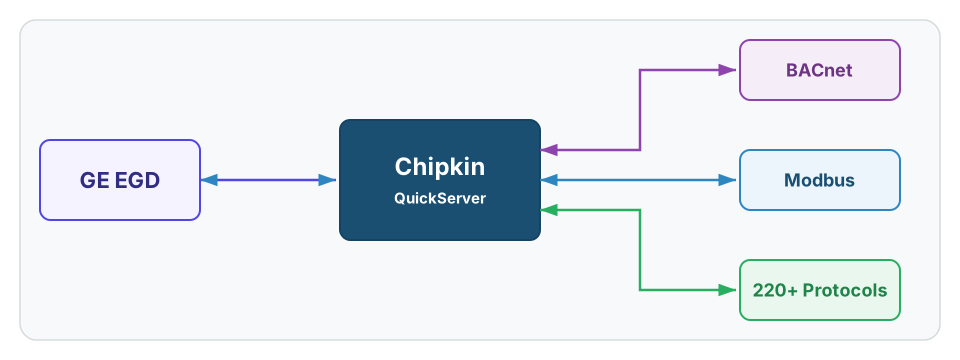
See QuickServer for GE EGD supervisory protocol conversion options
History
GE EGD comes from the PLC data-sharing side of the GE controls ecosystem, where controller-to-controller or controller-to-supervisory exchange had to move defined data blocks efficiently over Ethernet. That history matters because the protocol is organized around exchange definitions, not around browsed objects or friendly tag discovery.
In public Chipkin framing, GE EGD is best treated as a narrow but real source-side workflow. The clearest evidence supports validating the GE EGD source exchange first and keeping fallback paths open when the preferred target-side protocol becomes harder than the source itself.
Core Concepts
GE EGD projects usually depend on:
- Producer-consumer model: the source produces a defined exchange and the consumer interprets that exact payload.
- Exchange identity: producer identity and exchange identity have to be collected explicitly at intake.
- Payload layout: the engineering value is in the word, bit, and type layout, not just in proving packets are present.
- PLC context: controller family and source engineering ownership still matter because the exchange originates in the PLC project.
- Fallback discipline: if a preferred target protocol becomes brittle, a simpler exposure path may be the better delivery outcome.
Most GE EGD delays are not caused by link-level communication loss. They come from weak exchange definition or downstream assumptions that do not match the source data model.
GE EGD-Specific Information
Producer-Consumer Exchange Model
GE EGD integrations start with a produced exchange, not with device discovery. The source PLC or controller defines a payload that other systems consume according to the same engineering definition. That means the gateway project is only as good as the exchange documentation behind it.
This is why GE EGD jobs should begin with the source export, not with downstream target mapping. If the producer identity, exchange identity, or payload layout is still vague, the gateway cannot create a dependable point model.
Data Layout And Mapping Risk
The exchange payload also has to be interpreted correctly. Word and bit handling matter, and some real-world GE EGD jobs have surfaced bit-to-byte translation problems where the source data shape did not match what the downstream side expected. In those cases, proving one known-good source value and then validating the type strategy is more effective than trying to debug every point at once.
That is the main native-mechanics lesson for GE EGD: the protocol may be online, yet the engineering meaning of the payload can still be wrong. Good intake requires the exchange layout, the data-type expectations, and any bit-level interpretation rules together.
Fallback-Oriented Project Scoping
Current public evidence supports a narrow but real GE EGD story. The source side can work, but target-side complexity may still determine the final delivery path. That is why Modbus often appears as a lower-risk fallback while more demanding target protocols need stricter proof before they should be promised.
If the team can prove the GE EGD payload and one simple downstream target cleanly, the project is in a healthier place than a scope that assumes a harder target path without validating the source model first.
Common Variants
| Variant | Where It Fits | Why It Matters |
|---|---|---|
| Produced GE EGD exchange | Source-side PLC data publication | Core starting point for gateway intake |
| Consumed GE EGD exchange | Peer or downstream controller consumption | Important when the site already uses EGD internally |
| GE EGD to Modbus | Simpler supervisory exposure | Often the cleaner fallback when target validation matters |
| GE EGD to EtherNet/IP | Higher-risk interoperability path | Should stay evidence-constrained until the exact target behavior is proven |
How To Get The Points List
For GE EGD, the points list should come from the controller exchange definition and PLC engineering project.
Preferred sources:
- PLC exchange definition export
- Controller project and memory documentation
- Existing SCADA or gateway map
- Controls-team point schedule tied to the real exchange blocks
If the site can name the PLC but cannot provide the exchange structure, the GE EGD scope is still incomplete.
Devices that Support GE EGD
Representative source environments include:
| Source Environment | Why It Matters |
|---|---|
| GE or GE-adjacent PLC environments with defined exchanges | Typical source-side EGD context |
| PACSystems-style controller projects | Common place where exchange definitions drive the scope |
| Brownfield PLC migrations | Often where fallback target planning becomes important |
Common Integration Targets
- Modbus for straightforward supervisory visibility and fallback paths
- BACnet for supervisory monitoring of industrial subsystems
- MQTT where telemetry publishing is needed downstream
Tools & Diagnostics
| Tool | Type | Description |
|---|---|---|
| QuickServer | Gateway | Use when exposing a proven GE EGD source exchange to supervisory targets such as BACnet, Modbus, or MQTT |
| FieldServer Toolbox | Gateway diagnostics | Useful after source blocks are validated and the map is being checked against downstream exposure |
| PLC engineering tools | Source validation | Useful for confirming the actual exchange definition and controller ownership of the payload |
| Packet capture tools | Network validation | Useful for verifying that the live exchange is present before changing the point map |
Frequently Asked Questions
What is the most common GE EGD intake problem?
The team knows the PLC platform but does not have the actual exchange definition. Without that source artifact, the payload meaning is guesswork.
Why can GE EGD be online while the mapped points still look wrong?
Because payload presence is not the same as correct interpretation. Word layout, bit handling, and data typing can still be wrong even when the exchange is active.
Why is Modbus often mentioned as a fallback path?
Because a simpler supervisory target can be easier to validate cleanly once the source GE EGD payload is proven. That makes it a practical fallback when a preferred target protocol adds too much uncertainty.
Is GE EGD a broad field-proven QuickServer target family?
No. Current public framing should stay narrow: GE EGD is a real source-side workflow, but the supported delivery story is evidence-constrained and fallback-aware.
Reference Documents
- Emerson programmable automation controller resources - Vendor entry point for PACSystems and related controller context around GE-adjacent PLC environments.