What ControlNet Is
ControlNet is a legacy CIP-family industrial network used for deterministic data exchange in automation systems. In current Chipkin evidence, it should be treated as a brownfield reference and intake-screening topic rather than a routine modern gateway deployment path.
When ControlNet appears in a project, the first engineering question is usually whether the installed card, media path, and node assumptions are healthy enough to justify configuration work at all.
For field-level diagnostic workflow, use the ControlNet Troubleshooting Guide.
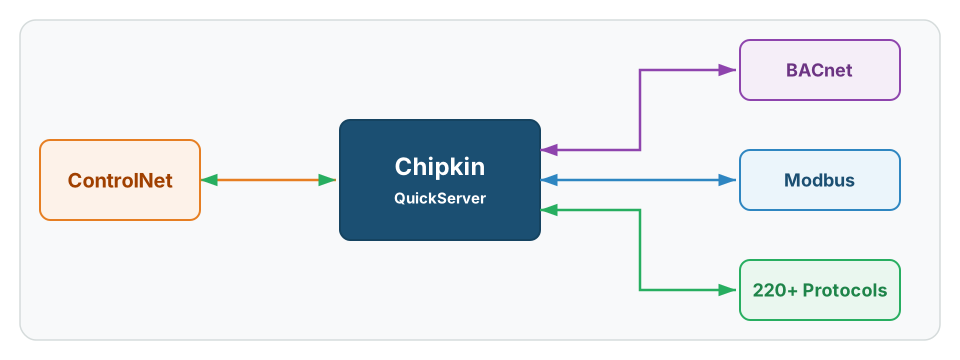
See QuickServer for brownfield protocol conversion options
History
ControlNet was built for deterministic industrial communication before standard Ethernet displaced many proprietary and semi-specialized control-network designs. Its historical value was scheduled, predictable exchange across legacy automation systems that needed more timing discipline than generic network traffic could provide.
That history also explains why current ControlNet work is usually brownfield triage rather than repeatable productized integration. The engineering risk often sits in hardware age, media condition, and source viability before gateway mapping even begins.
Core Concepts
ControlNet scoping usually depends on:
- Node and network design assumptions
- Scheduled versus unscheduled traffic expectations
- Coax or redundant-media integrity
- Legacy hardware health
- Clear target-side protocol expectations
ControlNet-Specific Information
ControlNet projects should be treated as narrow, legacy-focused, and source-validation-heavy. The challenge is proving the source can still be used reliably enough to justify downstream integration work.
Brownfield Risk Areas
| Area | Why It Matters | Common Failure Mode |
|---|---|---|
| Scheduled versus unscheduled traffic expectations | Determines what behavior the system really needs | A partially alive network is mistaken for a healthy production source |
| Media condition | Older coax or redundant links can be the actual blocker | Time is spent on mapping before the physical network is trustworthy |
| Hardware and card health | Legacy modules may be the limiting factor | The protocol is blamed when the installed hardware is failing |
| Migration target clarity | Brownfield work needs a clear business reason | The source can be browsed, but the conversion goal is still vague |
Common Variants
| Variant | Where It Fits | Why It Matters |
|---|---|---|
| Single-media ControlNet | Standard bus deployments | Simpler physical validation path |
| ControlNet Redundant Media | Higher-availability plant networks | Adds physical troubleshooting complexity |
| ControlNet Scheduled Traffic | Deterministic cyclic exchange | Core historical ControlNet value proposition |
| ControlNet Unscheduled Traffic | Diagnostics and acyclic exchange | Still part of normal operation |
How To Get The Points List
For ControlNet, the points list normally comes from the controller and I/O engineering environment rather than broad discovery.
Preferred sources:
- PLC or controller project export
- I/O schedule or network update plan
- Existing gateway or SCADA configuration
- Hardware documentation showing node layout and data ownership
Devices that Support ControlNet
QuickServer should be approached here as part of a narrow brownfield workflow, not as a claim of routine, broad ControlNet delivery.
Representative environments include legacy Allen-Bradley ControlLogix or PLC-class systems, remote I/O islands, and installed ControlNet segments where hardware viability has already been proven onsite.
Common Integration Targets
- Modbus for industrial interoperability
- BACnet for supervisory plant visibility
- EtherNet/IP for CIP-family comparison and migration planning
Tools & Diagnostics
| Tool | Type | Description |
|---|---|---|
| QuickServer | Protocol gateway | Supports narrow brownfield ControlNet workflows after source viability is proven |
| FieldServer Toolbox | Gateway diagnostics | Useful for validating downstream behavior after source-media and hardware health are confirmed |
| Vendor hardware diagnostics | Source validation | Useful for validating card and media health |
| Network media inspection | Physical validation | Critical on older coax and redundant-media systems |
Frequently Asked Questions
Why do ControlNet projects often take longer than expected?
Because many are aging brownfield jobs where hardware health and media integrity must be proven before mapping work is even the main issue.
Is ControlNet the same as EtherNet/IP?
No. Both are CIP-family protocols, but ControlNet is a legacy deterministic network with different media and commissioning behavior than EtherNet/IP.
What is the first decision on a ControlNet job?
Whether the source network is healthy enough to justify continuing. Many ControlNet jobs should be scoped as viability assessments before they are treated as integration projects.
Why is ControlNet documentation often incomplete?
Because many current sites are old enough that the original controller project, schedule data, or media drawings are no longer easy to recover.
Reference Documents
- ControlNet overview - Useful overview source for legacy ControlNet concepts and background context.