What SNMP Is
SNMP is the Simple Network Management Protocol, a monitoring and management protocol built around manager and agent communication, hierarchical object identifiers, and Management Information Base (MIB) definitions. Its practical advantage is broad interoperability for infrastructure telemetry: routers, switches, uninterruptible power supplies, power distribution units, cooling equipment, environmental monitors, and many industrial or facility-adjacent devices expose data over SNMP long before they offer a building-automation-native protocol.
SNMP is widely used in enterprise IT, data centers, telecom, and infrastructure monitoring worldwide because it gives operators a standard way to read status, counters, alarms, and health data from multi-vendor devices. In practice, the protocol usually rides over User Datagram Protocol (UDP), with requests commonly sent to port 161 and notifications sent to port 162.
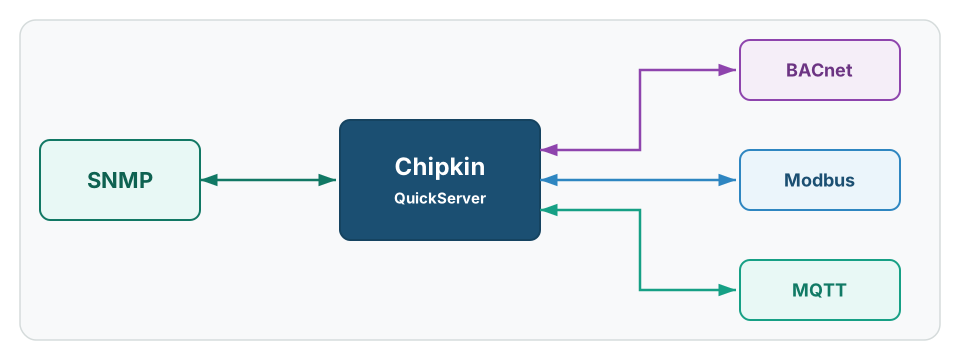
In Chipkin work, SNMP usually appears as a source protocol whose OIDs and MIB semantics need to be exposed upward as BACnet, Modbus, MQTT, or other supervisory formats.
Public SNMP guidance can be treated as field-proven for infrastructure telemetry, but the intake still has to stay disciplined around MIB availability, OID scope, notification expectations, and per-device SNMPv3 behavior. A reachable agent is not the same thing as a ready supervisory model.
See QuickServer for SNMP protocol conversion options
History
SNMP emerged from Internet network-management work where operators needed a consistent way to retrieve device status, counters, and alarms from many vendors without building a custom integration for every product line. Early adoption centered on routers, switches, and other IP infrastructure, but the protocol spread into adjacent device families such as UPS systems, cooling equipment, environmental monitoring hardware, and power infrastructure.
That history matters because most live SNMP projects inherit a mixed installed base. Some sites still rely on older community-string workflows, while others require stronger authentication and privacy through SNMP v3. The protocol looks simple from the outside, but real success depends on getting the device’s MIBs, OIDs, polling assumptions, and alarm behavior aligned with the downstream system.
Core Concepts
SNMP integrations usually depend on these concepts:
- Manager and agent roles: a manager polls or receives notifications, while an agent exposes management data on the device.
- MIB and OID structure: data points are identified by hierarchical object identifiers, and the MIB gives those identifiers names, data types, and meaning.
- Transport defaults: SNMP commonly uses UDP, with port 161 for manager-to-agent requests and port 162 for notifications.
- Read, walk, bulk, and write behavior: practical projects often use
GET,GETNEXT,GETBULK, and sometimesSET, but actual writable coverage varies by device. - Polling versus event-driven monitoring: periodic reads provide trend and state data, while SNMP traps or informs support alarm-style notification workflows.
- Version and security model: SNMP v2c is still common in legacy environments, while SNMP v3 adds authentication, privacy, and access-control expectations.
Without the MIB or a dependable OID inventory, the device may be reachable on the network but the project is not operationally ready.
SNMP-Specific Information
SNMP is deeper than a manager polling an agent. The meaningful work sits in object identity, MIB interpretation, version handling, and the difference between poll-driven and event-driven monitoring.
Manager, Agent, and Request Model
The classic SNMP pattern is a manager communicating with many agents. The manager issues requests such as GET, GETNEXT, and GETBULK to collect values, while the agent returns responses from the device’s exposed management model. Some devices also support SET, but write support is narrower than many teams assume and often limited to carefully defined objects.
This matters in protocol-conversion work because a gateway usually behaves like the manager side of the exchange. The integration design has to decide which OIDs are worth polling, how frequently they should be read, and whether the destination really needs every raw value or only a curated subset.
Read more about the SNMP manager-agent model and request flow
MIBs, OIDs, and Object Identity
SNMP does not identify useful points by friendly labels alone. It identifies management data by Object Identifiers (OIDs), and the MIB defines what those OIDs mean, which types they hold, and how tables or indexed instances are organized. In other words, SNMP reaches a device by IP address and UDP port, but it reaches a point by OID hierarchy.
That distinction is where many projects fail. A customer may know they want battery runtime, discharge state, or inlet temperature, but the real integration still depends on the vendor’s exact OID structure and instance model. On larger devices, table-based walks and indexed objects matter just as much as fixed scalar points.
For SNMPv3 environments, identity gets another layer: the authoritative SNMP engine is identified by snmpEngineID, which is not simply the same thing as the network address. That distinction matters when security, contexts, or notification handling become part of the design.
Read more about SNMP MIBs, OIDs, and object identity
Table Indexing and Walk Strategy
Many practical SNMP point models are not a flat list of scalar values. They are tables with indexed rows for interfaces, power branches, battery strings, sensors, or other repeated resources. That means a successful integration depends on understanding which table branch matters, what the index means, and whether the destination needs one summarized value or a full set of repeated instances.
That is why a generic snmpwalk is a starting point, not a finished design artifact. It proves that the agent exposes something useful, but the real handoff still needs a curated OID list tied to the monitored functions the site actually cares about.
For deeper protocol-mechanics coverage, use SNMP MIBs and OIDs and SNMP Manager-Agent Model.
Version, Security, and Notification Behavior
Version selection changes both deployment effort and site risk. SNMPv2c remains common because it is easy to configure and widely supported, but it relies on community strings rather than modern authenticated and encrypted sessions. SNMPv3 adds stronger security models, user-based authentication, privacy options, and access-control considerations, so it is usually the right choice where policy and exposure matter.
Notification behavior also needs to be designed explicitly. Polling is good for periodic telemetry and trend data, but it is not the same thing as event-driven alarming. Traps are unconfirmed notifications, while informs use a confirmed request-response pattern. If the destination expects alarm-style behavior, the project needs to decide whether polling latency is acceptable or whether notification traffic must be part of the architecture.
Read more about SNMP versions, security, traps, and informs
MIB and OID Reality
| Area | Why It Matters | Common Failure Mode |
|---|---|---|
| MIB files | Provide naming, types, tables, and semantics for the OIDs | Device responds, but the project still lacks a dependable point model |
| OID inventory | Defines the actual points to expose downstream | Team has the device model number but not the monitored object list |
| Polling strategy | Drives freshness, bandwidth, and device load | Too many OIDs are polled too aggressively |
| Version selection | Changes authentication, privacy, and access-control behavior | Site expects SNMPv3, but the design assumes v2c simplicity |
| Trap or inform usage | Supports event-driven monitoring | Team expects alarms without designing the notification path |
Read more about SNMP traps and notification workflows
Common Variants
| Variant | Where It Fits | Why It Matters |
|---|---|---|
| SNMP v2c | Legacy monitoring environments | Common but simpler authentication models |
| SNMP v3 | Security-sensitive environments | Requires more careful authentication, privacy, and access setup |
| SNMP Traps | Event-driven workflows | Useful when the destination needs alarm-style notifications |
How To Get The Points List
For SNMP, point lists usually come from the MIB and the real OID inventory tied to the installed device.
Preferred sources:
- Manufacturer MIB files
- OID export from the existing monitoring system
- Device documentation tied to actual monitored values
- Proven poll list from an existing NMS or DCIM platform
The most useful intake package is a combination of the MIB, a short list of the exact OIDs the site cares about, and a note about which values are polled versus alarm-driven. That gives the gateway project a realistic starting point for naming, scaling, alarm mapping, and downstream exposure.
If the device already lives in an existing network management system, a point export or known-good poll list is often better than starting from the entire vendor MIB and guessing which branches matter.
Devices that Support SNMP
QuickServer is Chipkin’s primary gateway for normalizing SNMP-based source telemetry into supervisory and analytics-friendly protocols.
Common SNMP-capable device families include UPS systems, network switches and routers, computer room air conditioning units, power distribution units, environmental monitors, generator support equipment, telecom power systems, and other infrastructure-class devices. The useful scope usually depends on the exact vendor MIB branches and indexed table structure, not only on the device category.
In building-automation-adjacent work, SNMP is often the protocol that exposes the right telemetry before the device offers native BACnet or Modbus integration. That makes it especially useful when the project goal is supervisory visibility rather than deep native control.
Common Integration Targets
- BACnet for BMS visibility and alarming
- Modbus for PLC and SCADA-oriented point exposure
- MQTT for telemetry publishing and analytics pipelines
Tools & Diagnostics
| Tool | Type | Description |
|---|---|---|
| QuickServer | Protocol gateway | Normalizes SNMP source data for downstream supervisory, industrial, and analytics protocols |
| FieldServer Toolbox | Gateway diagnostics | Useful for validating downstream point exposure after OID naming, scaling, and notification expectations are settled |
| iReasoning MIB Browser | MIB browser | Useful for loading MIB files, browsing OID trees, and confirming object names, types, and instance paths |
snmpwalk and snmpget | CLI tools | Useful for verifying live agent access, credentials, and OID values |
| Wireshark | Packet capture | Useful for confirming UDP/161 and UDP/162 traffic, retries, and notification flow |
| Manufacturer MIB browser tools | OID discovery | Useful for interpreting object meaning |
| Existing NMS or DCIM exports | Intake artifact | Useful for confirming the exact OIDs a live site already cares about |
Frequently Asked Questions
Why is the MIB so important on SNMP projects?
Because the MIB gives meaning to the OIDs. Without it, the source may be reachable but the data model is not operationally trustworthy.
Is SNMP a polling protocol or an event protocol?
Both patterns exist. Polling is common for telemetry collection, while traps and informs are used for event-driven monitoring.
What is the most common SNMP intake mistake?
Starting from the device model name alone instead of the actual MIB and OID set. A reachable device is not the same thing as a ready point model.
What do OIDs represent in SNMP?
An OID identifies a specific managed object or object instance inside the SNMP information model. The network address gets you to the device, but the OID hierarchy gets you to the actual point.
Why does SNMPv3 usually take longer to commission than SNMPv2c?
Because SNMPv3 adds authenticated identities, optional privacy, engine and user configuration, and access-control expectations. That extra setup is often worth it, but it is still extra engineering work.
Reference Documents
- RFC 3411 - Architecture overview for the SNMP management framework, including managers, agents, security models, access control, and engine identity.
- RFC 3416 - Protocol operations reference covering
GET,GETNEXT,GETBULK,SET, traps, informs, and message-size behavior. - RFC 3417 - Transport mappings for SNMP over UDP and other transports, useful for practical network-path expectations.
- Wikipedia: Simple Network Management Protocol - Useful high-level overview of SNMP history, versions, and common deployment patterns.
- Net-SNMP project - Widely used open-source SNMP tooling and implementation reference for testing and diagnostics.