What Siemens XLS / Cerberus Is
Siemens XLS and Cerberus are Siemens fire-panel integration families used when alarm, supervisory, trouble, and status data must be exposed to another supervisory protocol while keeping the installed fire system in place. Their primary practical advantage is preserving the source fire-panel environment while enabling downstream visibility into selected event and point data.
Siemens XLS / Cerberus belongs in fire-system integrations where the site needs downstream visibility in BACnet or another supervisory system without replacing the installed Siemens fire platform. Current Chipkin evidence supports field-proven public coverage, but the guide should still keep family identification, XML-export quality, naming limits, point-count planning, and fire-contractor coordination explicit.
For field-level diagnostic workflow, use the Siemens XLS / Cerberus Troubleshooting Guide.
See QuickServer for fire-panel protocol conversion options
History
XLS and Cerberus remain relevant because many sites still need to preserve installed Siemens fire systems while surfacing operational data into a BAS, monitoring platform, or other supervisory layer. These are usually structured fire-panel integrations rather than generic fieldbus conversions.
In current Chipkin framing, XLS / Cerberus has stronger public evidence than the Desigo/APOGEE retrofit story, but it still requires disciplined intake and family identification. Real success depends on structured source exports, naming-policy agreement, and scope control before the job reaches site testing.
Core Concepts
Siemens XLS and Cerberus projects usually depend on:
- Family identification: the job has to confirm whether it is XLS, MXL, Cerberus PRO, FireFinder, or another related Siemens fire family.
- Structured source exports: XML or validated engineering data is much stronger than partial PDFs or screenshots.
- Naming policy agreement: description lengths, map-descriptor limits, and BACnet object naming need early agreement.
- Point-count discipline: alarm, trouble, supervisory, and analog scope must fit the actual ordered tier.
- Aggregation strategy: multi-panel or pseudo-point workflows have to be designed deliberately.
Siemens XLS / Cerberus-Specific Information
Family Identification Before Mapping
The first XLS / Cerberus question is which Siemens fire family is actually installed. Current public evidence supports real delivery, but it does not support collapsing every Siemens fire-panel job into one generic pattern. XLS, MXL, Cerberus PRO, and FireFinder context all shape the source assumptions differently.
That is why the guide should be explicit about family identification. If the intake says only “Siemens fire panel,” the engineering work is not ready to start cleanly.
XML Exports And Engineering Data Quality
Structured exports are one of the biggest practical advantages in these jobs. When XML or other reliable engineering data is available, mapping can stay disciplined. When the team works from partial PDFs or screenshots, the project often slows down and accumulates avoidable naming or point-identity rework.
This is why public XLS / Cerberus guidance should keep data quality central. Source export quality is not a minor convenience. It shapes the entire mapping effort.
Naming Limits And Multi-Panel Aggregation
Many XLS / Cerberus jobs become difficult after communication is already working. The remaining problems are naming policy, field-length constraints, and how multiple panels or pseudo points are consolidated. Those are presentation and architecture questions, but they are still part of the protocol-delivery reality.
That is why public guidance should discuss naming and aggregation openly. A project can fail late not because the gateway cannot communicate, but because the scope and naming rules were never stabilized.
Common Variants
| Variant | Where It Fits | Why It Matters |
|---|---|---|
| XLS single-family workflow | Sites with clear family identity and structured exports | Best fit for efficient, lower-rework mapping |
| Cerberus or multi-family fire migration | Sites with related Siemens fire families and more complex scope | Requires stronger intake and naming discipline |
| Multi-panel pseudo-point aggregation | Larger sites consolidating several panels or event sets | Aggregation strategy becomes a major delivery gate |
How To Get The Points List
For Siemens XLS / Cerberus, point lists usually come from XML exports, validated point-source documents, and a clearly agreed count of the alarm, trouble, supervisory, and analog points required downstream.
Preferred sources:
- XML export or structured Siemens engineering data
- Validated point-list PDFs where structured exports are incomplete
- Confirmed family identification for the installed Siemens fire platform
- Site-confirmed naming rules and downstream object expectations
The most useful intake package combines family identification, structured source exports, naming-policy agreement, and a recalculated point count before the gateway tier is finalized.
Devices that Support Siemens XLS / Cerberus
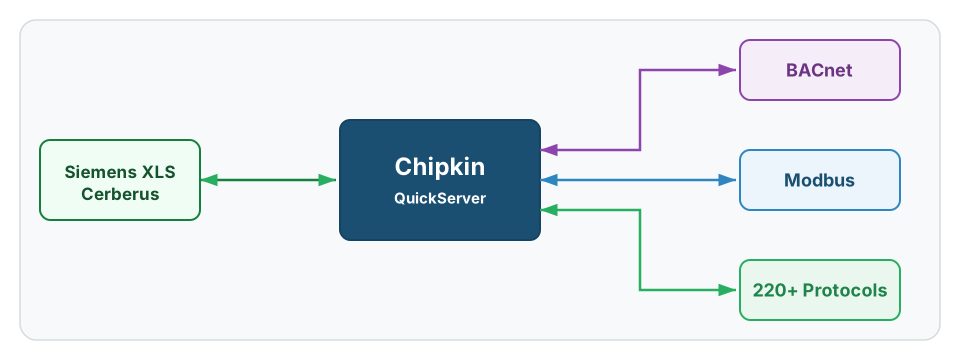
QuickServer is Chipkin’s primary gateway platform when Siemens XLS or Cerberus data needs to be normalized into BACnet, Modbus, or another supervisory protocol.
Representative contexts include fire-panel monitoring overlays, BAS visibility for life-safety states, and structured multi-panel integrations where the installed Siemens system remains in place.
Common Integration Targets
- BACnet for BMS-side alarm and status visibility
- Modbus for mixed SCADA environments with register-based delivery
Tools & Diagnostics
| Tool | Type | Description |
|---|---|---|
| QuickServer | Protocol gateway | Normalizes Siemens XLS or Cerberus panel data into BACnet, Modbus, and many other downstream protocols |
| FieldServer Toolbox | Gateway diagnostics | Useful for separating source-family and point-count issues from downstream visibility problems |
| CAS BACnet Explorer | BACnet validation tool | Useful once source mapping is stable and destination-side verification is needed |
| XML exports and point-list PDFs | Intake artifact | Useful for building a disciplined point model and confirming scope before commissioning |
Frequently Asked Questions
Is Siemens XLS / Cerberus field-proven in current public guidance?
Yes, but the public guide should still keep family identification, source exports, and point-count planning explicit.
Why are XML exports so important on XLS / Cerberus jobs?
Because structured source data reduces rework and makes point identity, naming, and mapping much more reliable.
Why do these jobs get stuck on naming instead of protocol transport?
Because description length, map-descriptor rules, and BACnet object naming can become real late-stage delivery blockers even after communication is working.
What is the most common XLS / Cerberus scope mistake?
Letting point count drift upward after the hardware tier or naming rules were already assumed.
Reference Documents
- Siemens Fire Safety - Official manufacturer context for Siemens fire-system families and product ecosystem.