What Siemens Desigo / APOGEE Is
Siemens Desigo and APOGEE refer to a family of Siemens building-automation environments, legacy networks, and controller ecosystems that still appear in retrofit modernization work. Their primary practical advantage is preserving installed Siemens field infrastructure while allowing data to move into newer supervisory layers.
Siemens Desigo / APOGEE belongs in legacy building-automation retrofit environments where P1, FLN, P2, XNET-era, or other Siemens-specific controller contexts still have to be preserved long enough to expose useful data into BACnet, Modbus, or another downstream system. Current Chipkin evidence should stay narrow and high-risk. Public wording should treat this as legacy scoping and retrofit guidance rather than as proof of routine field-proven QuickServer delivery.
For field-level diagnostic workflow, use the Siemens Desigo / APOGEE Troubleshooting Guide.
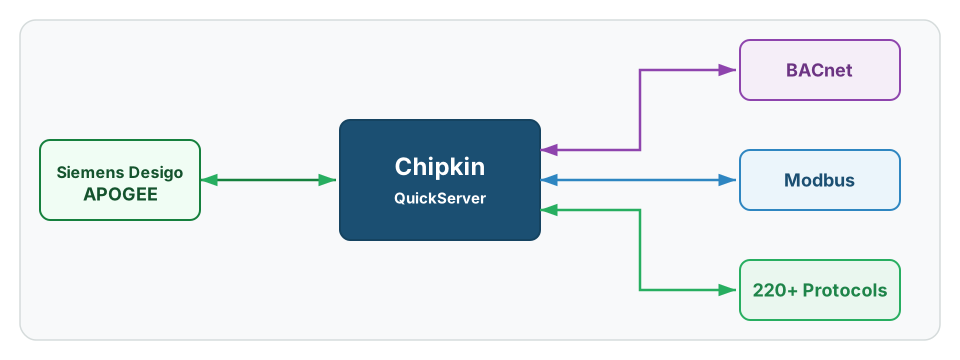
See QuickServer for retrofit protocol conversion options
History
Desigo and APOGEE remain relevant because many sites still operate large Siemens controller estates that cannot be replaced immediately even when the supervisory layer is changing. That makes these jobs less about choosing a modern protocol and more about preserving a legacy field network long enough to complete a staged migration.
In current Chipkin framing, that history matters because the strongest public evidence is one large retrofit-oriented effort with unresolved field-verification questions. The guide therefore has to stay explicit: useful as high-risk retrofit scoping guidance, not as a blanket statement of routine deployment success.
Core Concepts
Siemens Desigo and APOGEE projects usually depend on:
- Exact network-family identification: the project has to say whether the site is P1, FLN, P2, XNET, or something else before engineering starts.
- Controller-family separation: mixed Siemens controller families should not be grouped under one vague label.
- Engineering-export quality: XML, Desigo, Insight, or XWorks-derived data is often the difference between real engineering and guesswork.
- Scale discipline: large multi-panel or multi-controller jobs can fail from scope drift as much as from protocol problems.
- Field-verification planning: the site needs a runbook for proving source reception before anyone argues about BACnet object naming.
Siemens Desigo / APOGEE-Specific Information
Legacy Network Identification Comes First
Many Siemens retrofit jobs start with the word “Siemens” and nothing more. That is not enough. Before a guide can even discuss mapping, the project has to identify whether the installed path is P1, FLN, P2, XNET-era, or another specific Siemens environment.
That matters because each of those families carries different controller assumptions, different exports, and different risks. A technically polished map built for the wrong Siemens family is still the wrong project.
Engineering Exports And Source Proof
Desigo and APOGEE jobs are unusually dependent on source-side engineering artifacts. XML exports, controller lists, or structured tool outputs often determine whether the map is practical at all. When the project is working from screenshots or informal notes, revision count and field uncertainty usually rise quickly.
This is why the public guide should keep export discipline explicit. If source engineering data is incomplete, the project is still in intake, not in final troubleshooting.
Large Retrofit Scope And Verification Risk
Scale is one of the biggest Desigo/APOGEE risks. A job may involve several controller families, multiple panel groups, or a large object count. In those cases, the hardest problem is not always communication. It is proving that the gateway is actually receiving the right source data and that the scope has been controlled tightly enough to commission the result.
That is why public Desigo/APOGEE wording should stay cautious. These are high-touch retrofit jobs where source verification and feasibility screening remain part of the protocol story.
Common Variants
| Variant | Where It Fits | Why It Matters |
|---|---|---|
| Legacy Siemens building retrofit | Sites preserving older controller networks during modernization | Best public framing for current evidence |
| Mixed-family controller migration | Sites where several Siemens controller families were grouped together historically | Requires strong family separation before mapping |
| Large export-driven scope | Multi-panel or large XML-based engineering jobs | Scope control and source verification become hard gates |
How To Get The Points List
For Siemens Desigo / APOGEE, point lists usually come from structured Siemens engineering exports, controller-family documentation, and a validated site inventory grouped by actual network family.
Preferred sources:
- Desigo, Insight, XWorks, or equivalent engineering exports
- Controller-family and panel-group inventory
- Site-confirmed list of required downstream points and object count
- Known-good sample points chosen for field verification
The most useful intake package identifies the real Siemens network family first, then groups the exports and point inventory by the same source structure.
Devices that Support Siemens Desigo / APOGEE
QuickServer is Chipkin’s primary gateway platform when legacy Siemens field data must be normalized into BACnet, Modbus, or another supervisory protocol.
Representative contexts include legacy-building modernization, Siemens controller-retention projects, and high-risk retrofits where the installed field infrastructure has to be preserved while downstream visibility is added.
Common Integration Targets
- BACnet for modernization of legacy Siemens controller networks
- Modbus for register-based interoperability with SCADA and PLC systems
Tools & Diagnostics
| Tool | Type | Description |
|---|---|---|
| QuickServer | Protocol gateway | Normalizes legacy Siemens field data into BACnet, Modbus, and many other downstream protocols |
| FieldServer Toolbox | Gateway diagnostics | Useful for proving source reception before downstream naming debates begin |
| CAS BACnet Explorer | BACnet validation tool | Useful once the gateway shows expected source behavior and the target side needs validation |
| Siemens engineering exports | Intake artifact | Useful for verifying the real controller groups, point identities, and total project scale |
Frequently Asked Questions
Is Siemens Desigo / APOGEE a routine field-proven QuickServer path?
No. Current public evidence should treat it as narrow, high-risk retrofit guidance rather than routine delivery proof.
What is the most important first step on a Desigo or APOGEE job?
Identify the actual Siemens network family or interface context before doing anything else.
Why do large Desigo projects feel harder than normal protocol jobs?
Because export quality, controller-family separation, and total object scope can be as important as transport mechanics.
What is the most common Desigo/APOGEE scoping mistake?
Treating the site as one generic Siemens system instead of separating the actual network families and controller groups.
Reference Documents
- Siemens Building Automation - Official manufacturer context for Siemens building-automation families and modernization environment.
- Wikipedia: APOGEE Building Automation System - Useful overview source for legacy APOGEE context where available.