What PROFIBUS Is
PROFIBUS, short for Process Field Bus, is an industrial fieldbus family used for controller and device communications in factory and process automation environments. Its primary practical advantage is deterministic field communications across a large installed base of controllers, remote I/O, drives, instruments, and field devices that were engineered around PROFIBUS rather than around Ethernet-native industrial networks.
PROFIBUS is especially associated with Siemens-centric and European industrial installations, though it appears more broadly wherever long-lived fieldbus systems remain in service. In current Chipkin evidence, project coverage should still be treated carefully and with fallback awareness, but the protocol itself is a major legacy fieldbus rather than a niche curiosity.
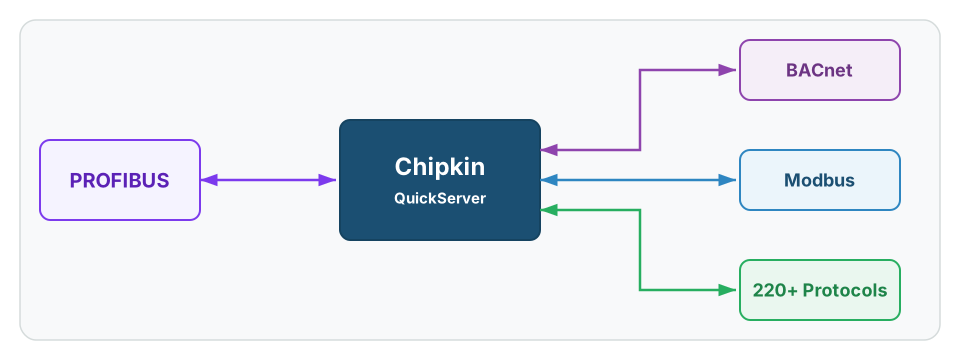
See QuickServer for PROFIBUS-adjacent protocol conversion options
History
PROFIBUS grew out of German fieldbus standardization efforts in the late 1980s and became one of the defining industrial communications families for both factory and process automation. Over time the ecosystem converged on two dominant variants: the faster controller-oriented PROFIBUS DP path and the process-instrument-oriented PROFIBUS PA path.
That history still matters because many live PROFIBUS jobs are brownfield jobs. They inherit cable rules, segment design, GSD files, address conventions, and installed-device behavior from systems that were commissioned years ago and are now being extended rather than replaced.
Core Concepts
PROFIBUS projects usually depend on these concepts:
- DP versus PA context: PROFIBUS DP and PROFIBUS PA solve related but different problems and should not be treated as interchangeable.
- Hybrid access model: classic PROFIBUS combines token passing between masters with master-slave communication to field devices.
- Physical-layer discipline: wiring, segment length, repeaters, termination, and shielding assumptions are often decisive.
- GSD-driven engineering: device integration depends heavily on the correct GSD file and matching engineering configuration.
- Installed-base reality: many projects are retrofit or extension jobs where the existing network rules matter more than generic protocol theory.
PROFIBUS-Specific Information
PROFIBUS integrations succeed or fail on the fieldbus details. This is not a protocol family where vague reachability assumptions are enough.
DP Versus PA
The two most important PROFIBUS variants are PROFIBUS DP and PROFIBUS PA.
| Variant | Typical Role | Why It Matters |
|---|---|---|
| PROFIBUS DP | Faster controller-to-remote-I/O and factory automation path | Usually associated with RS-485 physical-layer discipline and deterministic device polling |
| PROFIBUS PA | Process-automation instrumentation path | Uses a different physical-layer approach optimized for field instruments and hazardous-area use cases |
This distinction matters because a project can be technically “PROFIBUS” while still requiring completely different installation, coupler, and scoping assumptions depending on whether it is really DP or PA.
Access Method And Device Roles
Classic PROFIBUS networks use a hybrid access method that combines token passing between masters with master-slave communications to field devices. That means engineering work is shaped both by controller role assignment and by the expectations placed on the downstream devices.
Unlike a protocol family built around generic Ethernet reachability, PROFIBUS projects are sensitive to fieldbus timing, device counts, and installation quality.
GSD Files And Engineering Reality
Device engineering in PROFIBUS depends heavily on the correct GSD file. The GSD tells the engineering environment how the device should be represented, parameterized, and integrated. Without that file, the source may be physically present on the bus but still not be practically commissionable.
That is why PROFIBUS intake should always ask for the real device list, the engineering files, and enough site detail to know whether the project has local PROFIBUS installation and commissioning expertise.
Common Variants
| Variant | Where It Fits | Why It Matters |
|---|---|---|
| PROFIBUS DP | Factory automation and controller-to-I/O networks | Most common variant for fast deterministic field communications |
| PROFIBUS PA | Process instrumentation networks | Important where field devices and hazardous-area constraints shape the design |
How To Get The Points List
For PROFIBUS, point lists usually come from the actual engineering project, the configured device modules, and the GSD-backed device definitions rather than from a generic protocol description.
Preferred sources:
- Existing controller or engineering-station project files
- GSD files for the actual field devices
- Confirmed I/O or instrument channel lists
- Existing HMI, SCADA, or PLC point exports tied to the live installation
The most useful intake package includes the exact PROFIBUS variant, the device list, the engineering files, and clarity on whether the project team has real PROFIBUS commissioning experience onsite.
Devices that Support PROFIBUS
QuickServer is Chipkin’s primary gateway platform when PROFIBUS-adjacent source data must be normalized into supervisory or industrial protocols such as BACnet, Modbus, or MQTT.
PROFIBUS commonly appears on PLC networks, distributed I/O, drives, motor-control systems, and process instruments in older but still active industrial installations.
Common Integration Targets
- Modbus as a fallback path when PROFIBUS fit proves too brittle
- BACnet for supervisory visibility of industrial points
- MQTT when telemetry publishing is layered on top of a successful source-side integration
Tools & Diagnostics
| Tool | Type | Description |
|---|---|---|
| QuickServer | Protocol gateway | Normalizes PROFIBUS-adjacent source data into BACnet, Modbus, MQTT, and many other downstream protocols |
| PROFIBUS engineering tools | Device engineering tool | Useful for loading GSD files, configuring devices, and validating bus design assumptions |
| PROFIBUS tester or analyzer | Fieldbus diagnostic tool | Useful for confirming signal quality, wiring, termination, and segment health |
| Existing controller project exports | Intake artifact | Useful for deriving the real point model instead of guessing from the protocol family alone |
Frequently Asked Questions
Is PROFIBUS the same thing as PROFINET?
No. PROFIBUS is a fieldbus family, while PROFINET is an Industrial Ethernet family. They are related in vendor ecosystems but not the same protocol.
Why is the DP versus PA distinction so important?
Because the two variants imply different physical-layer, device, and commissioning assumptions even though both live under the PROFIBUS name.
Why do GSD files matter so much on PROFIBUS projects?
Because the engineering system depends on the GSD to understand the device structure, module options, and configuration expectations.
What is the most common PROFIBUS scoping mistake?
Treating the job as a generic protocol conversion problem instead of an installed fieldbus engineering problem with wiring, segment, and device-definition constraints.
Reference Documents
- Wikipedia: PROFIBUS - Useful overview of PROFIBUS history, variants, physical layers, and access method.
- PROFIBUS & PROFINET International - Official organization site for ecosystem, standards-adjacent references, and installation guidance.