
What OPC UA Is
OPC UA is an industrial interoperability protocol built around servers, nodes, namespaces, data models, and secure client access. Its practical value is rich structured data access rather than simple register polling.
It is widely used in manufacturing, industrial automation, SCADA, historians, and edge software platforms where the source system exposes a browseable information model instead of a flat register list. That richer model is exactly why OPC UA projects are powerful and why point intake quality matters so much.
In gateway work, OPC UA usually appears as the source-side server that is read and then exposed onward as BACnet, Modbus, or another operational protocol.
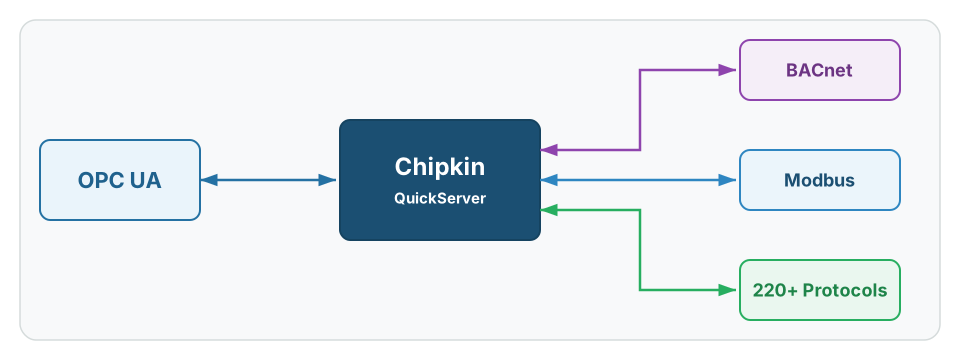
See QuickServer for OPC UA read-oriented protocol conversion options
History
OPC UA was designed as the secure, platform-independent successor to older OPC interoperability patterns. It combined rich data models, browseable server structure, and certificate-aware security so industrial systems could exchange more than raw values.
That history matters because OPC UA often looks simple in presentations and becomes more constrained in real field work. A routable endpoint is only the start; practical success depends on namespace clarity, stable NodeIDs, and security alignment.
Core Concepts
OPC UA projects usually depend on:
- Endpoint model: the server endpoint URL, transport profile, and security policy define how the session starts.
- Namespaces and nodes: OPC UA organizes data into namespaces, browse names, and node relationships rather than flat numeric registers.
- NodeIDs and data typing: stable NodeIDs and clear data types are the core of durable point mapping.
- Certificate-aware security: trust stores, user auth, and policy alignment are often the first operational gate.
- Browse scope and permissions: a reachable server may still hide the objects or methods needed for the project.
- Transport defaults: OPC UA commonly uses
opc.tcpon port4840, but real deployment details vary by server and security profile.
OPC UA-Specific Information
Current public guidance should keep OPC UA framed as a constrained, read-oriented gateway workflow unless the server behavior is proven otherwise. The hard work is usually on the intake side, not the transport side.
Nodes, Namespaces, and Addressing
OPC UA servers expose data as nodes inside a structured address space. A node can represent a variable, object, method, alarm source, folder, or type definition. Instead of polling register ranges, an integration browses this namespace tree and selects specific NodeIDs that remain stable enough to map.
Namespaces matter because the same browse name can exist in more than one namespace, and vendor models often extend the base OPC UA information model with their own objects and type definitions. A point list that omits namespace context may work in a screenshot and fail in a durable integration.
For deeper namespace structure details, see OPC UA Namespaces and OPC UA NodeIDs.
Session Security and Trust
OPC UA security usually combines endpoint policy selection, application certificates, and user authentication. Even when a server is reachable, the session can still fail because the client certificate is untrusted, the allowed security policy is different from the assumed policy, or the user token type is not what the gateway supports.
That is why certificate exchange, trust-store ownership, and exact endpoint policy details need to be collected at intake with the point list. Security settings are part of the point-access model, not later deployment polish.
For deeper certificate and policy guidance, see OPC UA Security.
Intake and Security Risk
| Area | Why It Matters | Common Failure Mode |
|---|---|---|
| Endpoint and certificate policy | Determines whether a session can even start | URL is known, but the gateway still cannot connect |
| Namespace structure | Affects stable browse and mapping behavior | Point names are copied from a browser without the namespace context |
| NodeID export quality | Controls whether the point list is durable | Screenshots exist, but there is no dependable mapping artifact |
| Write expectations versus read-only reality | Avoids overstating support | Project assumes routine writes where only read access is proven |
Common Variants
| Variant | Where It Fits | Why It Matters |
|---|---|---|
| OPC UA Namespaces | Server model organization | Critical when standard and vendor models mix |
| OPC UA NodeIDs | Stable point selection and export | Core to durable gateway mapping |
| OPC UA Security | Certificates, policies, and auth | Often the first operational blocker |
How To Get The Points List
For OPC UA, the points list should come from an exported browse or NodeID set from the live server, not from screenshots or hand-typed tags.
Preferred sources:
- Server browse export with NodeIDs and browse names
- Namespace-aware engineering export from the source platform
- Certificate and endpoint policy details collected with the point list
- Existing supervisory mapping if the site already consumes the server elsewhere
Common Integration Targets
- BACnet for building automation and BMS integrations
- Modbus for register-oriented interoperability
- MQTT for publish and subscribe telemetry pipelines
Devices that Support OPC UA
QuickServer supports constrained OPC UA client workflows centered on reading stable source-server points and exposing them to BACnet, Modbus, MQTT, and related targets.
Representative source environments include:
| Environment | Typical Role |
|---|---|
| Industrial historians and SCADA platforms | Expose structured operational data to downstream building or supervisory systems |
| PLC gateways and OEM edge servers | Bridge controller data into a browseable server model |
| Machine and process OEM platforms | Publish vendor-specific namespaces that require careful NodeID export and naming discipline |
| Software middleware and aggregation layers | Normalize data from many field sources before external consumption |
Tools & Diagnostics
| Tool | Type | Description |
|---|---|---|
| QuickServer | Gateway | Use when reading stable OPC UA points and exposing them to BACnet, Modbus, MQTT, or related supervisory targets |
| FieldServer Toolbox | Gateway diagnostics | Useful for separating source endpoint, security, and mapping issues from downstream exposure issues |
| UaExpert | OPC UA client browser | Useful for browsing namespaces, confirming NodeIDs, and testing endpoint security interactively |
| Prosys OPC UA Browser | OPC UA client browser | Useful for independent browse validation when comparing vendor endpoint behavior |
| Vendor certificate tools | Security validation | Useful for trust-store and policy setup |
Frequently Asked Questions
Why is the endpoint URL not enough for an OPC UA job?
Because the useful work still depends on accepted security policy, certificates, namespaces, and stable NodeIDs. A reachable endpoint is not a complete point model.
Is OPC UA always writable through a gateway workflow?
No. Public guidance should assume a constrained, read-oriented path unless the exact server behavior and permissions are proven.
What is the most common OPC UA intake mistake?
Treating a browser screenshot as the point list. Durable mapping needs exported NodeIDs, browse names, namespace context, and security details together.
Why do NodeIDs matter more than display names?
Because display names are for humans and can change or repeat across namespaces. NodeIDs are the durable identifiers that keep mappings stable after server restarts, firmware updates, or model reorganizations.
Reference Documents
- OPC Foundation OPC UA overview - Official high-level overview of the OPC UA architecture and positioning.
- OPC UA Specifications - Official reference entry point for the OPC UA specification set, including core services and information model details.
- Wikipedia: OPC Unified Architecture - Useful overview source for protocol history and terminology.

