What Omron FINS Is
Omron FINS, short for Factory Interface Network Service, is an Omron PLC communications service used to exchange data across different Omron network contexts such as Ethernet and serial-connected paths. Its primary practical advantage is consistency with Omron PLC data and addressing models, which lets engineering tools and host systems interact with Omron controllers without flattening everything into a third-party abstraction first.
FINS belongs in Omron-centric automation environments where the site cares about PLC memory areas, node addressing, and continuity with existing controller engineering practice. In Chipkin work, it should still be treated as inquiry-stage and early-stage scoping rather than a broadly proven repeat deployment path, but the protocol itself is established in Omron PLC ecosystems.
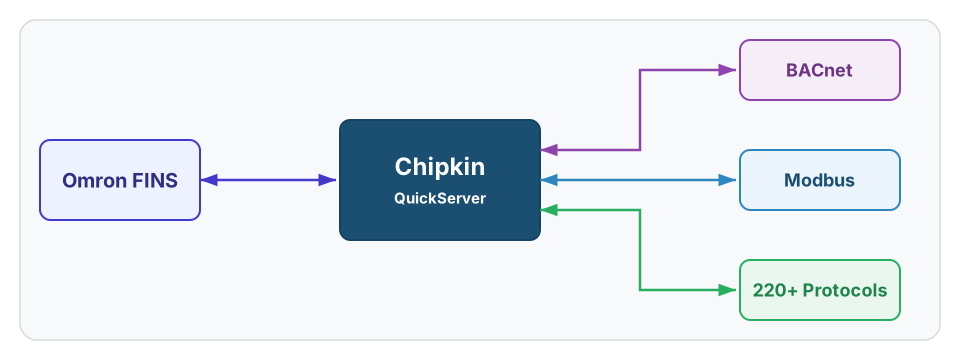
See QuickServer for Omron FINS protocol conversion options
History
FINS was developed by Omron to provide a consistent communications service across multiple Omron controller and network types. The design goal was not to create a generic multi-vendor fieldbus, but to let PLCs, computers, and engineering tools communicate with Omron controllers through a common service model even when the physical transport changed.
That history still matters because many FINS jobs are really Omron-ecosystem jobs. The project usually succeeds or fails based on controller family, memory-area knowledge, and network addressing clarity rather than on generic Ethernet reachability alone.
Core Concepts
FINS projects usually depend on these concepts:
- Omron PLC service model: FINS is tied to Omron controller behavior rather than to a broad multi-vendor device ecosystem.
- Network and node addressing: communications depend on network, node, and sometimes unit addressing rather than only an IP address.
- Memory-area access: projects usually revolve around PLC memory areas and words or bits, not around discovered semantic objects.
- Transport context: the integration has to identify whether the live path is FINS over Ethernet, serial-related tooling, or another Omron communications context.
- Project-specific point inventory: success depends on a real PLC memory map and an actual list of values the site needs downstream.
Omron FINS-Specific Information
The key technical work in FINS projects sits in address context and memory interpretation. A reachable PLC is only the start.
Network, Node, and Unit Addressing
FINS is not just about reaching a controller by IP address. The service model also depends on Omron addressing concepts such as network and node identity, and some jobs also care about unit addressing inside the controller context.
This matters because a site can have correct Ethernet connectivity and still fail at the application layer if the FINS addressing model is wrong.
Memory Areas And PLC Data Model
FINS projects usually revolve around reading or writing PLC memory areas rather than navigating a semantic object model. The exact map depends on the PLC family and the engineering conventions used in the actual Omron project.
That means the best intake artifact is usually not a broad protocol document. It is a real PLC memory map, symbol list, or controller export tied to the values the destination actually needs.
Transport And Scope Reality
Because FINS appears across more than one transport context, the first scoping question is always which live path the job really uses. For some sites the answer is clearly Ethernet. For others it is bound up with legacy Omron tooling, serial access, or controller-family details that must be confirmed before the job is treated as routine.
Common Variants
| Variant | Where It Fits | Why It Matters |
|---|---|---|
| FINS over Ethernet | PLC-to-host communications over Ethernet networks | Common choice when the site already exposes Omron controllers on IP networks |
| FINS UDP | Simpler Ethernet transport pattern | Often relevant when engineering notes or drivers specify FINS/UDP explicitly |
| FINS TCP | Session-based Ethernet transport pattern | Relevant when the specific driver or host expects TCP rather than UDP |
How To Get The Points List
For Omron FINS, point lists usually come from the actual PLC memory map, controller program documentation, or a site-confirmed symbol export.
Preferred sources:
- PLC memory maps or address lists from the controls team
- Controller program symbols or engineering exports
- Existing host or SCADA point lists tied to live Omron addresses
- Confirmed list of required words, bits, and scaling rules
The most useful intake package is the exact controller family, the addressing or memory-area list, and enough context to know which values are process data, states, counters, or commands.
Devices that Support Omron FINS
QuickServer is Chipkin’s primary gateway platform when Omron PLC data needs to be normalized into supervisory or industrial protocols such as BACnet, Modbus, or MQTT.
FINS is primarily associated with Omron PLC families and the engineering tools or host systems built around those controllers.
Common Integration Targets
- BACnet for supervisory visibility of PLC or relay states
- Modbus for controller-centric interoperability
- MQTT for telemetry publishing after the PLC point model is validated
Tools & Diagnostics
| Tool | Type | Description |
|---|---|---|
| QuickServer | Protocol gateway | Normalizes Omron FINS-adjacent PLC data into BACnet, Modbus, MQTT, and many other downstream protocols |
| Omron engineering software | PLC engineering tool | Useful for confirming controller model, node settings, and memory addresses |
| Wireshark | Packet capture | Useful for confirming whether the live path is behaving like the expected FINS Ethernet transport |
| Existing PLC symbol exports | Intake artifact | Useful for turning controller memory references into a usable downstream point list |
Frequently Asked Questions
Is FINS a general-purpose multi-vendor protocol?
No. FINS is an Omron communications service and is primarily meaningful inside Omron PLC environments.
Why is addressing clarity so important on FINS projects?
Because the application layer depends on Omron network and node concepts, not only on IP reachability.
What is the most useful intake artifact for a FINS job?
Usually a real PLC memory map, symbol list, or site-confirmed address export, not just the controller model name.
Why do FINS projects often remain scoping-heavy?
Because transport context, PLC family, and memory-area expectations all have to be confirmed before the job can be treated as routine.
Reference Documents
- Wikipedia: Factory Interface Network Service - Useful overview of FINS as an Omron PLC communications service across multiple network types.