What Notifier Is
Notifier is a Honeywell fire alarm protocol family used to expose alarm, trouble, and supervisory states into broader monitoring systems without replacing the installed fire panel. Its primary practical advantage is preserving installed fire infrastructure while enabling downstream visibility into operational event states.
In Chipkin work, practical success depends on model alignment, node mapping quality, and realistic downstream visibility scope. Public wording should stay narrow and model-sensitive, with printer-port or output constraints, untestable pre-shipment configs, and mandatory field validation kept explicit.
For field-level diagnostic workflow, use the Notifier Troubleshooting Guide.
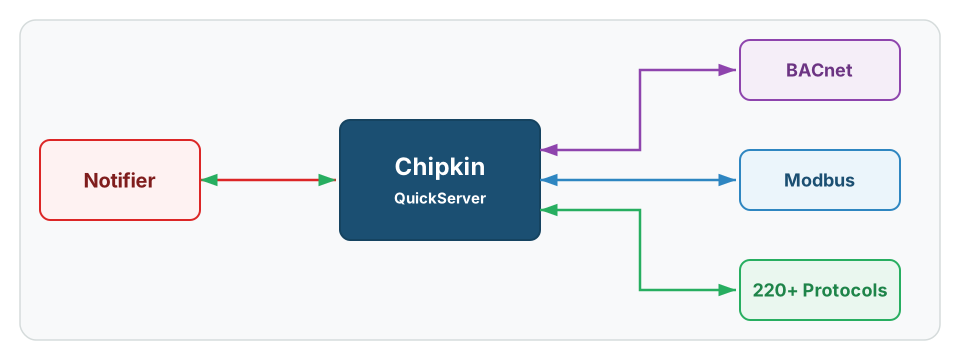
See QuickServer for Notifier protocol conversion options
History
Notifier integrations matter because installed fire panels often need supervisory visibility without replacement of the panel itself. In practice, that means model-sensitive gateway work, not broad protocol generalization.
That history matters because Notifier projects are often constrained by exact panel family, printer-port-style output behavior, and downstream parsing assumptions.
Core Concepts
Notifier projects usually depend on:
- Exact NFS, NCA2, and related panel context
- Node and array mapping quality
- Source-side point list completeness
- Clear destination-side BACnet or Modbus expectations
Notifier-Specific Information
Public guidance for Notifier should stay narrow and model-sensitive. The source panel family, output path, and parsing constraints matter more than high-level brand recognition.
Model and Parsing Risk
| Area | Why It Matters | Common Failure Mode |
|---|---|---|
| Exact panel family | Determines the real integration path | The job is scoped from the brand instead of the installed model |
| Node and array mapping | Controls usable downstream visibility | A point list exists, but it does not line up with the real node structure |
| Printer-port and output constraints | Can be the hard gate for the project | Integration assumptions are made before the actual source output is verified |
| Downstream model expectations | Avoids overpromising visibility | The target expects more semantic structure than the source really provides |
Common Variants
| Variant | Where It Fits | Why It Matters |
|---|---|---|
| Notifier NFS2-3030 | Common panel-family reference point | Keeps public guidance grounded in real family context |
| Notifier NCA2 | Node-display and network context | Can change scope and mapping assumptions |
| Notifier Printer Port Constraints | Parsing and source-output workflows | Often the real startup gate |
How To Get The Points List
For Notifier, the points list should come from the actual panel and node context, plus the source output format that will be parsed. Generic fire-panel assumptions are not enough.
Preferred sources:
- Exact panel family and network context
- Existing node and event inventory
- Sample output from the intended source path
- Downstream visibility requirements from the target system
Devices that Support Notifier
QuickServer guidance here should stay model-sensitive and narrow. The safe framing is Notifier-family integration under verified output constraints, not broad generic fire-panel coverage.
Representative contexts include Notifier-family fire-panel integrations, NFS and NCA2-adjacent workflows, and parsing-sensitive deployments where the source output format has to be proven before the downstream point model is trusted.
Common Integration Targets
Tools & Diagnostics
| Tool | Type | Description |
|---|---|---|
| QuickServer | Protocol gateway | Normalizes Notifier alarm and supervisory data into BACnet, Modbus, and many other downstream protocols |
| FieldServer Toolbox | Gateway diagnostics | Useful for validating downstream visibility after model and source-output alignment is proven |
| Panel-family records | Scope control | Useful for identifying the real source context |
| Source-output samples | Parsing validation | Useful for proving the intended data path |
Frequently Asked Questions
What is the first question on a Notifier project?
Which exact panel family and output path are in play. That determines whether the project is even scoping the right problem.
Why are printer-port and language constraints so important?
Because the parser and downstream point model depend on the actual source output format, not just on the panel brand.
Should Notifier public docs imply broad routine support?
No. The safer posture is narrow, model-sensitive, and explicit about field validation.
Why do Notifier projects fail late even when intake seemed complete?
Because the source-output path can still behave differently from the expected parser assumptions, and that often is not fully proven until live field validation.
Reference Documents
- Notifier - Official manufacturer context for the Notifier fire-panel product family.
- Wikipedia: Notifier - Useful overview source for brand and market context where available.