What McQuay Is
McQuay is a legacy HVAC equipment and controller integration context still encountered on chillers and related systems that need to expose data into a building-management workflow. Its primary practical advantage is continuity with installed HVAC controller fleets that still carry operational value long after their original supervisory environments have aged.
McQuay belongs in legacy HVAC and chiller environments where the site still depends on controller-specific data for alarms, temperatures, operating states, and service visibility. In Chipkin work, the strongest evidence is not one generic McQuay story. It is a set of narrower controller-specific patterns, including MicroTech-era equipment, PCL branches, OPM branches, and BACdrop replacement work.
For field-level diagnostic workflow, use the McQuay Troubleshooting Guide.
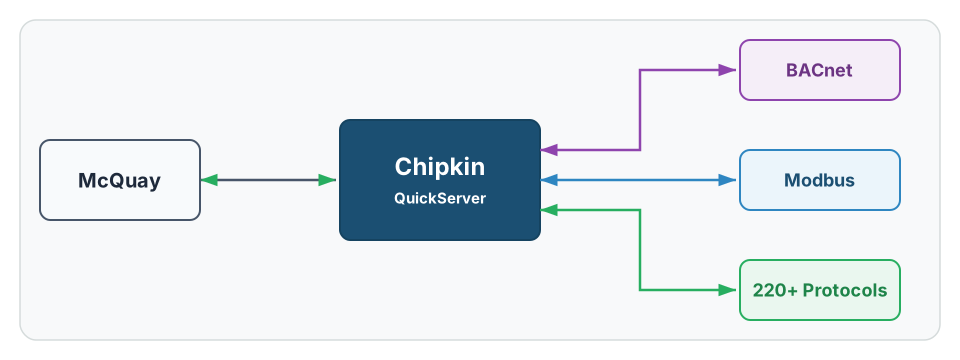
See QuickServer for McQuay supervisory protocol conversion options
History
McQuay remains relevant in retrofit building-automation work because many sites still operate long-lived HVAC equipment whose controller data has to be preserved even when the original supervisory path is being replaced or modernized. That history matters because these are usually brownfield controller-family jobs, not abstract protocol selections.
In public Chipkin framing, McQuay should stay controller-branch-specific. The risk is not just communications. It is choosing the wrong controller family assumption, the wrong PCL type, or the wrong retrofit template before source-side validation is actually complete.
Core Concepts
McQuay projects usually depend on:
- Controller-branch identification: one McQuay-branded site can still involve very different controller behaviors depending on the actual installed branch.
- PCL versus OPM context: these paths carry different setup expectations and should not be treated as interchangeable.
- Retrofit history: BACdrop replacement work and older reference configs can help, but only if the controller family really matches.
- Serial and setup details: node, baud, parity, and password fields can still be the real blocker even when the equipment branding looks familiar.
- Point-count discipline: gateway tier and final scope need to be validated before engineering drifts too far past the ordered footprint.
McQuay-Specific Information
Controller Branch And PCL Type Reality
The most important McQuay question is which controller branch is actually installed. Many delays happen because a team assumes all McQuay equipment behaves alike when the real difference is controller-side. PCL-specific jobs, MicroTech-oriented jobs, and OPM-driven jobs may share branding while requiring different commissioning assumptions.
That is why a reference config from another site is only useful after the installed branch is proven. The strongest public lesson here is to verify exact controller identity first, then validate the specific PCL type or controller profile before revising anything downstream.
OPM And Source-Side Parameter Accuracy
OPM-oriented jobs are equally sensitive to setup detail. Node address, baud rate, parity, and password assumptions can all block progress when even one field is wrong. A job that looks like a mapping problem can really be a source-setup problem that never should have reached the BAS side.
This is also why McQuay documentation should stay grounded in concrete setup patterns instead of broad generic statements. Real success depends on controller-family accuracy and parameter discipline.
Retrofit And Point-Tier Scope
McQuay jobs frequently inherit retrofit history. A BACdrop replacement or prior reference config may be part of the story, but reuse has to stay disciplined. The old template is helpful only if the current unit is on the same controller branch and the requested point scope still fits the actual gateway tier.
That means point-count planning is not just commercial cleanup. It is part of the technical scoping discipline.
Common Variants
| Variant | Where It Fits | Why It Matters |
|---|---|---|
| PCL-oriented McQuay workflow | Sites where the controller branch is defined by PCL setup | PCL type selection can be the decisive setup gate |
| OPM-oriented McQuay workflow | Jobs built around OPM board settings and serial parameters | Parameter accuracy matters more than generic brand familiarity |
| BACdrop replacement or retrofit context | Brownfield modernization work | Prior templates help only when the controller branch really matches |
How To Get The Points List
For McQuay, point lists usually come from the exact controller-family documentation, a validated source export, and the real BAS point requirements for the installed unit.
Preferred sources:
- Controller-specific point maps or engineering references
- Prior site exports only when the controller branch matches exactly
- Site-confirmed list of required alarms, temperatures, states, and commands
- Controller setup details tied to the installed equipment model
The most useful intake package includes the exact equipment family, controller branch, serial settings, and a point-count-validated scope.
Devices that Support McQuay
QuickServer is Chipkin’s primary gateway platform when McQuay controller data needs to be normalized into BACnet, Modbus, or another supervisory protocol.
Representative contexts include chiller integrations, MicroTech-era controller environments, BACdrop replacement work, and other brownfield HVAC modernization projects.
Common Integration Targets
- BACnet for BAS visibility of chiller alarms, temperatures, and states
- Modbus where the destination expects register-based handoff
Tools & Diagnostics
| Tool | Type | Description |
|---|---|---|
| QuickServer | Protocol gateway | Normalizes McQuay controller data into BACnet, Modbus, and many other downstream protocols |
| FieldServer Toolbox | Gateway diagnostics | Useful for separating source-side setup issues from BAS-side presentation issues |
| Controller-family setup references | Source validation | Useful for confirming PCL type, OPM settings, and the actual controller branch |
| Site point-count and scope sheets | Intake artifact | Useful for validating technical scope against the ordered gateway tier |
Frequently Asked Questions
What is the most common McQuay scoping mistake?
Assuming the equipment brand tells you the controller behavior. The real deciding factor is the installed controller branch and setup path.
Why do PCL type and OPM settings matter so much?
Because one wrong controller-profile or parameter assumption can block the source side before any BACnet or Modbus mapping work becomes meaningful.
Can a prior McQuay config be reused safely?
Only after proving the current unit is on the same controller branch and the new point scope still fits the project.
Why is point-count planning part of technical scoping here?
Because these jobs often grow during retrofit work, and the gateway tier has to match the actual requested visibility instead of an early rough estimate.
Reference Documents
- Daikin Applied - Official manufacturer context for the broader McQuay and Daikin Applied equipment ecosystem.
- Wikipedia: Daikin - Useful overview source for brand history and corporate context around legacy McQuay equipment.