What LonWorks Is
LonWorks is a distributed control networking technology built around typed network variables, binding, and logical addressing rather than flat register tables. Its practical advantage is that devices can exchange semantically typed data across a peer-to-peer network without relying on a permanent master controller.
It is best known in legacy building automation systems, but the underlying LonTalk stack and Neuron model were also used in transportation, industrial, and utility environments. In the field, that usually means retrofit work where an installed LonWorks segment still contains usable control or metering data that must be exposed upward into a newer supervisory layer.
In Chipkin work, LonWorks remains a brownfield migration protocol. It usually appears when a legacy controller network must be exposed upward as BACnet or Modbus through a gateway instead of preserved as the long-term supervisory standard.
For detailed field troubleshooting, use the LonWorks Troubleshooting Guide and the LonWorks SNVT Reference & XIF Mapping Guide.
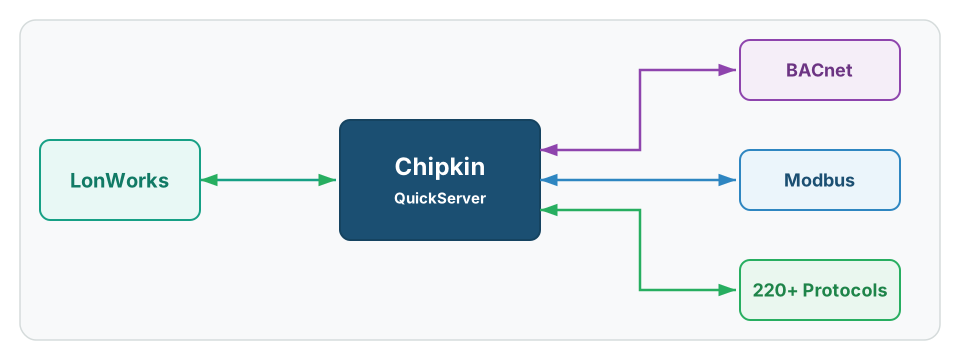
See QuickServer for LonWorks retrofit and protocol conversion options
History
LonWorks was introduced by Echelon in the late 1980s as a distributed control platform for networking everyday devices. Its design centered on the LonTalk protocol, Neuron-based implementations, and a commissioning model that allowed network behavior, bindings, and service choices to be configured at installation time rather than hard-coded into every device relationship.
That history still matters in modern retrofit projects. LonWorks can model real building intent cleanly, but only when the original commissioning information survived. A live bus is not enough if the XIF files, binding records, SNVT expectations, or Neuron identity records have been lost.
Core Concepts
LonWorks projects depend on a few concepts that are different from flat-address protocols:
- Peer-to-peer exchange: LonWorks devices do not need a permanent master. Nodes can publish or consume network variables directly based on commissioning and binding.
- Binding at commissioning time: Input and output network variables are connected during commissioning, which is why working network-management data is often more important than a generic protocol analyzer trace.
- Logical addressing over physical identity: Neuron IDs are used to bootstrap and commission devices, but day-to-day operation normally depends on domain, subnet, node, and group addressing.
- Typed data semantics: Standard Network Variable Types (SNVTs) carry both value shape and engineering meaning, which is why unit mismatches can break a mapping even when communication is otherwise healthy.
- Multiple media options: LonTalk can run over several media types, so identifying the actual physical segment in use remains a real startup requirement on legacy sites.
When those pieces are missing, the project stops being a straightforward mapping exercise and turns into a reconstruction effort.
LonWorks-Specific Information
LonWorks is deeper than a generic field bus. The real complexity lives in the source engineering model, especially the relationship between XIF files, SNVT definitions, bound variables, message services, and the destination-side unit expectations.
Key Engineering Artifacts
| Artifact | Why It Matters | Typical Failure Mode |
|---|---|---|
| XIF files | Define the device interface the gateway must map | Mapping starts without a real interface definition |
| SNVTs | Define engineering meaning and units | Destination sees a value, but not the right semantic interpretation |
| Neuron IDs | Required for bootstrap identity and commissioning workflows | The site knows the device names but cannot prove device identity |
| Domain, subnet, and node data | Define the logical network relationship | The bus is live, but there is no dependable way to map the installed topology |
| Existing supervisory map | Helps preserve proven naming and point expectations | Retrofit rebuild creates avoidable renaming and semantic drift |
Addressing, Binding, And Message Services
The LonTalk model separates physical identity from operational identity. A device can first be discovered or commissioned by its 48-bit Neuron ID, but normal network operation typically uses logical addressing such as domain, subnet, and node identifiers, with group addressing added where one-to-many behavior is required.
That matters in practice because replacement devices and retrofit rebuilds should not force every other node to be re-engineered around a new hardware identity. The Neuron ID is a bootstrap mechanism; the working system depends on the commissioned network image.
LonWorks also supports several delivery patterns, including unacknowledged, repeated unacknowledged, acknowledged, and request-response exchanges. In retrofit work, the exact message service is not academic detail. It affects network load, event behavior, retry expectations, and how well a reconstructed system will resemble the original installation.
Network Variables And Why XIF Files Matter
LonWorks applications exchange data through network variables. Those variables can be defined as inputs or outputs, and they are typically bound during commissioning instead of being permanently wired together in application code. That is one of the reasons XIF files are such a hard intake gate: they describe the variables, types, and interfaces the gateway must understand.
This is also why SNVTs matter so much. They do not only define payload shape. They also define the meaning and engineering-unit expectations of the data, which is often the difference between a useful retrofit and a technically connected but operationally misleading one.
Why Retrofit Jobs Get Hard
Unlike Modbus, where a vendor register map is often the central artifact, LonWorks depends on interface definitions and commissioning history. If the site only has vague controller names, the project is not equivalent to a partially documented register integration. It is a reconstruction effort.
Destination-Side Unit Constraints
A recurring LonWorks challenge is unit alignment. Some SNVTs imply engineering-unit families that do not map cleanly to what the destination system wants. That is why successful retrofit work often depends on changing downstream expectations rather than endlessly revising the gateway map.
Common Variants
| Variant | Where It Fits | Why It Matters |
|---|---|---|
| LonWorks FT-10 | Legacy HVAC and controller trunks | Common field deployment in older BAS estates |
| LonWorks SNVTs | Typed variable and unit model | Core semantic layer for the data model |
| LonWorks XIF Files | Interface definition and commissioning data | Hard prerequisite for dependable mapping |
How To Get The Points List
For LonWorks, the points list comes from interface definitions and commissioning records, not from a flat register list.
Preferred sources:
- XIF files for each device profile
- LonMaker or IzoT export of network variables and bindings
- Neuron ID inventory tied to controllers or trunks
- Domain, subnet, and node records from the installed network
- Existing supervisory mapping that already references SNVTs
If the site has controller names but no XIF files or variable definitions, the point list is incomplete.
Devices that Support LonWorks
QuickServer is Chipkin’s primary gateway for exposing LonWorks source data into normalized supervisory protocols.
Common LonWorks device families include Echelon i.LON controllers, Honeywell Excel 500, Trane Tracer installations, Distech controllers, LonPoint modules, and Loytec L-VIS environments.
Common Integration Targets
- BACnet for retrofit normalization into modern BMS workflows
- Modbus for register-based interoperability with gateways and PLCs
- MQTT for cloud telemetry from legacy field systems
Tools & Diagnostics
| Tool | Type | Description |
|---|---|---|
| QuickServer | Protocol gateway | Normalizes LonWorks source data into BACnet, Modbus, MQTT, and many other downstream protocols |
| FieldServer Toolbox | Gateway diagnostics | Useful for verifying downstream exposure after source commissioning artifacts are confirmed |
| LonMaker | Network management | Useful for binding, browsing, and commissioning data |
| IzoT CT | Configuration | Useful for current LonWorks engineering, commissioning, and database export workflows |
| LonScanner Protocol Analyzer | Analyzer | Useful for confirming live LonTalk traffic |
Frequently Asked Questions
What is an XIF file?
It is the interface definition for a LonWorks device. Without it, the gateway cannot reliably interpret the source interface.
What is binding in LonWorks?
Binding is the commissioning process that connects output network variables to compatible input network variables. It is one of the main reasons LonWorks jobs depend on preserved engineering data instead of only packet captures.
Why is LonWorks harder than a register-based protocol?
Because the project depends on device-specific interface files, logical addressing, binding records, Neuron IDs, and SNVT interpretation rather than only a numbered address table.
What is the most common LonWorks intake blocker?
Missing XIF files or missing Neuron ID records. Those are usually the real blockers long before gateway configuration becomes the main issue.
Why do LonWorks unit mappings sometimes stay awkward even after communication works?
Because the source SNVT may be bound to a specific engineering-unit family. The right solution is often to adjust destination expectations rather than force an unnatural representation.
Reference Documents
- Real Time Automation LonWorks overview - Practical overview of the LonTalk model, Neuron architecture, addressing, binding, and message-service behavior.
- ISO/IEC 14908 overview - Standards overview for the LonWorks and LonTalk family.
- Renesas LonWorks resources - Vendor resources for current LonWorks engineering and tooling context.
- Wikipedia: LonWorks - Useful overview for historical context and terminology.