What KNX Is
KNX is a building automation protocol used for lighting, HVAC, shading, room control, and related building functions. Its main value is standardized group-address-based integration: field devices exchange typed values using KNX datapoint definitions rather than vendor-specific private payloads.
KNX is especially common in European building automation and in multi-vendor room-control deployments where installers want interoperable field devices instead of one closed vendor stack. In retrofit and supervisory crossover work, KNX often acts as the source-side building protocol that must be handed off to BACnet, Modbus, or analytics-oriented targets without losing the meaning carried by group addresses and datapoint types.
The most important intake dependency is not general protocol awareness. It is whether the ETS project data and group-address definitions are actually available.
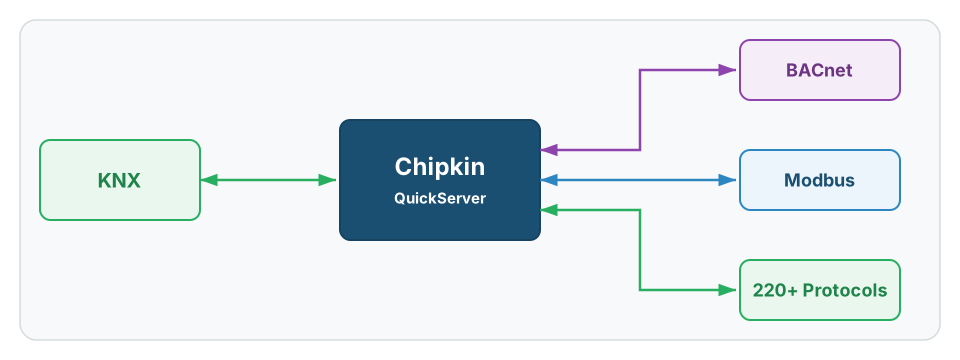
See QuickServer for KNX protocol conversion options
For field-level diagnostics and project intake discipline, start with the KNX Troubleshooting Guide.
History
KNX emerged from the consolidation of earlier European building-control efforts, especially EIB, BatiBUS, and EHS, into one standardized building-automation family. That history matters because KNX was built to support multi-vendor field devices and room-control workflows rather than the simpler point-polling pattern seen in many industrial protocols.
In practice, this means KNX projects tend to live or die on engineering artifacts such as the ETS project, group-address structure, and datapoint definitions rather than on packet transport alone.
Core Concepts
KNX projects usually depend on:
- Group-address structure: KNX point identity usually lives in group addresses, so usable integrations depend on the actual address hierarchy rather than only device names.
- Datapoint type (DPT) definitions: The DPT gives the value meaning, including encoding, scaling, and interpretation rules.
- ETS project availability: The ETS database is often the real source of truth for addresses, DPTs, comments, and commissioning intent.
- Media and router architecture: Twisted pair, IP tunneling, IP routing, and RF change how the integration reaches the source network and what must be validated.
- Clear destination-side point requirements: Good KNX integrations are selective; they translate the right building meaning upward instead of dumping every available group object.
Without the ETS export and the real group-address list, a KNX project usually stays in scoping rather than engineering.
KNX-Specific Information
KNX is deeper than a simple bus definition. The operational behavior depends on how the installation is engineered, how groups are named and structured, and whether the site preserved the ETS data required to make that structure usable outside the original contractor toolchain.
Group Addresses and Datapoint Types
| Component | Why It Matters | Typical Failure Mode |
|---|---|---|
| Group address hierarchy | Defines how the building is logically organized | Site has values but no reliable way to map them to building functions |
| Datapoint type (DPT) | Gives engineering meaning to each value | Destination sees traffic, but values are interpreted incorrectly |
| ETS project | Source of truth for both address and DPT definitions | Integration is attempted from partial screenshots or handwritten notes |
KNX is not just a collection of device addresses. In day-to-day engineering, the system meaning usually lives in the group-address model. A point becomes useful when the project knows which group address represents the function, what the DPT is, and how the integrator should present that value downstream. That is why a live bus capture is helpful but not sufficient. It can show that traffic exists, but it does not automatically recover the intended semantics.
This is also why point-list quality matters so much. A handoff that includes the group address, DPT, plain-language function, and room or equipment context is dramatically more valuable than a spreadsheet of labels with no KNX structure behind it.
Topology, Media, and Coupler Behavior
KNX projects also depend on how the installation is physically and logically segmented. A site may use KNX TP for field wiring, KNX IP for tunneling or routing, and KNX RF in smaller retrofit niches. Line couplers, backbone routers, and filter behavior matter because the gateway is not just reading values from nowhere. It is joining a real KNX topology with area, line, and traffic-management assumptions.
That topology matters during commissioning. A project can have correct group addresses and still fail operationally if the access path is wrong, if IP tunneling was assumed where routing is required, or if coupler filtering prevents the expected traffic from being visible where the gateway is attached.
Commissioning and Gateway Reality
Unlike a more browse-oriented protocol such as BACnet, KNX often depends on engineering exports that already exist before the gateway project starts. If the integrator does not have the ETS project, then the work is usually blocked at intake rather than delayed only at commissioning.
Supervisory Handoff Pattern
In Chipkin-style crossover projects, KNX is usually the source protocol while the destination expects normalized supervisory points. That means the real engineering task is not merely “read the bus.” It is preserving building meaning while translating group-address-based values into a target data model that a BMS or analytics system can use consistently.
Common Variants
| Variant | Where It Fits | Why It Matters |
|---|---|---|
| KNX TP | Twisted-pair building networks | Common in room and floor-level controller deployments |
| KNX IP | Routed and supervisory access | Important when KNX data needs to cross IP infrastructure |
| KNX RF | Wireless device niches | Relevant when retrofit constraints prevent new wiring |
How To Get The Points List
For KNX, the points list should come from the ETS project and group-address export, not from improvised discovery.
Preferred sources:
- ETS project export
- Group-address list with datapoint types
- Existing KNX supervisory mapping
- Site controller schedule tied to KNX functions
If the project does not provide group addresses and datapoint types, the mapping is not ready.
Devices that Support KNX
QuickServer is Chipkin’s primary gateway for exposing KNX-based source data to supervisory and cross-protocol environments.
Representative KNX device families seen in the field include Siemens room controllers, ABB building automation devices, Schneider Electric KNX controllers, MDT lighting modules, and JUNG wall-station and room-control devices. The real integration artifact is usually not the vendor name by itself, but the ETS project that ties those devices to group addresses and DPT definitions.
Common Integration Targets
- BACnet for supervisory BMS visibility and trending
- MQTT for broker-based telemetry and remote analytics
- Modbus where the destination expects register-oriented exchange
Tools & Diagnostics
| Tool | Type | Description |
|---|---|---|
| QuickServer | Protocol gateway | Normalizes KNX source data into BACnet, Modbus, MQTT, and other supervisory targets while keeping the project tied to the real group-address model |
| FieldServer Toolbox | Gateway diagnostics | Useful for validating downstream point exposure once the source access path and ETS data are confirmed |
| ETS | Engineering tool | Required source of truth for group addresses, DPT definitions, comments, and commissioning structure |
| Wireshark | Packet capture | Useful for validating KNX IP tunneling or routing traffic when the project depends on IP access |
| KNX IP test and visualization tools | Network validation | Useful for confirming router behavior, tunnel reachability, and line access assumptions |
Frequently Asked Questions
Why is the ETS project so important on KNX jobs?
Because it defines the group addresses and datapoint types that give the traffic meaning. Without it, point mapping is mostly guesswork.
Is KNX more like BACnet or Modbus?
Conceptually it is closer to building-automation protocols such as BACnet than to raw register protocols such as Modbus, because the real job depends on typed values and system structure rather than a flat register table.
Can a KNX site be integrated without the original ETS project?
Sometimes, but it becomes a much higher-risk reverse-engineering exercise. Canonical supervisory integration work should start from the ETS source data whenever possible.
What is the most common KNX scoping mistake?
Treating the project like a generic protocol browse task instead of an engineering-data task. The missing artifact is usually the address and datapoint definition set, not the gateway itself.
Reference Documents
- KNX Association - Official KNX Association site for protocol overview, architecture, and ecosystem context.
- KNX ETS - Official engineering tool reference for ETS project structure, commissioning workflow, and practical configuration context.
- Wikipedia: KNX - Useful overview source for protocol history, predecessor standards, and broad deployment context.