What Hunter ACC2 Is
Hunter ACC2 is a commercial irrigation-controller platform used on larger landscape, campus, and site watering systems. Its primary practical advantage is controller-level visibility into zones, schedules, alarms, and irrigation operating state from one central controller environment.
Hunter ACC2 belongs in irrigation and landscape-control environments where the site wants controller data exposed into a broader supervisory platform such as BACnet or another building-operations workflow. Public Chipkin evidence supports real but constraint-aware coverage, with strong emphasis on correct controller IP setup, point inventory quality, and coexistence expectations.
For field-level diagnostic workflow, use the Hunter ACC2 Troubleshooting Guide.
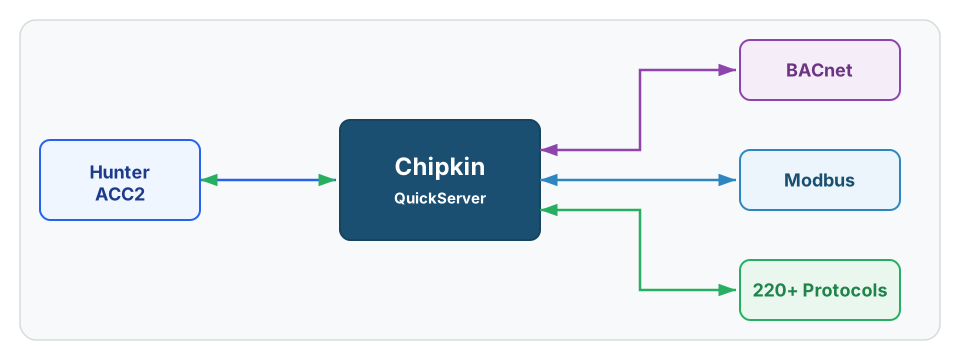
See QuickServer for Hunter ACC2 supervisory protocol conversion options
History
Hunter ACC2 comes from the commercial irrigation-controller side of site operations, where watering schedules, zone states, and controller alarms have to be managed as part of a larger facilities workflow. That history matters because ACC2 jobs are controller-specific integrations, not generic building-automation point conversions.
In public Chipkin framing, the protocol story should stay productized and disciplined. Real success depends less on abstract protocol theory and more on the exact controller model, live point export, command expectations, and whether the gateway must coexist with the site’s remote-management or cloud tooling.
Core Concepts
Hunter ACC2 projects usually depend on:
- Controller identity: exact model, firmware, and installed feature context matter before mapping starts.
- Point inventory quality: a real points spreadsheet or equivalent export is more valuable than generic product familiarity.
- Controller IP discipline: one of the repeatable setup failures is using the wrong IP assumption at intake.
- Alarm and schedule scope: ACC2 projects are shaped by which schedules, alarms, and operational states really matter downstream.
- Coexistence expectations: remote-management or cloud behavior, including Centralus-style expectations, should be validated early instead of treated as an afterthought.
Hunter ACC2-Specific Information
Controller-Centric Data Model
Hunter ACC2 is best understood as a controller workflow rather than a generic irrigation protocol. The project usually revolves around controller state, zones, schedules, alarms, and operational values that have meaning only when tied back to the actual ACC2 controller export.
That means the first strong engineering artifact is the controller’s points spreadsheet or equivalent export. If the team does not have that, the gateway map is still being guessed.
IP And Command-Detail Intake
Current public evidence shows that ACC2 jobs can fail on surprisingly specific intake mistakes, especially around source addressing and command-level assumptions. The installed controller IP has to be captured accurately, and command-oriented point documentation needs to be trusted only after it is verified against the real controller context.
This is also why controller-specific documentation quality matters. Small command-document or offset mistakes can create unnecessary trial-and-error even when the overall architecture is sound.
Single-Controller Versus Multi-Controller Scope
Public ACC2 framing should stay productized and constraint-aware. One well-defined controller is a very different scope from a project that expects one gateway pattern to cover several controllers with different schedules, alarms, or remote-management expectations.
If the site wants one gateway workflow for multiple ACC2 controllers, that architecture should be proven deliberately rather than assumed from a single-controller success pattern.
Common Variants
| Variant | Where It Fits | Why It Matters |
|---|---|---|
| Single-controller ACC2 deployment | Most straightforward building or campus irrigation integration | Best fit for a defined points export and controlled scope |
| Cloud-coexisting ACC2 workflow | Sites that need remote-management tooling to stay active | Requires coexistence validation early |
| Multi-controller irrigation architecture | Larger sites with several controllers | Higher-risk than a simple single-controller scope |
How To Get The Points List
For Hunter ACC2, point lists usually come from the controller export, points spreadsheet, or a site-confirmed command inventory tied to the installed controller.
Preferred sources:
- ACC2 points spreadsheet or equivalent export
- Controller-specific alarm and schedule inventory
- Site-confirmed list of live values that must update downstream
- Documentation showing which commands, statuses, or schedule objects matter operationally
The most useful intake package combines the exact controller IP, the points export, and a clear statement of which schedules, alarms, and statuses are actually in scope.
Devices that Support Hunter ACC2
QuickServer is Chipkin’s primary gateway platform when ACC2 irrigation-controller data needs to be normalized into BACnet, Modbus, MQTT, or another supervisory protocol.
Representative contexts include campus irrigation systems, commercial landscape-control environments, and building-operations workflows that need irrigation visibility alongside HVAC and other facility data.
Common Integration Targets
- BACnet for unified supervisory visibility across building systems
- Modbus when the destination expects controller-centric data handoff
- MQTT for telemetry publishing where applicable
Tools & Diagnostics
| Tool | Type | Description |
|---|---|---|
| QuickServer | Protocol gateway | Normalizes Hunter ACC2 controller data into BACnet, Modbus, MQTT, and many other downstream protocols |
| FieldServer Toolbox | Gateway diagnostics | Useful for separating controller-side visibility problems from downstream mapping issues |
| Hunter controller exports and spreadsheets | Intake artifact | Useful for proving the real zone, schedule, and alarm model before revising the map |
| Site network validation tools | Network validation | Useful for confirming the actual controller IP and controller reachability |
Frequently Asked Questions
What is the most common Hunter ACC2 setup mistake?
Using the wrong controller address or working from an incomplete points inventory before source validation is complete.
Why does Hunter ACC2 need a points spreadsheet so early?
Because the integration is controller-specific. Without the real export, the project does not know which schedules, alarms, or statuses are actually available.
Can one successful ACC2 deployment pattern be copied to every site?
Not safely. Single-controller and multi-controller scopes behave differently, and coexistence expectations can vary from site to site.
Why do cloud or remote-management expectations matter on ACC2 jobs?
Because the site may expect those features to remain active while the gateway is attached. That coexistence should be proven early instead of discovered during commissioning.
Reference Documents
- Hunter ACC2 controller page - Official product entry point for ACC2 controller context and feature overview.