What Gamewell FCI E3 Is
Gamewell FCI E3 is a fire-alarm panel integration family used when alarm, trouble, supervisory, and related life-safety data must be exposed without replacing the installed panel. Its primary practical advantage is preserving the installed fire system while making status and event data visible to a building or supervisory platform.
Gamewell FCI E3 belongs in life-safety and fire-panel integrations where building operators want monitored visibility into a Gamewell system through protocols such as BACnet or Modbus. Current Chipkin evidence should stay narrow. CAMWORKS remains a hard intake gate, and public wording should not treat config delivery alone as proof of field success until live panel verification is confirmed.
For field-level diagnostic workflow, use the Gamewell FCI E3 Troubleshooting Guide.
See QuickServer for fire-panel protocol conversion options
History
Gamewell FCI E3 remains relevant because many sites still need supervisory visibility into installed fire systems without replacing the panel stack. That matters because most practical Gamewell jobs are not protocol-first greenfield builds. They are life-safety retrofits shaped by panel revision, export quality, source wiring, and the availability of qualified panel-side ownership.
In Chipkin terms, current public coverage should stay evidence-constrained. Real engineering value exists, but the successful pattern is narrow and source-data dependent. A delivered config is not the same thing as a verified field outcome unless the site has actually tested live behavior.
Core Concepts
Gamewell FCI E3 projects usually depend on:
- CAMWORKS dependency: real source exports or equivalent engineering data are a hard gate.
- Panel revision accuracy: upgrade history and actual installed family details matter before config reuse is trusted.
- RS-485 path validation: source wiring and physical-path ownership must be proven before downstream mapping debates start.
- Live verification discipline: config handoff is not field success until the panel behavior is tested on site.
- Multi-party ownership: fire-panel, gateway, and BAS responsibilities have to be named clearly.
Gamewell FCI E3-Specific Information
CAMWORKS As A Start Condition
The most important public Gamewell lesson is that CAMWORKS or equivalent source data is not optional polish. It is the difference between engineering from validated source information and engineering from guesswork. If the export never arrives, the job is not really ready for mapping.
That is why public Gamewell wording should stay firm. Missing source exports are not a small inconvenience. They are a real stop condition.
Panel Revision And Config Reuse Risk
Gamewell projects often inherit prior configs, templates, or assumptions from earlier work. That can help, but only after the team proves the current installed panel family and revision. An E3 job with upgrade history can look close enough to reuse while still requiring real revalidation.
This is where narrow public framing matters. Reuse can be valuable, but it should never be sold as automatic portability between panel revisions.
Live Panel Verification Versus Paper Completion
One of the recurring risks on Gamewell jobs is the appearance of completion before live panel behavior has actually been checked. Source communication, downstream object creation, and file delivery can all look healthy while the site still has not proven live alarm or status behavior.
That is why Gamewell coverage should keep verification language explicit. Until live field behavior is confirmed, the work should be treated as still in validation.
Common Variants
| Variant | Where It Fits | Why It Matters |
|---|---|---|
| CAMWORKS-backed E3 workflow | Sites with complete source exports and defined panel ownership | Best fit for stable engineering and lower rework |
| Revision-sensitive retrofit | Sites reusing older configs after panel changes or upgrades | Requires source-side revalidation before reuse |
| Fire-panel monitoring handoff | Sites exposing alarms and supervisory events into BAS or SCADA | Works only when live point behavior is actually tested |
How To Get The Points List
For Gamewell FCI E3, point lists usually come from CAMWORKS exports, full point schedules, and a site-confirmed record of the installed panel revision and expected event scope.
Preferred sources:
- CAMWORKS export or equivalent source engineering data
- Panel revision and upgrade-history details
- Full points list with alarm, trouble, and supervisory scope
- Site-confirmed list of values or events that must appear downstream
The most useful intake package combines the actual panel family, the export, the RS-485 path assumptions, and the named party who can verify live panel behavior.
Devices that Support Gamewell FCI E3
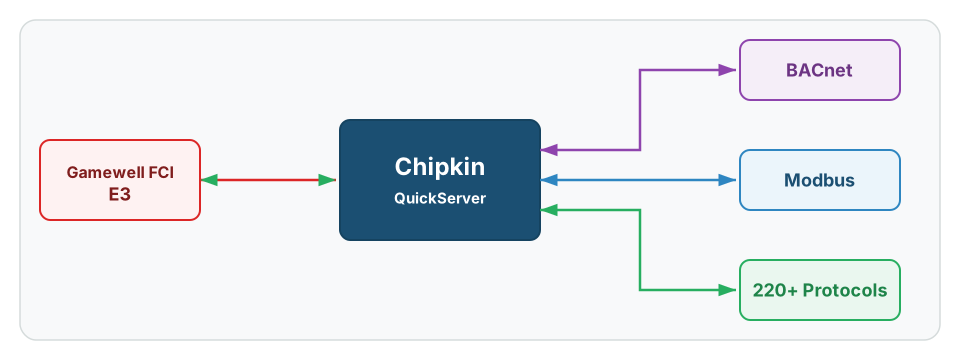
QuickServer is Chipkin’s primary gateway platform when Gamewell FCI E3 panel data needs to be normalized into BACnet, Modbus, or another supervisory protocol.
Representative contexts include fire-system monitoring overlays, BAS visibility for alarm and supervisory states, and retrofit projects where the site wants to preserve the installed panel while exposing selected status points downstream.
Common Integration Targets
Tools & Diagnostics
| Tool | Type | Description |
|---|---|---|
| QuickServer | Protocol gateway | Normalizes Gamewell FCI E3 panel data into BACnet, Modbus, and many other downstream protocols |
| FieldServer Toolbox | Gateway diagnostics | Useful for separating source-path uncertainty from downstream object-model problems |
| CAMWORKS export | Source engineering artifact | Useful for proving the real panel point model before building the map |
| Fire-panel technician validation | Field verification step | Useful for confirming live panel behavior rather than treating file delivery as final success |
Frequently Asked Questions
Can a Gamewell FCI E3 project start without CAMWORKS?
Not cleanly. Current public evidence treats CAMWORKS or equivalent source exports as a hard intake requirement.
Is a delivered config enough to call the project successful?
No. Public Gamewell guidance should require live panel verification before treating the job as field success.
Why do reused Gamewell configs fail after upgrades?
Because panel family and revision changes can invalidate assumptions that looked reusable on paper.
What is the most common Gamewell project-management mistake?
Leaving panel-side ownership vague so no one is responsible for proving the source behavior during testing.
Reference Documents
- Honeywell Gamewell FCI brand page - Official product-family context for the Gamewell FCI ecosystem.
- Wikipedia: Gamewell-FCI - Useful overview source for brand history and fire-alarm market context.