
What Franklin Fueling Is
Franklin Fueling is a fuel-site and tank-monitoring integration context used when console, tank, probe, and alarm data must be exposed into a supervisory system. Its primary practical advantage is access to operational fuel-inventory information without replacing the installed tank-monitor platform.
Franklin Fueling belongs in retail fuel, commercial fueling, and tank-monitoring environments where inventory, sensor, relay, or alarm data needs to move into a broader monitoring system such as BACnet or Modbus. Current Chipkin evidence is real but narrow. Public guidance should stay tied to Franklin EVO workflows, serial intake quality, and the decision between Veeder Root-style compatibility and an explicit Modbus fallback.
For field-level diagnostic workflow, use the Franklin Fueling Troubleshooting Guide.
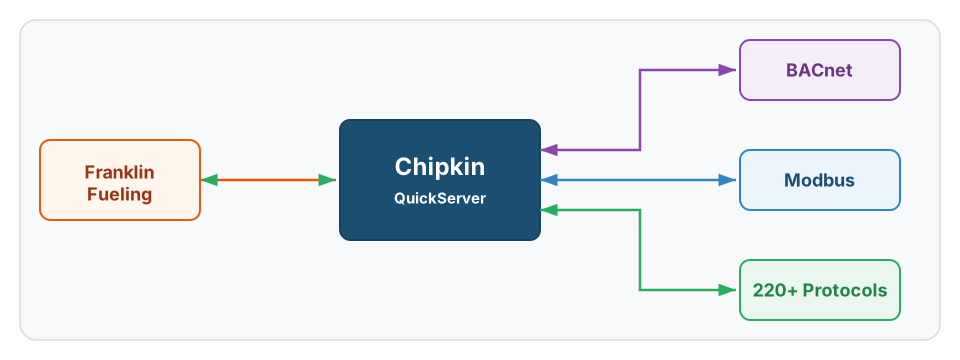
See QuickServer for fuel-site protocol conversion options
History
Franklin Fueling appears in modern monitoring projects because fuel sites often need to preserve their installed tank-monitor console while making inventory and alarm data visible to another supervisory layer. That matters because these jobs are usually not generic protocol exercises. They are console-behavior and point-family decisions shaped by the exact site hardware.
In current Chipkin framing, the strongest public story is around Franklin EVO environments where the first practical question is whether the installed console behaves well enough through a Veeder Root style path or whether the job needs Modbus to reach the missing point families. That makes Franklin Fueling a real but constrained guide rather than broad generic protocol coverage.
Core Concepts
Franklin Fueling projects usually depend on:
- Console identity: the exact EVO or related console context matters before any point map is trusted.
- Tank and sensor schedule quality: the real site tank, probe, and sensor inventory is a hard intake requirement.
- Compatibility-path selection: some jobs fit a Veeder Root-style path while others need Modbus fallback for missing values.
- Serial intake discipline: source-side serial assumptions still decide whether the project starts cleanly.
- Point-family realism: tank values, relay status, alarms, and other data families do not always arrive equally through the same source path.
Franklin Fueling-Specific Information
Franklin EVO As The Main Public Scope
The strongest public Franklin Fueling story should stay tied to Franklin EVO tank monitors and similar real console workflows. That matters because saying only “Franklin Fueling” is often too vague to define the actual console behavior, interface path, or available point families.
Good scoping starts by proving the exact console model and then deciding whether the project is primarily tank-inventory visibility, broad site alarm exposure, relay-state capture, or a mixed-scope fuel-monitoring job.
Veeder Root-Style Compatibility Versus Modbus Fallback
One of the most important Franklin Fueling decisions is whether the source behaves well enough through a Veeder Root style path. That path can be useful, but current public evidence should keep the wording narrow. Partial compatibility is not the same as full function-equivalent behavior.
If the job proves one point family cleanly but another stays absent, the correct next step is often to validate whether Modbus is the better source for those missing values instead of endlessly reworking the same compatibility map.
Tank, Probe, And Alarm Inventory Discipline
Franklin Fueling jobs are defined by real site inventory. Tank count, probe count, sensor addresses, and alarm expectations shape the map more than generic protocol language does. When the schedule is incomplete, the gateway work is still underspecified.
This is why public Franklin docs should be direct about intake quality. If the site does not yet have a trustworthy tank and sensor schedule, the main problem is missing source definition, not downstream mapping.
Common Variants
| Variant | Where It Fits | Why It Matters |
|---|---|---|
| Franklin EVO with Veeder Root-style path | Sites where core tank data is available through a compatibility-oriented console workflow | Best public fit when the required point families are limited and proven |
| Franklin EVO with Modbus fallback | Sites where relay, status, or other point families do not expose cleanly through the compatibility path | Useful when the compatibility path is only partial |
| Brownfield tank-monitor replacement workflow | Sites preserving older expectations from a prior monitoring system | Requires explicit comparison against the old point scope |
How To Get The Points List
For Franklin Fueling, point lists usually come from the real tank and sensor schedule, the exact installed console model, and a site-confirmed list of required alarm and status families.
Preferred sources:
- Tank count and tank-address schedule
- Probe and sensor inventory
- Console-specific engineering notes for the installed Franklin EVO or related platform
- Site-confirmed list of required values, alarms, relay states, and status points
The most useful intake package combines the tank schedule, the console identity, and a clear statement of which point families must be delivered through which source path.
Devices that Support Franklin Fueling
QuickServer is Chipkin’s primary gateway platform when Franklin Fueling console data needs to be normalized into BACnet, Modbus, or another supervisory protocol.
Representative contexts include Franklin EVO tank-monitor projects, fuel inventory integrations, and brownfield replacements where the site needs to preserve source visibility while modernizing the downstream monitoring path.
Common Integration Targets
- BACnet for supervisory tank visibility and alarm exposure
- Modbus for controller-oriented monitoring and fallback point access
- Veeder Root as the closest adjacent console workflow and compatibility reference
Tools & Diagnostics
| Tool | Type | Description |
|---|---|---|
| QuickServer | Protocol gateway | Normalizes Franklin Fueling console data into BACnet, Modbus, and many other downstream protocols |
| FieldServer Toolbox | Gateway diagnostics | Useful for separating source-console visibility issues from downstream mapping issues |
| Tank and sensor schedules | Intake artifact | Useful for proving the real site inventory before map work begins |
| Console engineering notes | Source validation | Useful for validating whether the installed path should behave like Veeder Root compatibility or a different interface |
Frequently Asked Questions
Is Franklin Fueling basically the same as Veeder Root?
No. Some Franklin EVO jobs are best understood through a Veeder Root-style compatibility path, but that should be treated as constrained compatibility, not full equivalence.
When should a Franklin Fueling job switch to Modbus fallback?
When the required point families do not expose cleanly through the original compatibility path even after the source-side definition is validated.
What is the most important Franklin intake artifact?
The real tank and sensor schedule tied to the exact installed console model.
Why do Franklin jobs feel incomplete even when one tank value works?
Because proving one value is not the same as proving every required point family. Tank values, alarms, relay states, and other data may expose differently.
Reference Documents
- Franklin Fueling official site - Official manufacturer context for Franklin EVO and related fuel-monitoring products.
- Wikipedia: Franklin Electric - Useful overview source for corporate context around the Franklin Fueling brand family.
