What Farenhyt Is
Farenhyt is a fire-panel integration family encountered when a gateway must expose alarm, trouble, supervisory, and restore states into a supervisory system. Its primary practical advantage is preserving installed fire infrastructure while surfacing operational states into a building or monitoring layer.
In Chipkin work, the strongest evidence centers on Farenhyt IFP-family panels, especially IFP-2100-class contexts, where driver-family selection and event translation matter as much as serial communication. Public wording should stay centered on those verified family patterns rather than implying broad generic fire-panel support.
For field-level diagnostic workflow, use the Farenhyt Troubleshooting Guide.
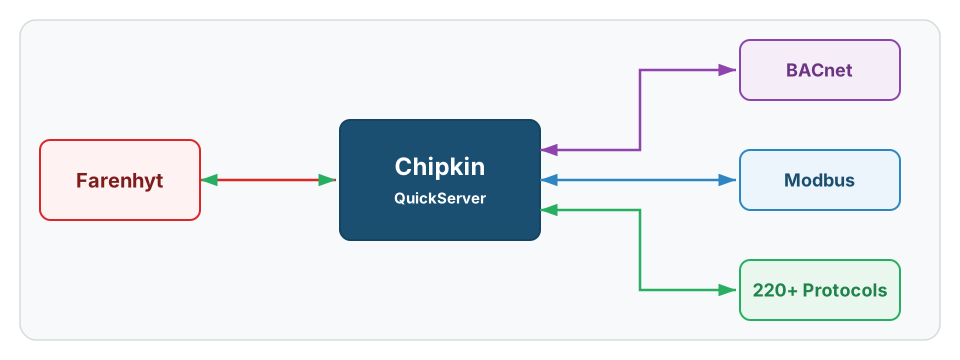
See QuickServer for Farenhyt protocol conversion options
History
Farenhyt integrations matter because sites often need to expose fire-panel events to supervisory systems without replacing installed panel infrastructure. In Chipkin evidence, the practical pattern is not generic fire-panel abstraction. It is driver-family alignment around real IFP-family hardware and event translation requirements.
That history is important because many project risks are semantic rather than electrical. The wire can work while the event model is still wrong for the downstream system.
Core Concepts
Farenhyt projects usually depend on:
- Exact panel family and interface alignment
- Event and point translation expectations
- Alarm, trouble, and supervisory data scope
- Clear target-side BACnet model expectations
Farenhyt-Specific Information
Public guidance should stay centered on IFP-family evidence and on the translation of panel events into clean supervisory states.
Fire-Panel Integration Risk
| Area | Why It Matters | Common Failure Mode |
|---|---|---|
| Panel-family identification | Determines whether the right driver assumptions are used | The project starts from brand-level assumptions instead of the actual panel |
| Event translation | Controls downstream alarm, trouble, and restore behavior | Raw communication works, but the supervisory state model is wrong |
| Multi-loop scope | Increases mapping complexity | Point count and loop structure are underestimated |
| Target-side model expectations | Defines what the downstream system can consume | The panel can speak, but the target model is not fit for purpose |
Why Event Translation Drives The Work
Farenhyt jobs can appear healthy at the transport layer while still failing operationally because the downstream system is not receiving a usable event model. Alarm, trouble, restore, and supervisory states have to be translated into something the target side can consume consistently.
That is why public Farenhyt guidance should not collapse everything into “serial communications.” The real engineering value is often in the event model and the target-side fit.
Common Variants
| Variant | Where It Fits | Why It Matters |
|---|---|---|
| Farenhyt IFP-2100 | Strongest current public reference family | Keeps guidance tied to real evidence |
| Farenhyt Event Translation | Alarm, trouble, and restore normalization | Often more important than raw serial connectivity |
| Farenhyt Multi-Loop Panels | Larger or more complex panel scope | Raises mapping and quoting risk |
How To Get The Points List
For Farenhyt, the points list should come from panel-family detail, event scope, and downstream supervisory intent rather than from a generic expectation that all fire panels expose the same model.
Preferred sources:
- Exact panel family and interface details
- Existing event and point schedule
- Alarm, trouble, and supervisory translation expectations
- Existing supervisory graphics or alarm lists if they already exist onsite
Devices that Support Farenhyt
QuickServer guidance here should stay tied to Farenhyt IFP-family panels, especially IFP-2100-class contexts, rather than implying broad generic support across unrelated fire-panel families.
Representative contexts include IFP-family fire-panel integrations, event-normalization projects, and multi-loop panel environments where the site needs supervisory visibility without replacing the installed panel.
Common Integration Targets
- BACnet for supervisory visibility of fire-panel events
- Modbus where controller-side or SCADA-style monitoring is required
Tools & Diagnostics
| Tool | Type | Description |
|---|---|---|
| QuickServer | Protocol gateway | Normalizes Farenhyt event data into BACnet, Modbus, and many other downstream protocols |
| FieldServer Toolbox | Gateway diagnostics | Useful for validating translated point exposure after source-family alignment is confirmed |
| Panel-family records | Scope control | Useful for identifying the correct driver family |
| Event list and alarm schedule | Semantic validation | Useful for defining downstream point behavior |
Frequently Asked Questions
What is the most important startup question on a Farenhyt project?
Which exact panel family is installed. That determines whether the rest of the scope is even being discussed correctly.
Why is event translation as important as serial communication?
Because the supervisory system needs meaningful alarm, trouble, and restore states. Raw communication alone does not guarantee that.
Should Farenhyt public docs claim broad generic fire-panel support?
No. The safe public posture is IFP-family-centered and evidence-driven.
What usually causes Farenhyt jobs to drift during quoting?
Multi-loop scope and event-translation expectations are often underestimated when the intake is based only on brand recognition instead of the installed panel family.
Reference Documents
- Silent Knight / Farenhyt - Manufacturer entry point for Silent Knight and Farenhyt fire-system product families.
- Wikipedia: Silent Knight - Useful overview source for brand context around the Farenhyt ecosystem.