What DNP3 Is
DNP3 is a utility and SCADA protocol built around master and outstation roles, typed data objects, event handling, and reliable telemetry over serial or IP networks. Its primary practical advantage is disciplined telemetry exchange: a site can move status, analog values, counters, controls, and event data with explicit semantics instead of flattening everything into an undifferentiated register table.
At a protocol level, DNP3 matters because it combines a formal data-object model with event classes, time-stamped changes, unsolicited reporting, and explicit control workflows. That makes it especially well suited to electric transmission and distribution, substation automation, water and wastewater, transportation, and oil and gas telemetry. It is most strongly associated with North American utility communications, while also appearing in other regions and adjacent infrastructure sectors.
In public QuickServer guidance, DNP3 can be treated as field-proven, but the strongest evidence still comes from brownfield telemetry and serial-first utility workflows. Protocol level, role assignment, addressing, and control-sequence discipline need to stay explicit from the start.
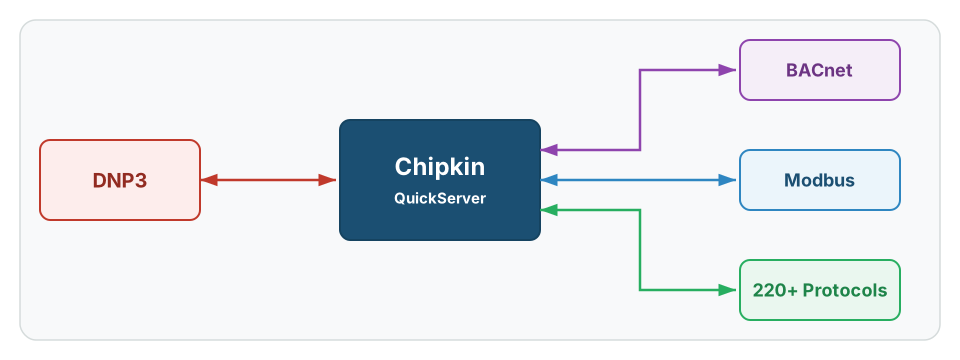
See QuickServer for DNP3 protocol conversion options
For field diagnostics and configuration detail, start with the DNP3 Troubleshooting Guide and the DNP3 Control Points & Ethernet Configuration Guide.
History
DNP3 was developed for utility and SCADA environments that needed more disciplined telemetry than a generic polling protocol could provide. It formalized master and outstation roles, typed data objects, event handling, and control workflows so utilities could move beyond device-specific serial conventions.
That history still matters because many current DNP3 projects are not greenfield. They are retrofit or expansion projects where legacy serial assumptions, addressing habits, and field-device documentation still shape what a gateway can realistically do.
Core Concepts
DNP3 projects usually succeed or fail on five assumptions:
- Master versus outstation role assignment: One side initiates and one side responds; if that assumption is wrong, the link fails before point mapping matters.
- Source and destination addressing: Application-layer addresses still matter on serial and on TCP deployments.
- Supported protocol level and object support: A device may be reachable while still lacking the required groups, variations, or control behavior.
- Serial versus TCP transport details: Serial timing and line settings still dominate many brownfield projects, while TCP adds routed-path and firewall assumptions.
- Event polling, integrity polling, and unsolicited responses: A healthy DNP3 design needs the right mix of static baseline reads and event-driven reporting.
Most DNP3 failures are application-layer mismatches, not raw transport failures.
DNP3-Specific Information
DNP3 is deeper than transport selection alone. The practical engineering work sits in object groups, event handling, protocol levels, and control behavior.
Roles, Levels, and Object Behavior
| Area | Why It Matters | Common Failure Mode |
|---|---|---|
| Master versus outstation role | Defines who initiates and who responds | Both sides are configured with incompatible assumptions |
| Protocol level and object support | Controls what data and controls are valid | Basic reads work, but required advanced behavior does not |
| Control model | Governs select-before-operate and related write paths | Reads succeed while controls fail or are ignored |
| Event handling | Determines whether the design is event-driven or poll-driven | Site expects unsolicited updates, but the design only polls |
For a deeper breakdown of master versus outstation assumptions, protocol subset expectations, and why level support matters during commissioning, see DNP3 Roles and Levels.
Protocol Level and Subset Discipline
Not every device that says DNP3 implements the same practical feature set. Protocol level still matters because it changes what the master can expect around object support, time synchronization, controls, unsolicited behavior, and interoperability with more demanding SCADA designs.
That is why protocol-level mismatch is a hard gate in public guidance. A site may confirm transport reachability and even complete basic reads, yet still fail the real project objective because the outstation does not support the expected level, subset, or control workflow.
That design question should be tied back to DNP3 Serial or DNP3 TCP early, because transport validation alone will not answer whether the endpoint supports the required telemetry and control behavior.
Data Objects, Classes, and Event Flow
DNP3 organizes data into object groups and variations rather than a flat register map. Binary inputs, analog inputs, counters, frozen counters, and control objects each have defined group and variation families. That structure matters because the master has to request data in ways the outstation actually supports, and the project point list has to preserve object, variation, class, and index detail instead of only using human-friendly labels.
The protocol also separates static and event-driven reporting through Class 0, 1, 2, and 3 behavior:
| Class | Purpose | Practical Meaning |
|---|---|---|
| Class 0 | Static data | Current baseline values returned on integrity polls |
| Class 1 | High-priority events | Fast reporting path for the most critical changes |
| Class 2 | Medium-priority events | Normal operational event traffic |
| Class 3 | Lower-priority events | Less urgent change reporting |
That event model is one of the protocol’s defining strengths. A DNP3 system can combine periodic integrity polling with event polls and unsolicited responses, which is why a healthy DNP3 design often behaves very differently from a simple request-response register protocol.
For deeper references, use DNP3 Data Objects, DNP3 Event Classes, and DNP3 Event Flow.
Control Semantics
Control behavior is another area where DNP3 is more structured than many simpler protocols. Binary controls commonly use CROB-style operations, and many devices distinguish between direct operate and select-before-operate workflows.
In practice, that means a link can read correctly while still failing every real control operation. If the device profile, control permissions, or expected function sequence is wrong, the problem is not Ethernet versus serial. It is the control model itself.
For a deeper reference on select-before-operate, direct operate, and why control testing often fails after reads succeed, see DNP3 Control Operations.
Addressing and Telemetry Design
Source and destination addressing are central to DNP3 behavior. Each endpoint still uses DNP3 application-layer addresses even when the transport is TCP, so a routed Ethernet path does not remove the need to align master and outstation identity correctly. On serial multidrop links, that addressing model sits alongside line settings and physical segment design.
Point identity matters too. A usable DNP3 point schedule normally includes object group, variation, class assignment when relevant, index, scaling, and control semantics so the master can request exactly what the outstation exposes.
That is why a DNP3 commissioning path normally starts with role confirmation, address validation, a minimal integrity poll, and then one known-good control test before the full point database is loaded. For deeper transport details, use DNP3 Serial and DNP3 TCP.
For a more focused explanation of DNP3 endpoint identity, multidrop assumptions, and what a usable addressing schedule should contain, see DNP3 Addressing.
Common Variants
| Variant | Where It Fits | Why It Matters |
|---|---|---|
| DNP3 Serial | Legacy and retrofit telemetry links | Common where RS-232 or RS-485 infrastructure is already installed |
| DNP3 TCP | Routed SCADA and modern IP-connected devices | Usually uses TCP port 20000, but device behavior still needs validation |
| Secure or vendor-constrained DNP3 deployments | Security-focused utility environments | Requires device-specific confirmation before scoping |
How To Get The Points List
DNP3 point lists usually start with the relay, RTU, or SCADA engineering database. The best handoff includes the object’s group, variation, class, index, scaling, and any control handling notes so commissioning can validate the intended design directly.
Preferred sources:
- Existing DNP3 point database with group, variation, and index detail
- RTU, relay, or SCADA export
- Control-point schedule from the utility or controls team
- Vendor configuration backup from the master or outstation
If the project only has point labels, the next step is to expand that list into object group, variation, index, and control detail before treating it as a finished mapping package.
Devices that Support DNP3
QuickServer is Chipkin’s primary gateway for exposing DNP3 source data to supervisory protocols and telemetry platforms.
Representative device families include S&C IntelliCap Plus, SEL-FLR, Orion LX, Servelec RTUs, and Schweitzer protective relays. In practice, the usable handoff usually depends less on the brand name alone and more on whether the project has a dependable point database with group, variation, class, and control detail.
Common Integration Targets
- BACnet for building and central plant visibility
- Modbus for PLC and controller-oriented exchange
- MQTT for broker-based telemetry forwarding
Tools & Diagnostics
| Tool | Type | Description |
|---|---|---|
| QuickServer | Gateway and diagnostics platform | Useful when DNP3 source data must be exposed as BACnet, Modbus, MQTT, or other supervisory formats while preserving a disciplined telemetry model |
| FieldServer Toolbox | Gateway diagnostics | Useful for validating downstream point presentation after roles, addresses, and one known-good source transaction are confirmed |
| Triangle MicroWorks | Test suite | Industry-standard DNP3 master and outstation simulation |
| ASE2000 | Analyzer | Useful for serial and TCP capture and decode |
| Wireshark | Packet analyzer | Useful for DNP3 over TCP sessions and addressing checks |
Frequently Asked Questions
What makes DNP3 different from Modbus?
DNP3 has a richer telemetry model. It uses typed data objects, event classes, unsolicited reporting, time-stamped events, and structured control workflows instead of treating everything as a flat register or coil space. That is one reason DNP3 is common in utility and SCADA environments where state changes and event timing matter.
Is DNP3 primarily serial or Ethernet?
Both exist in the field. Many retrofit jobs still use serial links, while newer systems often use DNP3 over TCP.
What is the most common DNP3 configuration error?
Role mismatch. If both sides are configured as the wrong role, the link can look alive while still failing completely.
Why do reads succeed while controls fail?
Control handling depends on more than base communications. The device may require select-before-operate, specific object support, or a different permission model than the read path.
What is the first thing to verify on a failed DNP3 link?
Role and addressing alignment. Those are the most common reasons a live link still behaves like a dead application path.
Reference Documents
- DNP Users Group Overview of DNP3 - Official overview covering the protocol’s utility focus, standards history, and adoption background.
- A DNP3 Protocol Primer - Official introductory technical primer from the DNP Users Group.
- DNP Users Group Home - Current mission, interoperability program, and adoption context including North American utility usage.
- Triangle MicroWorks DNP resources - Practical test, simulation, and training resources used in field engineering workflows.
- DNP3 on Wikipedia - Useful background summary for overview and history context.