What Control4 Is
Control4 is a smart-home and light-commercial automation platform that aggregates climate, lighting, audio-visual, security, and related control-system data into one automation experience. Its primary practical advantage is unified presentation and user interaction across many subsystems that would otherwise remain separate.
Control4 matters in residential, hospitality, and light-commercial automation environments where building-system data needs to appear inside the Control4 ecosystem rather than in a traditional industrial or building-management interface. Current Chipkin evidence should still be treated as narrow and constraint-heavy rather than as a broad routine Control4 integration story.
For field-level diagnostic workflow, use the Control4 Troubleshooting Guide.
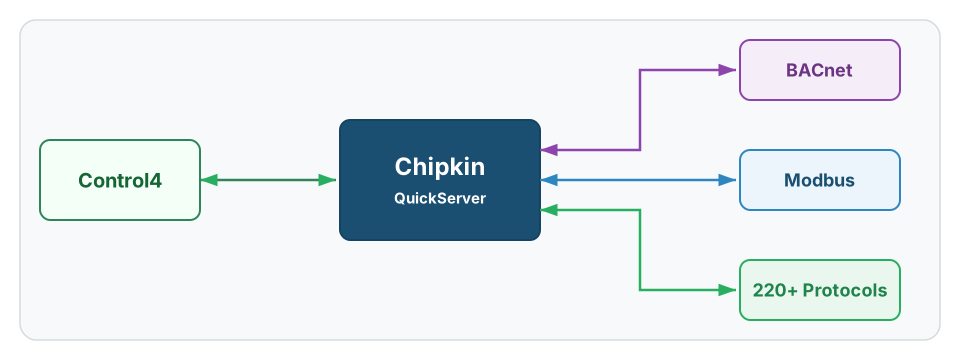
See QuickServer for Control4-adjacent protocol conversion options
History
Control4 grew as an automation platform focused on pulling multiple residential and light-commercial subsystems into one user-facing control layer. That history matters because many Control4 jobs are not really about raw protocol mechanics. They are about what the Control4-side architecture is willing to expose, display, or control cleanly.
In Chipkin terms, that makes Control4 a high-context integration. A technically valid upstream point model can still fail to deliver the expected user outcome if the Control4 driver, room model, or write path assumptions were wrong from the start.
Core Concepts
Control4 projects usually depend on:
- Architecture first: the real question is often whether the Control4-side path is read-only, write-capable, or dependent on a specific driver.
- Room and zone modeling: Control4 projects are shaped by room, thermostat, endpoint, and presentation assumptions rather than by flat point-count thinking alone.
- Upstream point discipline: source-system data, especially from BACnet, still has to be mapped clearly before Control4 can present it coherently.
- Driver and application context: a working transport path does not guarantee the right Control4-side user experience if the driver model is wrong.
- Constraint-heavy scope: current public evidence supports cautious scoping, especially where the project expects writes or broad zone coverage.
Control4-Specific Information
Read Versus Write Architecture
The first Control4 question is not usually transport. It is capability. Some Control4-facing integration paths are much stronger for monitoring than for commanding. A project can show live values correctly and still fail at the application layer because the chosen Control4-side architecture was never designed for the intended writes.
That is why public Control4 guidance has to stay careful. If the project needs true bidirectional control, that requirement should be proven early instead of being assumed from the presence of XML, HTTP, or upstream automation data.
Zone Model And Presentation Limits
Control4 integrations are also shaped by how the site wants rooms, zones, thermostats, or devices to appear in the Control4 experience. A point map that looks adequate to a building-automation engineer can still be unusable if the Control4-side zone model, driver behavior, or room breakdown does not match the actual user workflow.
This is why point scope and presentation scope have to be collected together. It is not enough to say that HVAC data should appear in Control4. The team has to know which rooms, which endpoints, and which specific interactions matter.
Upstream System Separation
Control4 jobs often rely on upstream building or device systems that carry the real operational semantics. BACnet is a common example. The source side may be healthy while the Control4-side user model is still wrong. That separation matters because it keeps the team from blaming the gateway for a driver or application-design problem above the transport layer.
Common Variants
| Variant | Where It Fits | Why It Matters |
|---|---|---|
| Monitoring-oriented Control4 path | Read-heavy building or room visibility | Often the safer fit when the project mainly needs status and feedback |
| Driver-mediated Control4 control path | Cases where Control4-side application logic is part of the design | Should be scoped explicitly rather than assumed |
| HVAC and thermostat presentation workflows | Climate integration in residential or light-commercial environments | Common place where room-model limits surface |
How To Get The Points List
For Control4, point lists usually come from the upstream automation system, the agreed room or zone model, and the exact Control4-side presentation requirements.
Preferred sources:
- Upstream system point export, especially from BACnet or the actual source platform
- Room and zone inventory tied to the Control4 user experience
- Any agreed driver or thermostat mapping document
- Site-confirmed list of which points must be readable versus writable
The most useful intake package combines point scope and presentation scope. If the team only says “integrate Control4,” the job is still underspecified.
Devices that Support Control4
QuickServer is Chipkin’s primary gateway platform when upstream building-system data must be normalized into a Control4-adjacent workflow.
Representative contexts include residential and light-commercial HVAC integrations, room-based automation overlays, and smart-building user experiences that need building-system visibility without exposing raw upstream protocol details directly.
Common Integration Targets
- BACnet when HVAC or building controls need to appear in the Control4 environment with an object-oriented building-automation model
- MQTT for telemetry-side workflows adjacent to the Control4 experience when the project also needs broker-based event distribution
- Modbus when the upstream system already uses register-based controller data that should stay simple on the source side
Tools & Diagnostics
| Tool | Type | Description |
|---|---|---|
| QuickServer | Protocol gateway | Normalizes upstream building-system data into Control4-adjacent workflows and other downstream protocols |
| FieldServer Toolbox | Gateway diagnostics | Useful for separating source-system transport issues from Control4-side presentation issues |
| Control4 Composer and related dealer tools | Platform engineering tool | Useful for validating room model, driver expectations, and Control4-side architecture |
| Upstream system exports | Intake artifact | Useful for proving that the source point model is sound before revising the Control4 layer |
Frequently Asked Questions
Is Control4 mainly a protocol problem or an architecture problem?
Usually an architecture problem. The transport path matters, but the harder issue is often whether the Control4-side design supports the intended monitoring or write behavior.
Why do Control4 jobs need room and zone details so early?
Because Control4 is presentation-driven. A technically valid point map can still fail if the room model, endpoint grouping, or thermostat workflow was never scoped clearly.
Can a Control4 integration be read-capable but not write-capable?
Yes. That is one of the most important early scoping questions and should be proven rather than assumed.
What is the most common Control4 scoping mistake?
Treating the job like a simple protocol conversion instead of defining the Control4-side architecture, driver path, and user workflow first.
Reference Documents
- Control4 official site - Official overview of the Control4 platform and ecosystem context.
- Wikipedia: Control4 - Useful overview source for platform history and market context.