
Siemens Canada Limited can now expose SBT-FSI fire panel data over BACnet/IP through a Chipkin QuickServer. The challenge was getting the panel settings, serial parameters, and BACnet-side expectations aligned through several rounds of review instead of assuming the first config would survive field commissioning unchanged.
This project centered on Siemens MXL or XLS fire alarm panels communicating through SBT-FSI. The downstream system needed a stable BACnet/IP handoff. Chipkin handled the mapping, serial-parameter alignment, and review cycle until the customer confirmed the integration was working.
At a Glance
- Industry: Fire safety
- Location: Surrey, British Columbia
- Customer: Siemens Canada Limited
- Facility type: Commercial fire alarm integration project
- Client role: Fire alarm and controls delivery team
- Protocols: From: SBT-FSI → To: BACnet/IP
- Chipkin product: Chipkin QuickServer
- Project window: May 2024 start
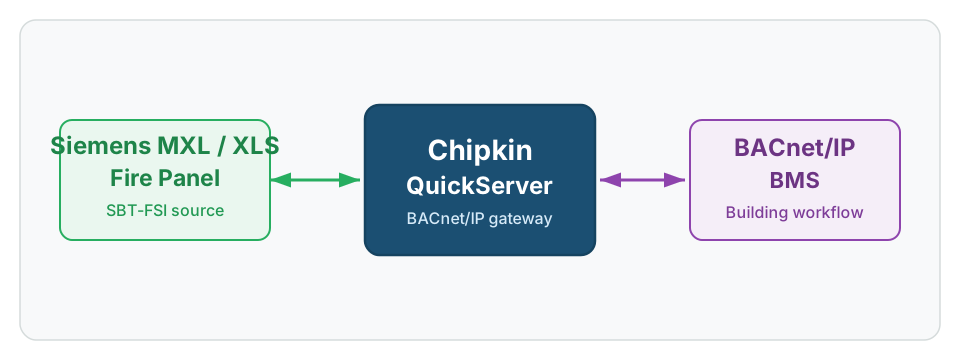
Siemens MXL / XLS Fire Panel → SBT-FSI → Chipkin QuickServer → BACnet/IP → BMS
SBT-FSI to BACnet/IP Fire Alarm Challenge
The upstream side of the project used Siemens fire alarm panels speaking SBT-FSI. The downstream side needed a BACnet/IP view that a building system could consume cleanly. The two sides did not line up automatically, and the project needed careful iteration around the configuration and communications settings.
This was not just a point-list issue. The serial side had to be aligned correctly, including 19200 baud, 7 data bits, and even parity, while the downstream BACnet side also had to match the expected network behavior. The project also depended on details such as network number and system node identity being reviewed and tested in the field instead of assumed.
That is why fire-alarm integrations like this often take multiple revisions. The gateway can support the protocol pair, but the live site still needs the panel settings, point model, and BACnet expectations to converge.
Why Chipkin
Chipkin was a fit because this was exactly the kind of integration where the protocol pair is only half the story. The customer needed a Chipkin QuickServer that could sit between SBT-FSI and BACnet/IP, plus a support team that could iterate through the panel-side details, follow up with multiple stakeholders, and refine the delivery until the site confirmed success.
That combination matters more than marketing language on jobs like this. Fire alarm integrations depend on precise settings, aligned assumptions, and timely field clarification. Chipkin’s role was to remove that ambiguity and keep the project moving.
The Solution
Siemens MXL / XLS Fire Panel → SBT-FSI → Chipkin QuickServer → BACnet/IP → BMS
Chipkin configured the Chipkin QuickServer to read the Siemens fire panel data over SBT-FSI and serve it downstream over BACnet/IP. The work involved repeated point-list review, communications validation, and refinement of the handoff as the customer team clarified the live site requirements.
The serial framing details mattered here because they were part of the commissioning risk, not just background settings. When the panel-side parameters and the BACnet-side expectations are both in play, the integration succeeds only after those two layers are verified together.
By the end of the project, the customer had a working BACnet/IP presentation of the fire panel data plus a clearer understanding of the settings required to reproduce the result.
Siemens SBT-FSI Integration Results
- Confirmed SBT-FSI-to-BACnet/IP handoff for the Siemens fire panel integration.
- 5 configuration revisions were completed before the site reached a working state.
- 3 live calls supported requirement clarification and validation.
- 40 support hours were invested across the project.
- 60% customer-side wait time shows the job required real coordination and clarification from the field, not just lab work.
Before: The Siemens fire panel data was not yet available as a dependable BACnet/IP handoff for the downstream building workflow.
After: The team had a validated Chipkin QuickServer serving the panel data over BACnet/IP with the key configuration assumptions confirmed.
Have a Similar SBT-FSI-to-BACnet/IP Project?
If you need Siemens fire panel data to appear cleanly on a BACnet/IP workflow, Chipkin can handle the gateway configuration, panel-side settings review, and commissioning support that gets the handoff working in the field. Tell us about your project.