
Trane Canada ULC’s downstream BMS now polls live chiller data over Modbus TCP — without the commissioning team having to reverse-engineer a single register. Getting there meant correcting intake assumptions against real device behavior and staying with the project until the data was confirmed.
At a Glance
- Industry: HVAC
- Customer: Trane Canada ULC
- Facility type: Commercial HVAC (facility details not disclosed)
- Client role: OEM / service organization
- Protocols: From: BACnet MS/TP → To: Modbus TCP
- Chipkin product: Chipkin QuickServer
- Project window: 11 months (April 2021 – March 2022)
BACnet-to-Modbus Challenge
The Trane RTAC chiller spoke BACnet MS/TP. The downstream BMS needed Modbus TCP. The two protocols use fundamentally different data models — BACnet is object-based, Modbus is register-based — and there was no native path between them. Without a gateway and someone to configure it correctly, the chiller’s operating data was invisible to the building management system.
The harder problem was that the customer-supplied point information did not fully match what the live chiller actually exposed. The intake documents assumed certain BACnet object mappings that had to be corrected once Chipkin read the device directly. For example, some object addresses in the point list did not correspond to the values the chiller was actually publishing. That kind of mismatch between paperwork and field reality is common in HVAC integration, and it is exactly where live validation adds value.
The customer team also needed someone who could quickly isolate whether a given issue lived in the upstream BACnet data, the gateway configuration, or the Modbus-side expectations. Without that diagnostic clarity, each review cycle becomes broader than it needs to be. The real cost of a protocol gap is rarely the hardware. It is the extra time spent when the integration path is not yet clearly defined.
Why Chipkin
BACnet-to-Modbus is one of Chipkin’s most common integration patterns. Chipkin QuickServer ships preconfigured for the specific protocol pair — not as a blank box the customer has to program from scratch. Chipkin also brings diagnostic tooling that shortens commissioning: CAS BACnet Explorer to verify what the upstream device actually exposes, and CAS Modbus Scanner to confirm what the downstream system receives. When intake documents and live behavior diverge — as they did here — that combination of preconfigured gateway, protocol tools, and experienced support helps the project converge on a working integration quickly.
The Solution
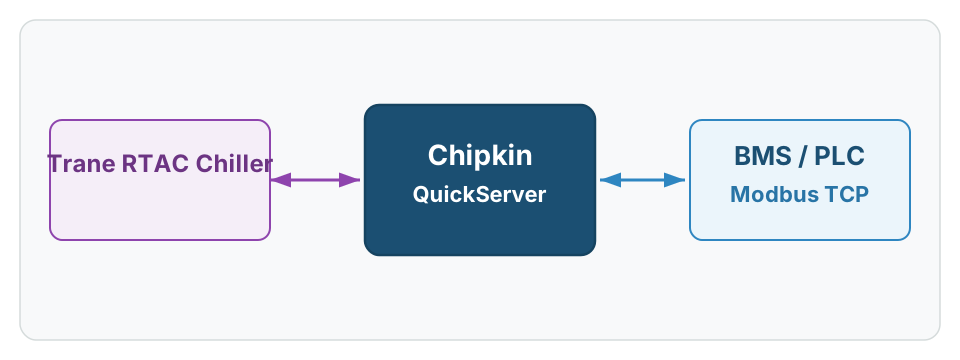
Trane RTAC Chiller → BACnet MS/TP → Chipkin QuickServer → Modbus TCP → BMS / PLC
Chipkin configured a Chipkin QuickServer to read the Trane RTAC chiller over BACnet MS/TP, translate the live object data into a clean register set, and present it to the downstream client over Modbus TCP.
Rather than treating the customer’s intake point list as final truth, Chipkin validated the configuration against what the chiller actually published. Where the supplied documentation didn’t match live behavior, Chipkin corrected the mapping and updated the configuration — a cycle that repeated through five revisions as the project moved from initial setup through field commissioning.
Each revision was supported by remote sessions where Chipkin used CAS BACnet Explorer to confirm what the chiller was broadcasting upstream and CAS Modbus Scanner to verify what the BMS was receiving downstream. That two-sided validation meant each review could be isolated to a specific layer — upstream device, gateway translation, or downstream polling — rather than requiring the customer team to validate the entire path on their own.
The delivered gateway came with documented point data so the commissioning team could map registers into the BMS directly, without having to reverse-engineer the output.
Trane RTAC Integration Results
- Confirmed working integration — the BMS now polls Trane RTAC chiller data over Modbus TCP.
- 5 configuration revisions delivered as field details were refined against live device behavior.
- 3 live support sessions used for remote setup, troubleshooting, and validation.
- 20 support hours invested across the full engagement.
- 11-month project — Chipkin stayed engaged through extended customer review cycles, with 60% of the calendar time spent waiting on customer-side feedback and internal approvals.
Before: The BMS had no usable Modbus interface to the chiller, and the intake documents still needed live validation against the device behavior.
After: The BMS polls a validated Modbus TCP register set from a preconfigured Chipkin QuickServer. The commissioning team received documented point data and a working gateway instead of a box to figure out on their own.
“Chetan’s support was invaluable in navigating the complexities of our project.”
— Trane Canada ULC, on working with Chipkin engineer Chetan
Have a Similar BACnet-to-Modbus Project?
If you need a BACnet device to appear as Modbus downstream, Chipkin can handle the point mapping, gateway configuration, and field validation steps that turn intake documents into a working handoff. Tell us about your project.