
Overview
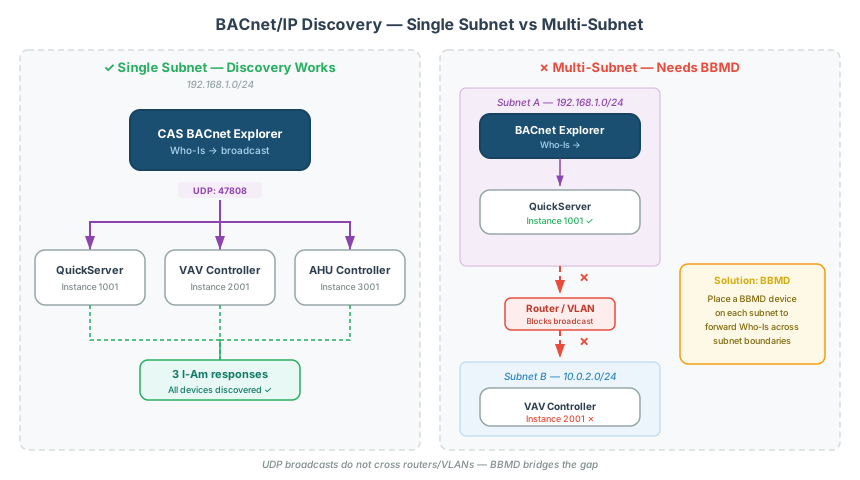
BACnet/IP device discovery uses UDP broadcast messages — a device sends a Who-Is request, and every BACnet device on the network responds with an I-Am containing its Device Instance, vendor ID, and capabilities. This works seamlessly on a single subnet but breaks the moment you cross subnet boundaries, NAT routers, VLANs, or virtual machine networks.
Understanding this architecture is critical for:
- Designing multi-building or multi-subnet BACnet/IP installations
- Troubleshooting “no devices found” scenarios with CAS BACnet Explorer
- Configuring QuickServer gateways on segmented networks
- Planning BBMD deployment for enterprise BACnet networks
How BACnet/IP Discovery Works
Who-Is / I-Am Services
See the BACnet Who-Is and BACnet I-Am service pages for the full request and response detail.
| Service | Direction | Purpose |
|---|---|---|
| Who-Is | Broadcast (or directed) | “Which BACnet devices are on this network?” |
| I-Am | Broadcast or unicast response | ”I’m here — Device Instance 1234, Vendor Chipkin, Model QuickServer” |
Who-Is is sent as a UDP broadcast on port 47808 (hex 0xBAC0). Every BACnet/IP device on the same subnet receives the broadcast and responds with I-Am.
[!NOTE] BACnet/IP uses UDP port 47808 by default. Some installations use non-standard ports (e.g., 47812) — these are editable in the device’s web interface, but both sides must agree on the port number.
I-Am Response: Broadcast vs Unicast
The BACnet standard permits an I-Am to be sent as either a broadcast or a unicast message. In practice, most standalone devices broadcast their I-Am (destination = subnet broadcast address, e.g., 192.168.1.255). However, some devices — particularly gateways that expose multiple virtual BACnet objects on behalf of downstream equipment — reply with a unicast I-Am addressed only to the original Who-Is sender.
| I-Am Mode | Destination Address | Typical Source |
|---|---|---|
| Broadcast | Subnet broadcast (e.g., x.x.x.255) | Most standalone controllers and gateways |
| Unicast | IP of the Who-Is sender | Some multi-device gateways exposing virtual sub-devices |
Why this matters: Not all BACnet clients handle unicast I-Am correctly. A supervisory controller or BMS that only processes broadcast I-Am will not discover devices responding via unicast — even though other tools on the same subnet see them fine.
Diagnosing the problem:
- Run a Wireshark capture filtered on UDP port 47808
- Send a Who-Is from your discovery tool
- Check the destination IP of each I-Am response
- If the I-Am destination is the requesting device’s IP (unicast) rather than the subnet broadcast address, and your BMS cannot see that device, you have a unicast I-Am interoperability gap
[!WARNING] A device that responds with unicast I-Am will appear in CAS BACnet Explorer and tools like YABE, but may be invisible to certain BMS platforms. Always verify discovery with the production supervisory system, not just a diagnostic tool.
Solutions:
- Contact the BMS vendor with packet capture evidence showing the unicast I-Am — some vendors can add unicast handling via firmware update
- Deploy a FieldServer or QuickServer concentrator — read all points from the unicast-responding gateway and re-serve them as a single BACnet device that responds with broadcast I-Am
- Use CAS BACnet BBMD on multi-subnet networks to ensure broadcast I-Am messages are forwarded correctly between subnets
Device Instance Numbers
See BACnet Device Instance for the addressing model and conflict handling.
Every BACnet device has a unique Device Instance — a 22-bit identifier ranging from 0 to 4,194,302. No two devices on the same BACnet internetwork can share a Device Instance.
Key facts:
- Device Instance is configured via the gateway’s web interface or config file
- It survives firmware updates and config reloads
- When replacing a gateway (e.g., legacy gateway → QuickServer), preserve the Device Instance to avoid BMS re-discovery
[!TIP] When replacing a gateway on an existing BACnet network, set the new gateway’s Device Instance to match the old one. The BMS may still require a re-scan, but preserving the Device Instance minimizes reconfiguration.
Single-Subnet Discovery
On a single subnet, discovery just works:
- CAS BACnet Explorer or BMS sends Who-Is broadcast on UDP 47808
- All BACnet/IP devices on the subnet receive the broadcast
- Each device responds with I-Am
- The explorer/BMS builds a device table
Requirements for single-subnet discovery:
- All devices on the same IP subnet
- UDP port 47808 open (no firewall blocking)
- Correct network adapter selected in the discovery tool
- No duplicate Device Instance numbers
[!WARNING] If your discovery tool has multiple network adapters (common on laptops with Wi-Fi + Ethernet), make sure you select the adapter connected to the BACnet network. Sending Who-Is on the wrong adapter is a frequent cause of “no devices found.”
Multi-Subnet Discovery: BBMD
UDP broadcasts do not cross subnet boundaries — this is a fundamental IP networking constraint, not a BACnet limitation. For BACnet/IP installations spanning multiple subnets, you need a BBMD (BACnet Broadcast Management Device).
What BBMD Does
A BBMD forwards broadcast messages between subnets so that Who-Is/I-Am discovery works across the entire BACnet internetwork:
┌──────────────┐         ┌──────────────┐         ┌──────────────┐
│   Subnet A   │         │   Subnet B   │         │   Subnet C   │
│  10.1.1.0/24 │         │  10.1.2.0/24 │         │  10.1.3.0/24 │
│              │         │              │         │              │
│  Gateway 1   │◄──────► │    BBMD      │◄──────► │  Gateway 2   │
│  QuickServer │  fwded  │  forwards    │  fwded  │  QuickServer │
│              │  bcast  │  broadcasts  │  bcast  │              │
└──────────────┘         └──────────────┘         └──────────────┘
Broadcast Distribution Table (BDT)
The BBMD maintains a BDT — a table listing every BBMD peer and their subnet information. When a broadcast arrives, the BBMD forwards it to every entry in the BDT.
Configuration: The BDT is typically configured via a bdt.ini file uploaded to the BBMD device, or through a web interface.
Foreign Device Registration (FDR)
See BACnet FDR and the BACnet BBMD page for the mechanism, and the Network Port object for where these settings live.
For devices that aren’t on any BBMD-managed subnet (e.g., a laptop on a VPN, a cloud service, or a virtual machine), Foreign Device Registration allows the device to register with a BBMD and receive forwarded broadcasts.
Common FDR use cases:
- Remote diagnostic tools accessing a building’s BACnet network via VPN
- Virtual machines running BACnet software (the VM’s virtual NIC is typically NAT’d)
- Cloud-based BMS platforms monitoring on-premise BACnet devices
[!TIP] If you’re running CAS BACnet Explorer in a virtual machine, BACnet discovery won’t work unless you configure Foreign Device Registration with a BBMD on the physical network. VM NAT networking blocks UDP broadcasts.
Network Architecture Patterns
Pattern 1: Single Building, Single Subnet
Simplest deployment. All BACnet/IP devices and the BMS on one subnet.
- No BBMD required
- Discovery works via broadcast
- Suitable for small-to-medium buildings
Pattern 2: Single Building, Multiple VLANs
Common in managed networks (hospitals, universities, corporate campuses) where IT separates automation traffic into VLANs.
- BBMD required on each VLAN, or a central BBMD with BDT entries for each VLAN
- Firewall rules must allow UDP 47808 between VLANs
- Coordinate with the IT team — they may block broadcast traffic by default
Pattern 3: Multi-Building Campus
Multiple buildings, each with its own subnet, connected via WAN or campus backbone.
- BBMD at each building’s BACnet subnet
- BDT entries for all peer BBMDs across buildings
- Consider bandwidth — forwarding all broadcasts across WAN links can create congestion on large installations
- CAS BACnet BBMD can run as a software BBMD on a server at the head end
Pattern 4: Remote Access / Cloud
Remote diagnostics or cloud-based analytics accessing on-premise BACnet/IP.
- BBMD on the local network with Foreign Device Registration enabled
- Remote device registers as a Foreign Device via the BBMD’s IP address
- VPN or secure tunnel for the connection
- UDP 47808 must be forwarded through any NAT/firewall
BACnet MS/TP Discovery
BACnet MS/TP uses a different discovery mechanism — token-passing on an RS-485 serial bus rather than UDP broadcasts.
Key Differences from BACnet/IP
| Aspect | BACnet/IP | BACnet MS/TP |
|---|---|---|
| Transport | UDP over Ethernet | RS-485 serial |
| Discovery | Who-Is/I-Am broadcast | Token-passing poll |
| Address range | Device Instance (0–4,194,302) | MAC address (Masters: 0–127, Slaves: 128–254) |
| Subnet bridging | BBMD | Gateway (e.g., QuickServer with BACnet Router) |
| Max devices | Practically unlimited per subnet | 127 masters + 127 slaves per trunk |
| Baud rate | N/A (Ethernet speed) | 9600, 19200, 38400, 76800 bps — must match all devices |
MS/TP Token-Passing
Devices take turns transmitting by passing a “token” around the bus. A device only discovers peers that participate in the token ring. If a device’s Max Masters parameter is set too low (below the highest MAC address on the bus), devices above that MAC won’t be discovered.
[!WARNING] The
Max Mastersparameter must be set to at least the highest master MAC address on the trunk. Setting it too low is a frequent cause of “missing devices” on MS/TP networks. See the BACnet MS/TP Troubleshooting Guide for more.
Troubleshooting Discovery Failures
No Devices Found
Symptom: Who-Is sent but no I-Am responses received.
| Check | Details |
|---|---|
| Network adapter | Correct NIC selected? Laptop Wi-Fi vs Ethernet? |
| Subnet | Discovery tool on the same subnet as BACnet devices? If not, BBMD needed. |
| Port 47808 | Firewall blocking UDP 47808? Check both Windows Firewall and network firewalls. |
| Device power | Are the target devices powered on and running? |
| Device Instance conflict | Two devices sharing the same Device Instance can cause both to stop responding. |
| Unicast I-Am | Device responding with unicast I-Am? Some BMS platforms ignore unicast responses — verify with Wireshark. See I-Am Broadcast vs Unicast. |
Partial Discovery (Some Devices Missing)
Symptom: Some devices respond, others don’t.
| Check | Details |
|---|---|
| Multi-subnet | Missing devices on a different subnet? BBMD required. |
MS/TP Max Masters | Set too low — devices above the threshold are invisible. |
| MAC conflicts | Two MS/TP devices sharing a MAC address — one will be intermittent. |
| Point count tier | QuickServer point tiers (250/500/1000) limit the number of exposable points — verify the tier matches the total point count. |
Discovery Worked Before, Now Fails
Symptom: Network was working, discovery suddenly stops after a change.
| Check | Details |
|---|---|
| Config file format | Uploading .xlsx instead of .csv can corrupt the config and break discovery. |
| Firmware update | New firmware may reset network settings — verify Device Instance and port survived the update. |
| Gateway replacement | BMS may need a full re-scan after hardware replacement, even with preserved Device Instance. |
| Config regression | Adding new points to an existing config can break MS/TP communication — always validate existing functionality after changes. |
Related Articles
- BACnet MS/TP Troubleshooting Guide — physical layer and token-passing troubleshooting
- EtherNet/IP Integration Guide — for EtherNet/IP ↔ BACnet crossover projects
- Modbus Addressing & Register Reference — for Modbus ↔ BACnet conversions
- Modbus Troubleshooting Guide — for diagnosing the Modbus side of mixed-protocol integrations
Chipkin Tools
- CAS BACnet Explorer — BACnet/IP and MS/TP device discovery, diagnostic tool, and network browser
- CAS BACnet BBMD — Software BBMD for multi-subnet BACnet/IP broadcast forwarding and Foreign Device Registration
- QuickServer — Multi-protocol gateway with BACnet/IP and MS/TP support, including BACnet Router functionality
- QuickServer — Legacy protocol gateway for BACnet integrations
- Chipkin Support — Configuration assistance, BBMD setup, and network architecture consulting